
Strategies for Success: How to Finance Your Education in Canada Without Financial Stress Analysis

The global roadmap for pursuing international higher education has fundamentally shifted into a highly structured, high-scrutiny environment. Moving through 2026, Immigration, Refugees and Citizenship Canada (IRCC) operates under strict national study permit application caps and modernized compliance frameworks designed to tightly manage temporary resident volumes. In this highly selective atmosphere, relying on last-minute financial arrangements or vague savings plans is a direct path to a visa refusal.
Securing your academic future at a Canadian Designated Learning Institution (DLI) requires an exhaustive, long-term financial strategy. Simply paying your first semester's tuition deposit is no longer sufficient to cross the border. Applicants must demonstrate sustainable, multi-layered financial self-sufficiency long before boarding their flight.
This comprehensive report offers an analytical blueprint on how to finance your education in Canada without financial stress analysis. We break down the mandatory federal living-cost thresholds, evaluate diverse funding vehicles, map out the modern student employment limits, and provide an actionable strategy to keep your education fully funded and stress-free.
1. Navigating the Upfront Costs: The Baseline Financial Requirements
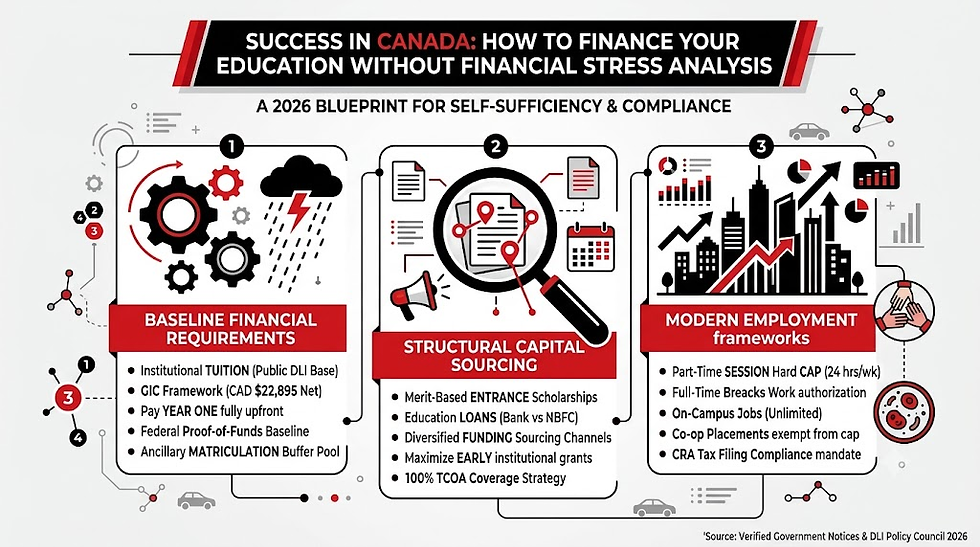
To eliminate financial stress, you must first understand the true baseline numbers required by the Canadian government. The overall cost of year-one matriculation is divided into three non-negotiable categories: institutional tuition, federal living-cost capital, and ancillary relocation expenses.
                 [THE CANADIAN YEAR-ONE FUNDING RADAR]
                                   │
         ┌─────────────────────────┼─────────────────────────┐
         ▼                         ▼                         ▼
[INSTITUTIONAL TUITION] [MANDATORY LIVING BASE]  [ANCILLARY MATRICULATION]
  • Public DLI Baseline   • Federal GIC Framework  • Travel & Moving Costs
  • Fully Paid Upfront    • CAD $22,895 Net Asset  • Health Insurance Logs
  • Full Year Required    • Released Monthly    • Textbook & Software Fees
The Institutional Tuition Foundation
Tuition rates across Canadian public institutions vary depending on your chosen program and province. While post-graduate business diplomas or arts programs may require between CAD $12,000 and CAD $20,000 per annum, competitive STEM fields—such as computer engineering or operating systems tracks—at top-tier universities can demand CAD $28,000+ per year. To ensure a smooth visa process, you should aim to pay the entire first year's tuition upfront rather than just a single term deposit.
The Mandatory Living Cost Base
The single largest adjustment to Canadian immigration policy is the scaling of the cost-of-living proof-of-funds baseline. IRCC updates this threshold annually based on Statistics Canada’s Low-Income Cut-Off (LICO) metrics to protect international students from cost inflation.
For all study permit applications, a single applicant must lock exactly CAD $22,895 into an approved Canadian financial institution's Guaranteed Investment Certificate (GIC). This money acts as an investment that releases a lump sum upon arrival and regular monthly payouts to cover your day-to-day living costs.
The Ancillary Expense Buffer
Beyond tuition and your GIC, a stress-free financial plan must account for upfront landing costs. You should allocate a dedicated buffer pool for:
One-way international airfare (CAD $2,000 to CAD $3,000).
Mandatory provincial health insurance coverage (CAD $800 to CAD $1,000).
Initial off-campus housing deposits and academic textbooks (CAD $1,500).
2. Structural Capital Sourcing: Building a Balanced Funding Mix
Relying entirely on a single source of capital to fund your degree creates high financial risk. A stable, stress-free strategy combines immediate family assets, external educational credit, and merit-based grants.
Maximizing Scholarships and Institutional Grants
The most cost-effective way to reduce your financial burden is securing non-repayable institutional aid. Because public undergraduate and postgraduate research programs face tight international quotas, top public universities reserve substantial merit-based entrance scholarships for high-achieving profiles.
Action Step: Submit your university applications 6 to 9 months before your intake opens. Early applicants are automatically considered for competitive institutional awards, which can reduce your year-one tuition costs by 10% to 50%.
The Strategic Value of Education Loans
When personal family savings are not enough to cover your total costs, securing an external education loan is the most effective way to close the gap. As detailed in market lending analyses, you must strategically choose between traditional public sector banks and specialized Non-Banking Financial Companies (NBFCs):
Traditional Public Banks: Offer the lowest long-term interest rates linked to repo benchmarks, but they require a slow approval process and tangible property collateral for high-value amounts.
Specialized NBFCs: Provide rapid, fully digital approvals within days and offer high-value unsecured loans without requiring physical property collateral, making them a great option for fast visa deadlines.
3. H2: Modern Employment Frameworks: How to Finance Your Education in Canada Without Financial Stress Analysis
A primary pillar of self-funding your studies is working part-time while maintaining your academic standing. This data-backed how to finance your education in Canada without financial stress analysis highlights the current legal limits governing international student employment.
┌────────────────────────────────────────────────────────┐
│             IRCC 2026 WORK HOUR LEGAL BOUNDARIES       │
├───────────────────────────────┬────────────────────────┤
│ Academic Session Window       │ Hard Cap: 24 Hours/Week│
│ Scheduled Academic Breaks     │ Full-Time (Unlimited)  │
│ On-Campus Campus Employment   │ Completely Unlimited   │
│ Co-op Program Placements      │ Exempt (Exempt from Cap)│
└────────────────────────────────────────────────────────┘
The Permanent 24-Hour Off-Campus Cap
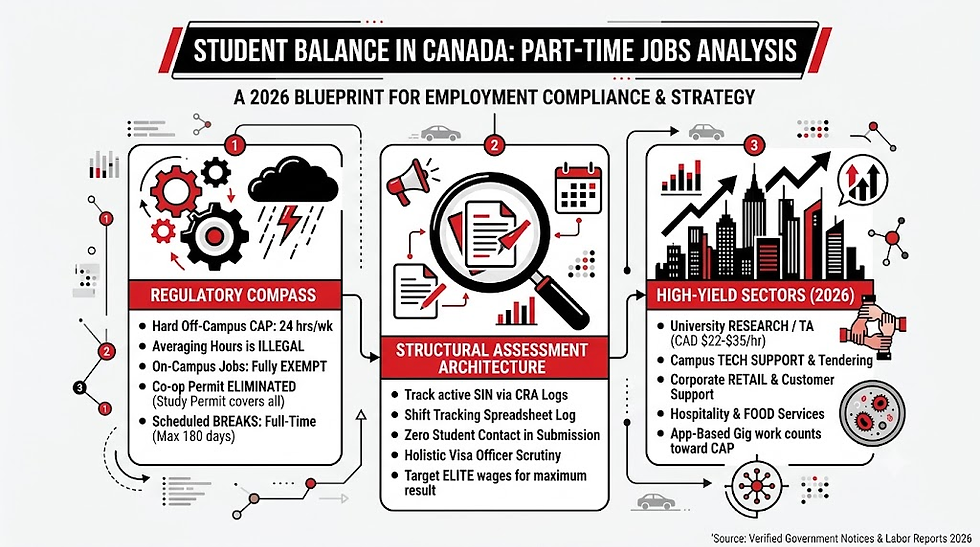
International students can work off-campus without a separate work permit, but they must adhere to a strict legal limit. The off-campus work limit stands at a permanent 24 hours per week during regular academic terms.
It is vital to recognize that the 24-hour cap is a strict weekly ceiling, not a monthly average. Working 30 hours in a single busy week followed by 18 hours the next week constitutes a formal compliance breach.
Because IRCC cross-references student enrollment logs with Canada Revenue Agency (CRA) payroll data, any violation can lead to a loss of student status or a denial of your future Post-Graduation Work Permit (PGWP).
The On-Campus and Co-op Exemptions
To maximize your income without breaking off-campus limits, you can look for alternative employment options:
On-Campus Jobs: Working directly for your DLI—such as in university libraries, research labs, or cafeterias—is governed by separate rules and is completely unlimited. You can combine 24 hours of off-campus work with part-time on-campus shifts safely.
The Co-op Simplification Rule: Post-secondary international students no longer need a separate co-op work permit for required work placements, provided the placement makes up 50% or less of the total program hours. These required hours are authorized separately and do not count against your 24-hour off-campus limit.
Technical Matriculation Matrix: Cost and Revenue Projections
This strategic financial framework maps out a realistic year-one budget against standard student income streams for an international student in 2026.
Core Financial Component | Net Outflow / Asset Requirement | Potential Source Channels | Strategic Stress-Reduction Action |
First-Year Tuition | CAD $15,000 – $28,000 | Education Loan / Personal Savings | Pay in full upfront to secure your unconditional LOA. |
Mandatory Living GIC | CAD $22,895 | Remitted Bank Savings Pool | Lock funds early with an approved provider (e.g., CIBC, Scotiabank). |
Term-Time Employment | Earns CAD $1,400 – $1,800/mo | 24 Hours/Week Off-Campus Work | Use a spreadsheet log to ensure you never exceed 24 weekly hours. |
Scheduled Holiday Breaks | Earns CAD $3,000 – $4,500/mo | Full-Time Shifts (Summer/Winter) | Target high-demand seasonal jobs during official school breaks. |
Tax Return Compliance | N/A (Admin Step) | CRA Income Tax Filing | File your taxes annually to claim GST credits and tuition tax roll-forwards. |
Strategic Financial Compliance Note "Managing your finances without stress requires separating your funds into distinct accounts. Your GIC is designed to cover day-to-day living costs like rent and food, while income from part-time work should serve as an extra buffer for emergencies or savings, rather than your primary way to pay tuition." — Board of International Student Financial Planning & Academic Integration
FAQ Section
What is the core value of this How to Finance Your Education in Canada Without Financial Stress Analysis?
This detailed how to finance your education in Canada without financial stress analysis gives international applicants a clear roadmap to navigate the costs of studying abroad. By planning for tuition fees, setting up the mandatory CAD $22,895 GIC, and balancing part-time work within legal limits, students can avoid common visa issues and unexpected financial shortfalls.
Can I rely entirely on part-time work to pay my ongoing tuition fees in Canada?
No. Relying on part-time income to cover tuition is a high-risk approach that often leads to severe financial stress. Your 24-hour-per-week part-time work is only meant to supplement your living costs. The IRCC expects your core tuition funding to be fully secured via personal savings or education loans before you arrive.
What happens if I accidentally work 25 hours off-campus in a single week?
Working even one hour over the legal 24-hour off-campus limit is a formal violation of your study permit conditions. If you realize you have gone over, you should stop working immediately and document the error. A repeated pattern of breaking this rule can lead to the loss of your student status or the rejection of your PGWP application.
Are there any tax obligations for international students working part-time?
Yes, absolutely. International students working in Canada are required to file an annual income tax return with the Canada Revenue Agency (CRA). Even if your total earnings sit below the standard tax-free threshold, filing your returns allows you to claim useful GST/HST tax credits and carry forward valuable tuition tax credits for your future career.
Access Official Canadian Financial & Immigration Registries
To build an accurate budget and verify the latest policy updates, always rely on official government platforms and verified administrative sources:
To track official study permit updates, download application checklists, and review current student funding policies, visit the Immigration, Refugees and Citizenship Canada (IRCC) Official Information Hub.
To verify the authorized list of financial providers, check GIC deposit procedures, and review student account options, explore the Canada Deposit Insurance Corporation (CDIC) Authorized DLI GIC Registry.
To read detailed guides on international student tax returns, claim tuition credits, and understand your payroll deductions, consult the Canada Revenue Agency (CRA) International Student Tax Portal.
Secure Your Academic Financing Foundation Today
Are you ready to turn this financial analysis into a concrete plan for success? Don't leave your university budgeting, GIC setup, or loan options to last-minute guesswork.
Take a proactive step toward your future by exploring customizable budget calculators, checking current bank rates, and matching your profile with verified lenders on the Vidya Lakshmi National Education Loan Portal, and build a high-value financial foundation today!


Comments