
Mastering Your Balance: Part-Time Jobs in Canada for Students Analysis

The economic blueprint guiding international higher education has entered an era defined by structural adjustments and rigorous regulatory oversight. As we move through 2026, Immigration, Refugees and Citizenship Canada (IRCC) operates under a high-scrutiny model, using national student caps, updated cost-of-living proof thresholds, and strictly monitored compliance frameworks. In this modern landscape, part-time work is no longer just a casual way to make pocket money—it is a critical, legally bound component of an international student's survival and career strategy.
Whether you are pursuing an advanced degree in computer engineering, navigating complex operating systems modules, or managing professional business diplomas at a public Designated Learning Institution (DLI), balancing your studies with a job requires total clarity on the rules.
This comprehensive report provides a data-backed part-time jobs in Canada for students analysis. We unpack the core structural updates from the federal government, evaluate the best on-campus and off-campus employment sectors, map out realistic cost-of-living vs. wage metrics, and detail the strict compliance strategies required to protect your temporary residency and future post-graduation pathways.
1. The Legal Framework: Navigating the 24-Hour Cap and Co-op Rules
To build a reliable employment plan, you must first clear up historical misinformation regarding what international scholars are legally allowed to do. The structural boundaries governing student work hours have seen major updates over the past two years.
The Permanent 24-Hour Off-Campus Cap
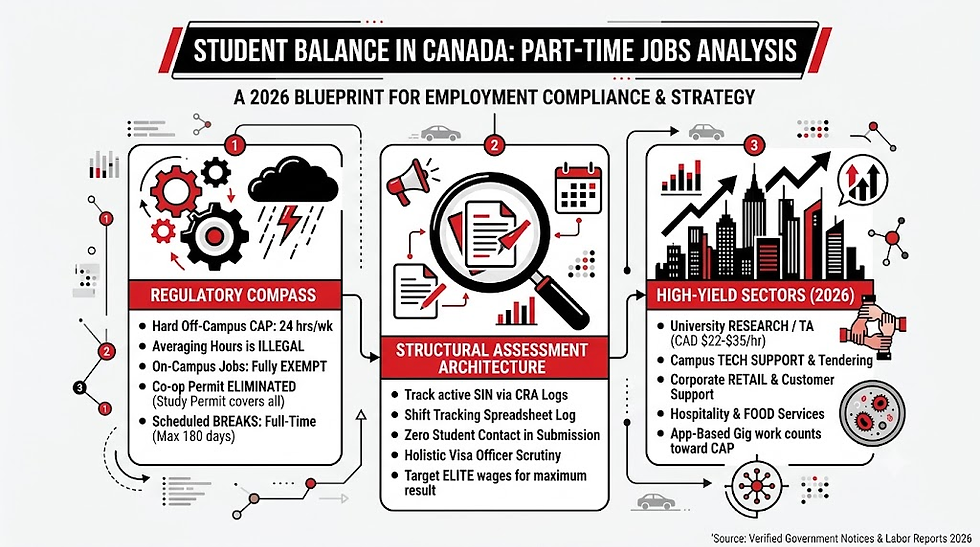
The absolute core of your employment compliance centers on the permanent off-campus work allowance. Following the transition away from pandemic-era exceptions, international students can work up to 24 hours per week off-campus during regular academic semesters.
It is vital to recognize that the 24-hour limit is a hard weekly ceiling, not an average. Working 30 hours during a busy corporate retail week followed by 18 hours the next week does not average out safely; the first week represents a serious violation of your study permit conditions. The week is calculated strictly from Monday through Sunday, and the cap applies to the cumulative hours across all off-campus employers.
The On-Campus Employment Exemption
If you need to expand your working hours without breaking the law, you should look inside your own university's borders. On-campus work hours are governed by a completely separate rule and are unlimited.
You can legally work 24 hours per week at an off-campus engineering firm or retail store while simultaneously logging part-time hours as a teaching assistant, library aide, or research assistant on the physical premises of your DLI. Only your off-campus hours count toward the federal 24-hour weekly cap.
The 2026 Co-op Work Permit Elimination
A massive structural change took effect on April 1, 2026, significantly cutting down administrative paperwork for students. Post-secondary international students no longer need a separate co-op work permit for required program placements.
If your academic program mandates an internship, practicum, or co-op placement, you are authorized to complete those placement hours using your study permit alone, provided the work is a formal graduation requirement and does not exceed 50% of the total program length. Crucially, these required integration placement hours are treated separately and do not count against your 24-hour off-campus limit.
2. H2: High-Yield Employment Sectors: Part-Time Jobs in Canada for Students Analysis
Maximizing your income within the legal weekly limit requires targeting high-yield, flexible roles. This professional part-time jobs in Canada for students analysis outlines the top student sectors categorized by accessibility, pay rates, and career-building potential.
High-Demand Technical and On-Campus Positions
For students with technical backgrounds, such as those navigating computer engineering or data sectors, on-campus technical roles offer the ideal balance:
Instructional and Research Assistants (TA/RA): Working directly under faculty members to grade papers, manage laboratory equipment, or support research grants. These roles offer high wages (often ranging from CAD $22 to CAD $35 per hour) and build strong relationships with professors for future letters of recommendation.
Campus Tech Support & Peer Tutoring: Assisting the DLI IT helpdesk with network deployments, troubleshooting software setups, or tutoring junior cohorts in challenging modules like Theoretical Computer Science or Java programming frameworks.
Traditional Off-Campus Service and Retail Roles
The service industry remains the fastest entry point into the job market due to its high flexibility:
Corporate Retail and Customer Support: Working as a customer representative or cashier at major chains (like Walmart or Loblaws). While these roles usually pay minimum wage, they provide predictable shift scheduling that makes it easy to stick to the 24-hour limit.
Hospitality and Food Services: Barista and hosting positions at national brands (like Tim Hortons or Starbucks). These roles offer steady work and the added benefit of tips, which can boost your net take-home earnings.
┌───────────────────────────────────────────────────────────────────────┐
│                   STUDENT LENDING & INCOME MATRIX                     │
├────────────────────────────┬──────────────────────────────────────────┤
│ Minimum Wage Scale         │ CAD $15.25 – $17.40/Hr (Varies by Prov.) │
│ Average Tech/TA Wages      │ CAD $22.00 – $35.00/Hour                 │
│ Hard Cap Enforcement Track │ Cross-Matched with CRA SIN Tax Logs      │
│ Gig Work Inclusion         │ Uber, DoorDash, Freelance fully count    │
└───────────────────────────────────────────────────────────────────────┘
The Pitfalls of App-Based Gig Work
Many students turn to app-based gig work (like driving for Uber, delivering for DoorDash, or doing freelance graphic design) assuming the flexible hours slip under the radar. This is a dangerous misconception. Every hour logged on a commercial app counts toward your 24-hour off-campus limit.
Because these companies issue formal tax forms tied directly to your Social Insurance Number (SIN), the IRCC can easily review your total active delivery hours. A single week of over-working logged on a delivery app can trigger a study permit violation, jeopardizing your future Post-Graduation Work Permit (PGWP) eligibility.
3. Financial Realities: Balancing the Cost of Living Against Student Wages
While working a part-time job helps lower your monthly bills, it cannot serve as your primary source of funding. The Canadian government expects international scholars to be financially self-sufficient before they arrive.
Understanding the Net Math
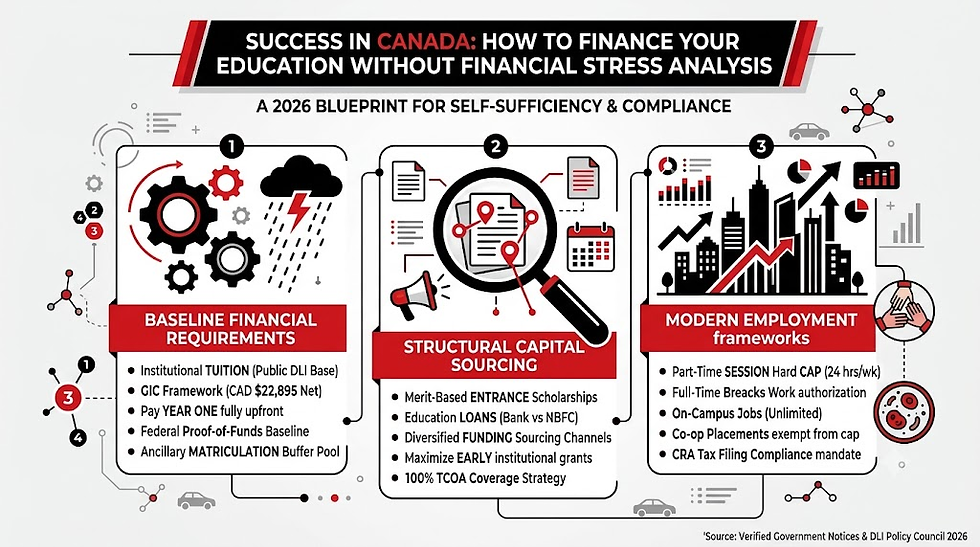
With the mandatory cost-of-living proof baseline set at CAD $22,895 (held in a secure Guaranteed Investment Certificate), the government ensures you have a baseline of roughly CAD $1,600 to CAD $1,700 per month released into your account to cover basic rent and food.
If you work the maximum legal allowance of 24 hours per week at an average Ontario or British Columbia minimum wage of roughly CAD $17.00 per hour, your gross monthly income will cap out around CAD $1,632. After basic payroll taxes and employment deductions, your net take-home pay will hover near CAD $1,400.
[Mandatory Net GIC Release: ~$1,650/mo] + [Max Legal 24-Hr Net Work: ~$1,400/mo] = [Total Available Monthly Capital: ~$3,050]
                                                                                                    │
                                                                                                    ▼
[Safely Covers: Rent, Utilities, Food, & Transit] ◄─── [Leaves Tuition Funds Intact in Separate Bank Account]
This blended income is perfect for covering premium off-campus housing, transit passes, grocery bills, and health insurance. However, it leaves zero room to pay for ongoing university tuition fees. Attempting to pay tuition out of your part-time earnings creates severe financial stress and often leads to academic failure or illegal over-working.
Technical Performance Matrix: Shift Tracking and Sector Benchmarks
This tracking matrix helps you compare the realistic wage expectations, flexibility scales, and logging requirements across major student employment tracks.
Targeted Employment Sector | Average Hourly Wage Range | On/Off Campus Classification | Schedule Flexibility Scale | Essential Tracking Requirement |
University Research / TA | CAD $22.00 – $35.00 | On-Campus | High (Aligned with semesters) | Log hours separately; completely exempt from the 24-hour cap. |
Corporate Retail Staff | CAD $16.00 – $18.50 | Off-Campus | Medium (Set shift blocks) | Keep a strict spreadsheet log to ensure you stay under 24 weekly hours. |
App Delivery / Gig Work | CAD $15.25 – $20.00 | Off-Campus | Maximum (Log in at will) | Track your total app connection time, as active logs are cross-checked by the CRA. |
Mandatory Program Co-op | CAD $18.00 – $28.00 | Exempt Placement | Fixed (Full-time blocks) | Exempt from the 24-hour limit; must be a formal DLI program requirement. |
Strategic Immigration Compliance Note "Visa officers review your full employment history when you apply for your Post-Graduation Work Permit (PGWP). Working 'under the table' for cash to bypass the 24-hour limit exposes you to workplace exploitation and legal risk. Keep a precise, weekly log of your hours using a simple spreadsheet to ensure your application remains clean." — Association of Certified Canadian Immigration Consultants & Policy Evaluators
FAQ Section
What is the primary takeaway of this Part-Time Jobs in Canada for Students Analysis?
This part-time jobs in canada for students analysis outlines the strict operational and legal realities of working while studying under 2026 rules. It highlights that while you can safely use on-campus roles and up to 24 hours of off-campus work to cover your monthly living expenses, you must track your hours carefully to avoid permit violations.
Can I average my part-time work hours across a two-week pay period?
No, absolutely not. The IRCC calculates the 24-hour off-campus limit on a strict, single-week basis from Monday through Sunday. You cannot balance out a 30-hour week by working 18 hours the next week; the week you work 30 hours stands as a breach of your permit conditions.
Do I need to apply for a separate work permit to complete my mandatory university co-op terms?
No. As of the major policy update on April 1, 2026, international post-secondary students no longer need to apply for a separate co-op work permit. Your standard study permit covers all required academic placements, provided they make up 50% or less of your program.
Am I allowed to work full-time during my summer and winter holidays?
Yes, you can work unlimited hours off-campus during official, scheduled breaks listed on your institution’s academic calendar. However, you must be enrolled full-time in the semesters immediately before and after the break to qualify, and this unlimited work is capped at a maximum of 180 days per calendar year.
Access Official Canadian Immigration & Employment Registries
To verify your employment rights, check current minimum wage updates, or review study permit rules, always rely on official government platforms:
To review the latest rules on international student work hours, check eligibility requirements, and read compliance guidelines, visit the Immigration, Refugees and Citizenship Canada (IRCC) Official Off-Campus Work Portal.
To check current minimum wage rates, overtime rules, and vacation pay guidelines across different provinces, explore the Government of Canada Central Job Bank and Labor Standards Database.
To learn about filing your annual income tax returns, managing payroll deductions, and claiming student tax credits, consult the Canada Revenue Agency (CRA) International Student Tax Registry.
Take Control of Your Canadian Academic Journey Today
Are you ready to build a compliant, stress-free path toward your global career goals? Don't leave your job searches, shift tracking, or immigration files to last-minute guesswork.
Take a proactive step toward your future by exploring active job boards, building clean student resumes, and connecting with top verified employers on the Official TalentEgg Canadian Student Employment Marketplace, and position your student journey for long-term success today!



Comments