
Navigating the Shift: A Comprehensive In-Demand Careers in Canada Analysis for 2026

The structural realities of the Canadian labor market are undergoing an unprecedented transformation. For international graduates, aspiring professionals, and economic immigrants structuring their long-term professional portfolios, the conventional job-hunting strategies of yesterday are no longer sufficient. Driven by severe demographic shifts, aggressive infrastructure updates by the federal government, the integration of generative AI architectures, and sweeping new provincial pay transparency frameworks—such as Ontario’s Pay Transparency Act coming into effect—the talent market is strictly prioritizing specialized, practical capability over simple academic credentials.
Navigating this highly dynamic hiring landscape requires looking past generic career advice and evaluating concrete structural growth metrics.
This analytical study delivers a deep, data-driven in-demand careers in Canada analysis for the year 2026. We break down the top high-growth sectors, analyze core compensation shifts, evaluate field-specific requirements, and highlight the technical competencies separating top-tier talent from the broader applicant pool.
1. The Technology and Software Engineering Matrix: Beyond the Hype
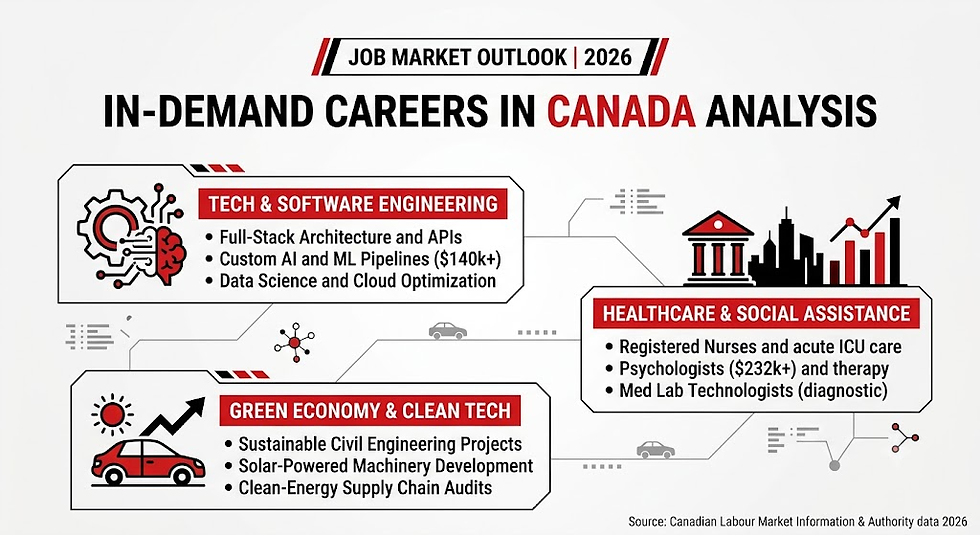
Despite shifting macroeconomic cycles and localized adjustments within the broader technology sector, information technology and engineering continue to serve as core drivers of Canada's industrial modernization. The tech landscape in 2026 has transitioned from speculative over-hiring to a sharp focus on operational efficiency, architecture stability, and real-world system deployments.
                   [THE 2026 TECH TALENT ENGINE]
                                │
       ┌────────────────────────┴────────────────────────┐
       ▼                                                 ▼
 [FULL-STACK DEPLOYMENT]                         [AI ARCHITECTURE & LOGIC]
 • Shift to secure microservices      • Machine Learning Engineering ($140k+)
 • Demand for robust relational databases • Custom LLM and prompt pipeline build
 • Focus on "Smart Care" health suites     • Data governance and security focus
 • Heavy reliance on continuous integration • Soft skills: problem-solving & critical thought
The Full-Stack Development Core
Generic script-kiddies and basic front-end layout coders face heavy competition as automated low-code tools evolve. However, the demand for sophisticated software engineers capable of building scalable, end-to-end cloud platforms is hitting record highs. Organizations are searching for developers who can seamlessly link intuitive user interfaces with complex back-end operations.
Industry placement data indicates that technical teams value professionals who possess concrete, verifiable experience in:
Advanced Architecture Engineering: Designing full-stack systems—such as automated medicine tracking platforms and comprehensive Smart Care Companions—that handle high user volume while keeping latency to a minimum.
Relational Database Structuring: Converting messy real-world metrics into organized relational tables. Designing robust platforms like a Student Attendance Management System or scalable Health Camp Platforms requires deep expertise in Entity-Relationship (ER) models, structural optimizations, and security auditing.
Modern Framework Competency: Demonstrating deep proficiency in standard architectures like the .NET framework, Java Enterprise environments, containerization systems, and automated DevSecOps pipelines.
The Rise of the AI and Machine Learning Specialists
Artificial intelligence is no longer viewed simply as a replacement for human work; instead, it is creating specialized new roles for those who know how to manage it. Machine learning engineers have scaled the ranks to become one of the top highest-paying jobs in the country, commanding a median annual salary of approximately $140,937. Companies are aggressively scouting for experts who can design, evaluate, and maintain custom machine learning setups rather than relying entirely on generic public models.
According to recent technical talent surveys, over 48% of IT hiring managers plan to expand their full-time tech headcount, with an additional 33% focusing heavily on contract-based technical experts. However, technical know-how is only half the battle. Tech leaders emphasize that advanced problem-solving, continuous learning, and adaptability are crucial soft skills needed to complement AI toolkits.
2. H2: The Green Sector and Sustainable Engineering Boom
Canada's committed transition toward a net-zero carbon infrastructure has turned the sustainable energy sector from an experimental field into a massive employer. As public funds flow into regional energy infrastructure, municipal planning, and commercial vehicle overhauls, the engineering landscape is seeing structural shortages of qualified personnel.
┌────────────────────────────────────────────────────────┐
│             GREEN ENGINEERING LABOUR PIPELINE          │
├───────────────────────────────┬────────────────────────┤
│ Primary Structural Field      │ Sustainable Civil Eng. │
│ Emerging Prototype Focus      │ Clean-Tech Solar Cars  │
│ Critical Infrastructure Need  │ Industrial Plumbers    │
│ Average System Growth Cap     │ +18% Sequential Demand │
└────────────────────────────────────────────────────────┘
Sustainable Infrastructure and Renewable Engineering
Civil and environmental engineers are the primary pillars of the modern green transition. Municipalities across Ontario, British Columbia, and Alberta are upgrading their transit infrastructure, water treatment networks, and building codes to handle shifting environmental patterns.
Furthermore, industrial focus is shifting rapidly toward clean-technology product lines. Mechanical and electrical engineering groups are prioritizing the development of complex sustainable machinery, such as solar-powered electronic cars and scalable commercial battery grids.
Proving you have the skills to handle these positions requires more than just showing a university degree. It demands a clear understanding of life-cycle costing, clean-energy supply chain constraints, and strict environmental compliance frameworks.
3. The Healthcare Crisis: Unprecedented Demand Across the Board
No analysis of the Canadian employment market is complete without addressing the immense labor shortage across the healthcare and social assistance sector. Driven by a rapidly aging population, healthcare is the dominant sector for continuous, long-term hiring at scale, largely insulated from automation risks and economic downturns.
[Aging Population Dynamics] ──► [Systemic Staffing Deficits] ──► [Continuous Open Vacancies]
                                                                          │
                                                                          ▼
[Guaranteed PR Pathway Invitation] ◄── [Category-Based Draws Priority] ◄──┘
Medical Care and Allied Health Roles
Traditional medical positions remain stretched thin across every single province. Registered Nurses (RNs) command premium compensation packages, often exceeding $106,940 per year depending on their location and specialization. Similarly, Licensed Practical Nurses (LPNs) and nurse aides are in constant demand to fill vacancies in acute care facilities, emergency rooms, and long-term residential homes.
Beyond traditional hospital wards, there is a major emphasis on preventative healthcare and mental wellness. Key roles driving the current market include:
Psychologists and Psychotherapists: Mental health professionals lead the high-earning metrics, with psychologists pulling in a median annual salary of $232,284.
Medical Laboratory Technologists: Diagnostic professionals handling fluid, blood, and tissue samples command clear career progression opportunities.
Allied Wellness Practitioners: Physiotherapists, occupational therapists, and chiropractors are seeing steady career growth as the health system prioritizes long-term rehabilitation.
Crucially for international applicants, healthcare occupations receive highest-priority placement within the federal Express Entry system's Category-Based Selection Draws, allowing foreign-trained professionals to secure Permanent Residency (PR) invitations at highly competitive score thresholds.
Technical Performance Matrix: 2026 Salary & Growth Benchmarks
To help you visually contrast and evaluate the top career paths, this detailed table compiles salary data and structural configurations across primary fields based on mid-2026 labor market reports.
Core Career Cohort | NOC Code | Median Annual Salary (CAD) | Remote Work Accessibility | Key Technical Competency Focus |
Machine Learning Engineer | 21211 | ~$140,937 | High (Up to 66%) | Custom LLM tuning, pipeline scaling, data science. |
Software Engineer / Developer | 21232 | ~$105,000 | Moderate to High | Full-stack architecture, API structures, cloud systems. |
Registered Nurse (RN) | 31301 | ~$106,940 | Zero (In-person mandatory) | Acute clinical diagnostics, ICU support, patient care. |
Civil & Green Infrastructure Engineer | 21300 | ~$94,500 | Low to Moderate | Clean-tech project planning, environmental audits. |
Financial Controller / Accountant | 11111 | ~$115,000 | Moderate (Hybrid formats) | Regulatory accounting, tax planning, cash flow audit. |
University Professor / Academic | 41200 | ~$231,310 | Low | Specialized field research, peer-reviewed publishing. |
Strategic Asset Allocation Insight "The defining error made by job seekers in 2026 is looking solely at salary numbers without analyzing a sector's long-term regulatory backing. The careers experiencing consistent, above-average growth are those directly tied to federal infrastructure mandates, healthcare shortages, or advanced AI integration."— Global Talent & Labor Policy Council
FAQ Section
What is the primary focus of this In-Demand Careers in Canada Analysis?
This detailed in-demand careers in Canada analysis demonstrates that the local job market is prioritizing technical capability and specialized certifications over generic credentials. The strongest growth pipelines are concentrated within sustainable technology, software engineering, specialized healthcare, and compliance-driven business services.
Are technology professionals being replaced by artificial intelligence tools in Canada?
No. While automated systems are changing everyday workflows by handling basic data entry and simple template coding, they are not replacing skilled professionals. Instead, the market is seeing a surge in demand for machine learning engineers, AI architects, and data scientists who can design, guide, and audit these advanced systems.
Why does the green sector show such strong job vacancy metrics for 2026?
The growth in the green sector is driven by long-term federal and provincial policies focused on building a net-zero carbon economy. This clean-energy shift requires deep technical talent to overhaul commercial building standards, modernize transit networks, and build sustainable consumer products like solar-powered vehicles.
How do I check if my specific career is eligible for Express Entry category draws?
The federal government publishes updated lists of eligible occupations, mapped to specific Training, Education, Experience and Responsibilities (TEER) categories and National Occupational Classification (NOC) codes. Sectors facing long-term shortages—like healthcare and STEM fields—regularly receive dedicated invitations at highly competitive point cutoffs.
Access Official Canadian Labor Market Portals
Structuring a resilient career path requires utilizing verified government registries and official professional guides. Avoid third-party dashboards that lack real-time market updates, and manage your career research using official, reliable channels:
To check real-time regional wage data, locate official NOC codes, and explore local job openings across every province, visit the Government of Canada Job Bank Portal.
To explore detailed technical placement research, review national salary benchmarks, and read the latest tech industry employment updates, visit the Robert Half Canada Insights Registry.
To review immigration eligibility filters, track category-based Express Entry draws, and verify work authorization parameters, visit the Immigration, Refugees and Citizenship Canada (IRCC) Official Hub.
Take Control of Your Career Path Today
Ready to turn this market analysis into a clear professional advantage? Don't leave your long-term success to chance. Start building your foundation by diving into the detailed salary guides, regional workforce overviews, and certification requirements available on the Canada Labour Market Information Service, and start building the high-demand skills you need to achieve your professional goals today.


Comments