
Ultimate TOEFL Preparation Guide for 2026: Master the Updated 90-Minute Exam
- Sairam Joshi
- 3 days ago
- 5 min read

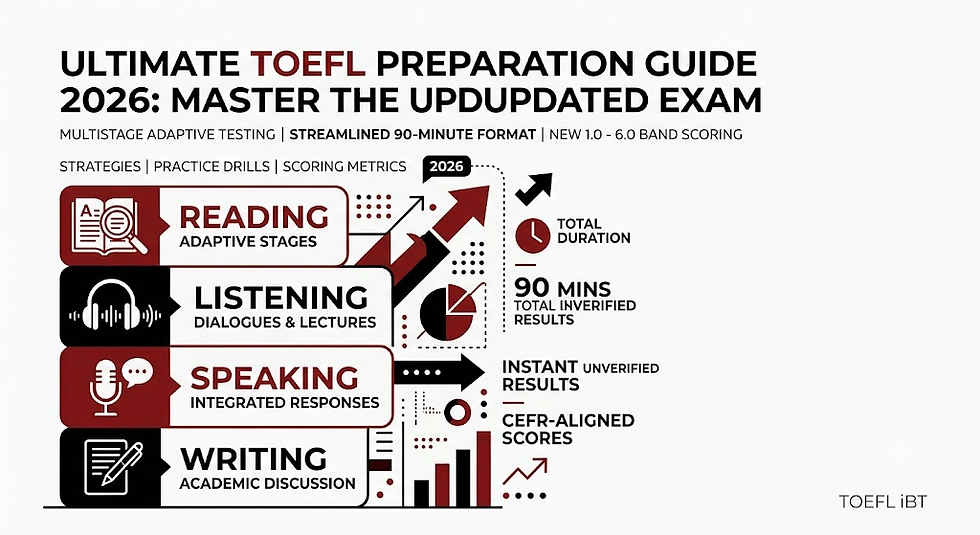
Preparing for the TOEFL iBT (Test of English as a Foreign Language Internet-Based Test) represents one of the most critical milestones for students and professionals seeking higher education, visa approvals, or professional registration in English-speaking nations. Following major global structural updates introduced by Educational Testing Service (ETS) in 2026, the exam experience has been revolutionized to reflect real-world academic and daily communication.
The revised TOEFL iBT is a streamlined, 90-minute evaluation featuring multistage adaptive testing in Reading and Listening, simplified Writing tasks, and a refreshed 1.0 to 6.0 CEFR-aligned band scoring system. Navigating these changes requires an updated approach. This comprehensive guide breaks down the new format, key strategies, sectional practice drills, and scoring metrics to help you achieve your target score.
Understanding the Updated 2026 TOEFL iBT Exam Structure
The modern TOEFL iBT emphasizes practical, communicative English competence alongside traditional academic rigor. The total test duration has been reduced from over two hours down to approximately 90 minutes, eliminating the mandatory 10-minute mid-exam break to reduce cognitive fatigue.
Multistage Adaptive Format
The Reading and Listening sections utilize a multistage adaptive algorithm. Every candidate completes an initial routing block of questions. Your performance in this initial stage determines the difficulty level of the subsequent question block. Performing well early unlocks higher-difficulty branches, allowing you to reach the top band scores.
The 1.0 to 6.0 Band Scoring Scale
ETS introduced a 1.0 to 6.0 band scoring system (in 0.5 increments) aligned directly with the Common European Framework of Reference for Languages (CEFR). During the multi-year transition phase (2026–2028), official score reports provide both the new 1.0–6.0 band score and the traditional 0–120 equivalent, ensuring seamless evaluations by university admissions boards worldwide. Score turnaround has also been accelerated, delivering verified results within 72 hours.
Developing Your Ultimate TOEFL Preparation Guide
Succeeding on an adaptive, fast-paced exam requires a structured study plan. Following an ultimate TOEFL preparation guide framework ensures balanced progress across all four language skills while mastering test mechanics.
Step 1: Establish Your Baseline and Target Score
Before opening study guides, complete an official full-length diagnostic test on the ETS portal. Identify your current score on both the 1.0–6.0 band scale and the 0–120 scale. Research the exact score requirements for your target institutions.
Top Ivy League & Tier-1 Universities (US): Typically expect a 100+ total (or 5.5 overall band).
UK Russell Group Universities: Generally require between 92 and 110 overall (or 4.5 to 5.5 band).
Competitive Graduate Programs: Often set minimum sectional sub-scores (e.g., Speaking 26+ / Band 5.0).
Step 2: Master Section-Specific Tactics
Reading: Adaptability & Speed
With shorter passages containing denser content, reading efficiency is critical. In addition to academic texts, passages now include real-world communication such as campus announcements and policy updates.
Focus on Contextual Meaning: Vocabulary questions evaluate context-specific usage rather than isolated dictionary definitions.
Identify Structural Relationships: Practice identifying main arguments, supporting evidence, and paragraph transitions quickly.
Navigate Adaptive Stages: Because back-navigation is restricted between adaptive stages, verify your answers before submitting each block.
Listening: Active Note-Taking & Campus Scenarios
The Listening section features academic lectures and natural campus conversations.
Track Conversation Dynamics: Listen for tone shifts, speaker intentions, and student-professor interactions.
Use Shorthand Notes: Record main ideas, cause-and-effect relationships, and key supporting details rather than attempting full transcription.
Practice Dual-Tasking: Practice answering detail-oriented questions under realistic time limits.
Speaking: Precision and Fluency
The Speaking section evaluates integrated communication over approximately 8 to 16 minutes. You will read short passages, listen to brief excerpts, and synthesize the information orally.
Structure Your Delivery: Use a standard structure: state the core position, cite key details from the reading/listening material, and conclude smoothly.
Maintain Pacing: Speak at a natural pace with clear articulation rather than rushing through details.
Familiarize with Custom Headsets: Practice using high-quality stereophones to simulate test-center conditions.
Writing: Practical and Academic Synthesis
The Writing section consists of two streamlined tasks completed in 23 minutes:
Integrated Writing Task (20 Minutes): Summarize academic points from a passage and lecture, explaining how they connect or contrast.
Writing for an Academic Discussion (10 Minutes): Express and support an opinion in an online professor-led discussion board thread.
2026 Scoring Benchmarks & Institutional Requirements
Understanding how universities interpret the dual-scoring system helps you set precise preparation goals. Below is a representative cross-section of university score cutoffs:
University | QS World Rank (2026) | Minimum Score (0–120 Scale) | Minimum Score (1.0–6.0 Scale) |
Massachusetts Institute of Technology (MIT) | 100 Overall | 5.5 Overall | |
Imperial College London | 92 – 100 Overall | 4.5 – 5.0 Overall | |
Harvard University | 80 (PG) / 109 (MBA) | 4.5 (PG) / 5.0 (MBA) | |
University College London (UCL) | 96 Overall | 5.0 Overall | |
University of Pennsylvania | 100 Overall | 5.0 Overall | |
Johns Hopkins University | 100 Overall | 5.5 Overall |
Data Source: Institutional admissions guidelines for 2026 entry cycles. Always verify exact department cutoffs prior to applying.
Common Pitfalls to Avoid in TOEFL Preparation
Using Outdated Prep Materials: Study resources published before 2025 often include obsolete task formats, lengthy linear Reading sets, or old essay styles. Stick exclusively to materials reflecting the 2026 format.
Neglecting Early Adaptive Blocks: Because early performance determines your test-branching ceiling, losing focus on the first block limits your maximum achievable score.
Over-polishing Simple Vocabulary: Modern evaluators favor accurate context-specific word choice and grammatical clarity over forced, obscure vocabulary.
Poor Pace Management: Spending too long on a single Reading question can leave you without enough time to finish the adaptive block.
Essential Preparation Checklist
Take an official ETS diagnostic test to set your baseline score.
Research target university cutoffs on both the 0–120 and 1.0–6.0 scales.
Set up a daily study schedule focusing on your weakest section.
Practice Academic Discussion responses within the 10-minute limit.
Perform timed adaptive reading drills to build pacing skills.
Simulate full-length test conditions using official software.
Frequently Asked Questions (FAQ)
Q1: What makes an ultimate TOEFL preparation guide effective for the updated 2026 exam?
An effective ultimate TOEFL preparation guide incorporates updated exam mechanics, including 90-minute full-length timing, multistage adaptive strategy training for Reading and Listening, streamlined Academic Discussion writing techniques, and dual-scale scoring practice (1.0–6.0 band and 0–120).
Q2: How long are 2026 TOEFL iBT scores valid, and how fast are results delivered?
TOEFL iBT scores remain valid for two years from your test date. Results are delivered directly to your ETS account within 72 hours.
Q3: How does the adaptive format affect my scoring potential?
The adaptive algorithm adjusts question difficulty based on your performance in the first block. High accuracy in Stage 1 routes you to higher-difficulty questions in Stage 2, which are required to reach top band scores (5.0–6.0).
Q4: Can I retake the TOEFL iBT if I do not achieve my target score?
Yes, you can take the TOEFL iBT as many times as you like, provided there are at least 3 calendar days between test appointments. ETS also offers the MyBest® Scores feature, which combines your top sectional scores from all valid tests over the past two years.
Ready to Master the TOEFL iBT? Start Preparing Today!
Achieving your dream score on the updated TOEFL iBT requires reliable tools, updated practice tests, and accurate guidance. Leverage official ETS preparation resources to build confidence and streamline your prep:
Official Registration & Test Center Booking: Register for your test date on the official ETS TOEFL iBT Registration Portal.
Official Test Prep & Practice Tools: Access updated adaptive practice sets via the ETS TOEFL Official Test Preparation Center.
Score Scale & Acceptance Guides: Verify institutional requirements using the ETS TOEFL Score Acceptance Directory.
Start your prep early, stay consistent, and take the next step toward your international academic goals!



Comments