
Mastering TOEFL Speaking Topics: The Ultimate 2026 Guide and Sample Questions
- Sairam Joshi
- 3 days ago
- 7 min read


Achieving a high score on the Test of English as a Foreign Language (TOEFL) iBT requires more than general English fluency; it demands structured communication under strict time constraints. The Speaking section remains one of the most challenging modules for international students aiming to study in top academic institutions worldwide.
This comprehensive guide breaks down mastering TOEFL speaking topics for 2026. You will discover the latest exam format, real sample prompts, high-scoring response templates, scoring rubrics, and proven practice strategies to earn a score of 26 or higher.
TOEFL Speaking Section Overview (2026 Format)
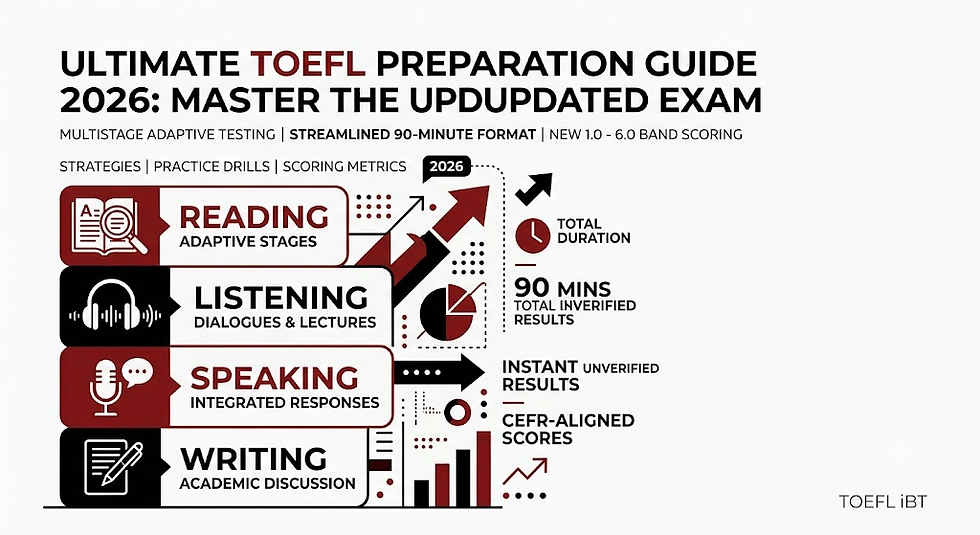
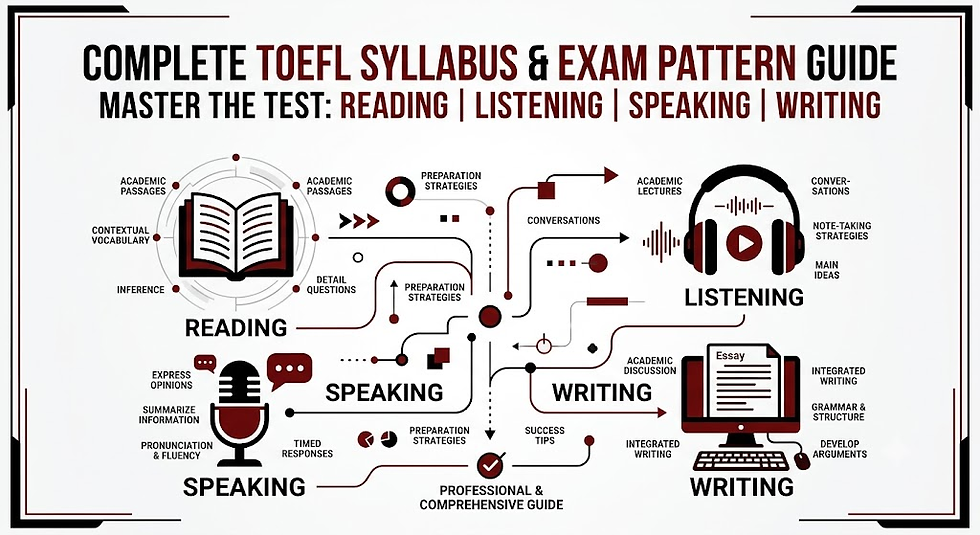
The TOEFL iBT Speaking section evaluates your ability to speak English effectively in academic and university settings. Conducted via computer with a headset microphone, the entire module takes approximately 16 to 17 minutes and contains four distinct tasks.
Task Type | Task Name | Reading / Listening Input | Prep Time | Speaking Time |
Task 1: Independent | Personal Choice | None (Question Prompt Only) | 15 sec | 45 sec |
Task 2: Integrated | Campus Situation | 100-word passage + 60-90 sec dialogue | 30 sec | 60 sec |
Task 3: Integrated | Academic Concept | 100-word passage + 60-90 sec lecture | 30 sec | 60 sec |
Task 4: Integrated | Academic Lecture | 90-120 sec lecture only | 20 sec | 60 sec |
How Responses Are Evaluated
Your answers are evaluated by certified ETS raters and SpeechRater®, an automated scoring engine. ETS scores each response on a scale of 0 to 4 across three primary criteria, which are then converted to a scaled total score out of 30:
Delivery: Clear pronunciation, natural pacing, proper intonation, and rhythm with minimal hesitations or filler words.
Language Use: Effective vocabulary selection and accurate complex grammatical structures.
Topic Development: Coherent ideas, clear organization, and detailed explanation of points.
Detailed Breakdown of the 4 TOEFL Speaking Tasks
Task 1: Independent Speaking (Personal Choice)
Task 1 tests your ability to express and justify a personal opinion without prior reading or listening material. You will be presented with two opposing views or a preference choice.
Format: 15 seconds to prepare, 45 seconds to answer.
Common Formats: Agree/Disagree, Preference (Option A vs. Option B), or Paired Choice.
Sample Task 1 Prompts
Agree/Disagree: "Do you agree or disagree with the statement that university students should take gap years before entering college? Give specific reasons and examples."
Preference: "Some people prefer attending live music concerts, while others prefer listening to recorded music at home. Which do you prefer and why?"
Paired Choice: "Should universities eliminate mandatory attendance policies for lectures? Provide detailed justifications."
Recommended Response Template
State Position (5–7 seconds): "In my opinion, taking a gap year before college offers immense benefits for students."
Reason 1 + Example (18–20 seconds): "First, it gives students real-world work experience. For instance, when my older brother worked at a local marketing firm for a year, he learned valuable time-management skills that helped him excel academically."
Reason 2 + Example (15–18 seconds): "Second, it prevents academic burnout. Taking a break allows high school graduates to recharge mentally, ensuring they enter university with fresh enthusiasm."
Conclusion (Optional, 2–3 seconds): "That is why I strongly support gap years."
Task 2: Integrated Speaking (Campus Announcement & Discussion)
Task 2 tests your ability to combine information from a reading passage and a campus conversation.
Format: Read a 100-word text (45 seconds) regarding a campus change or policy update. Listen to two students discussing the change (60–90 seconds) where one student clearly agrees or disagrees. You have 30 seconds to prepare and 60 seconds to speak.
Sample Task 2 Scenario
Reading Passage: The university plans to eliminate print textbooks in favor of mandatory digital e-books to lower costs and reduce paper waste.
Listening Audio: A female student strongly disagrees with the policy. She argues that e-books cause digital eye strain during long study sessions and that the university's digital portal frequently crashes during midterms.
Recommended Response Template
State the Change & Opinion (10–12 seconds): "The university plans to switch entirely to digital e-books. However, the female student disagrees with this policy for two main reasons."
First Reason (20–22 seconds): "First, she points out that reading on digital screens for hours leads to eye fatigue and headaches, making it harder to study effectively for exams."
Second Reason (20–22 seconds): "Second, she highlights that the online student portal experiences frequent server downtime during exam weeks, which would leave students without access to study materials."
Wrap-up (3–5 seconds): "Therefore, she feels the decision will disrupt academic preparation."
Task 3: Integrated Speaking (Academic Concept & Example)
Task 3 assesses your capacity to explain an abstract academic concept using a concrete illustration provided in a short lecture.
Format: Read a short text introducing an academic term (45 seconds). Listen to a professor explaining a specific example or case study (60–90 seconds). You have 30 seconds to prep and 60 seconds to speak.
Sample Task 3 Scenario
Reading Passage (Biology): Batesian Mimicry is a defensive phenomenon where a harmless organism evolves physical traits resembling a toxic or dangerous species to deter predators.
Listening Audio: The professor illustrates this with the Hoverfly and the Yellow Jacket wasp. Hoverflies are harmless, but they evolved yellow and black stripes identical to wasps. Birds avoid preying on hoverflies because they mistake them for stinging wasps.
Recommended Response Template
Define the Concept (10–12 seconds): "The reading passage describes Batesian Mimicry, which occurs when a harmless animal mimics a dangerous species to avoid predators."
Connect the Example (12–15 seconds): "The professor illustrates this concept using the example of the harmless hoverfly."
Detail the Example (25–28 seconds): "He explains that while hoverflies cannot sting, they have developed black and yellow stripes identical to yellow jacket wasps. Because birds know that yellow jackets deliver painful stings, they stay away from hoverflies as well."
Conclusion (3–5 seconds): "This demonstrates how mimicking visual cues helps harmless creatures survive."
Task 4: Integrated Speaking (Academic Lecture Summary)
Task 4 evaluates your listening comprehension and oral synthesis of a complex university lecture without a reading passage.
Format: Listen to a 2-minute lecture on a scientific, historical, or business topic. You have 20 seconds to prepare and 60 seconds to speak.
Sample Task 4 Scenario
Listening Audio (Marketing): The professor discusses two pricing strategies businesses use when introducing new products: Price Skimming and Penetration Pricing.
Price Skimming: Setting a high initial price when releasing innovative tech (e.g., luxury smartphones) to maximize revenue from early adopters before lowering prices later.
Penetration Pricing: Setting a low initial price (e.g., a new subscription streaming service) to rapidly attract a large market share away from established competitors.
Recommended Response Template
Main Topic (8–10 seconds): "The professor explains two distinct pricing strategies companies use when launching new products into the market."
First Concept + Detail (22–25 seconds): "First, he describes price skimming, where a business sets a high initial price. For instance, high-end smartphone makers charge premium rates to early adopters before dropping the price later as competition increases."
Second Concept + Detail (22–25 seconds): "Second, he introduces penetration pricing, which involves offering very low prices initially. An example is a new streaming service offering cheap subscriptions to pull customers away from established competitors."
High-Frequency TOEFL Speaking Themes in 2026
Preparing for common thematic trends helps build topic-specific vocabulary and speeds up your delivery. Standard test patterns highlight five main categories:
Education & Campus Life: Class registration policies, campus dining options, dorm regulations, group projects, online vs. in-person lectures.
Technology & Innovation: Artificial intelligence tools in learning, screen time, remote work, automation, social media usage.
Environment & Sustainability: Campus recycling campaigns, public transportation, renewable energy initiatives, wildlife preservation.
Career & Personal Development: Remote work vs. office work, career switching, gap years, leadership qualities.
Society & Lifestyle: Public health policies, art funding, travel benefits, urban planning, community green spaces.
Key Strategies for Mastering TOEFL Speaking Topics
Successfully mastering TOEFL speaking topics requires strategic preparation rather than memorizing rigid scripts. Follow these targeted practices:
1. Master Transition Words for Cohesion
Using varied discourse markers ensures high marks in Topic Development and Delivery:
Adding Points: Furthermore, additionally, in addition to this, moreover.
Contrasting Ideas: However, on the other hand, conversely, despite this.
Illustrating: For instance, to illustrate, specifically, a clear example of this is.
Showing Cause/Effect: Consequently, as a result, therefore, owing to this.
2. Control Your Timing and Pace
Task 1 (45s): Reach Reason 1 by second 10 and Reason 2 by second 28.
Tasks 2–4 (60s): Finish summarizing the context by second 20, leaving 35–40 seconds for detailed points and examples.
3. Take Structured Notes
Divide your scratch paper into clean quadrants during the test:
4. Practice Audio Shadowing and Recording
Record your answers on a smartphone or computer. Listen back to identify hesitation patterns, overuse of fillers ("um," "ah," "like"), and mispronunciations. Shadowing native speakers from academic podcasts (such as NPR Science Friday or BBC Science in Action) improves natural speech rhythm and intonation.
TOEFL Speaking Scoring Benchmark
Understanding how raw task performance translates to official scores helps set accurate targets:
TOEFL Speaking Score Range | CEFR Level | Proficiency Descriptor | Target Goal For |
26 – 30 | C1 – C2 | Advanced / Fluent | Ivy League & Top 30 US Universities |
22 – 25 | B2 High | Competent / Clear | Most Global Graduate Programs |
18 – 21 | B2 Mid | Intermediate | Standard Undergraduate Admission |
Below 18 | B1 | Limited | Requires Remedial Language Prep |
Frequently Asked Questions
What is the best strategy for mastering TOEFL speaking topics?
The most effective approach when mastering TOEFL speaking topics is combining structured note-taking with timed practice using response templates. Focus on clear pronunciation, natural pacing, and utilizing transitions rather than memorizing complete scripts, as ETS raters penalize rehearsed answers.
How long do I have to answer each TOEFL Speaking question?
For Task 1 (Independent), you receive 15 seconds of preparation and 45 seconds to respond. For Tasks 2, 3, and 4 (Integrated), you receive 20 to 30 seconds of prep time and 60 seconds of speaking time per prompt.
Are full accents penalized in the TOEFL Speaking test?
No. ETS raters do not deduct points for regional accents. You are scored on clarity, intelligibility, appropriate word stress, and natural speech cadence—not on sounding like a native speaker.
Can I take notes during the TOEFL Speaking section?
Yes. You are provided with paper and pencils at the test center (or whiteboards for the TOEFL iBT Home Edition). Writing concise keywords during reading and listening segments is crucial for organized delivery.
Ready to Elevate Your TOEFL Score?
Mastering the TOEFL Speaking section requires expert feedback, official practice tests, and structured learning tools. Explore these trusted resources to begin your preparation:
Access official ETS practice tests and materials at the ETS Official TOEFL Portal.
Practice real interactive prompts using the ETS TOEFL Free Practice Test Suite.
Start recording your sample responses today, refine your templates, and secure your target university admission!


Comments