
The Complete TOEFL Exam Syllabus 2026 Guide: Pattern, Section Breakdown, and Scoring Changes
- Sairam Joshi
- 4 days ago
- 6 min read

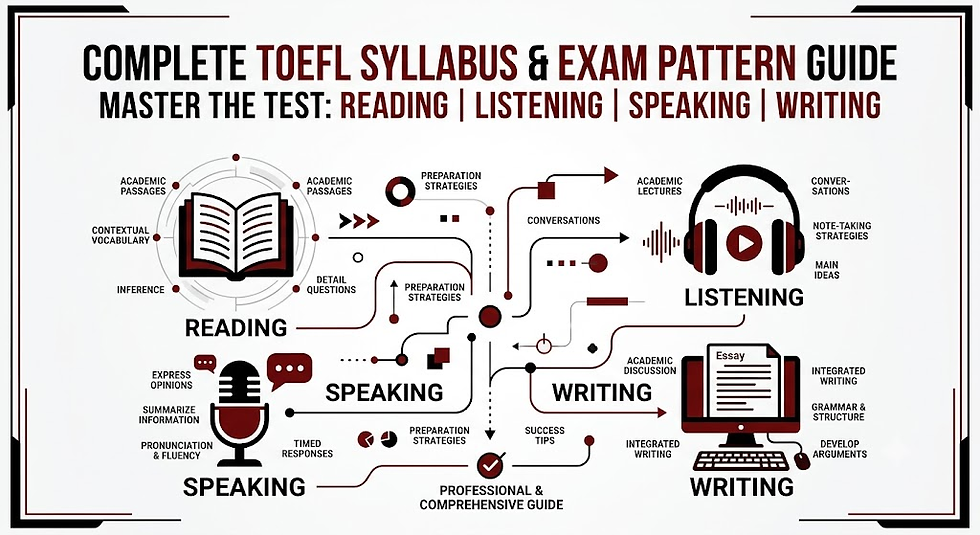
Mastering English language proficiency is a crucial step for non-native speakers aiming to study, work, or migrate to English-speaking countries. The Test of English as a Foreign Language (TOEFL), administered by Educational Testing Service (ETS), remains a global benchmark recognized by over 11,500 institutions in more than 160 nations.
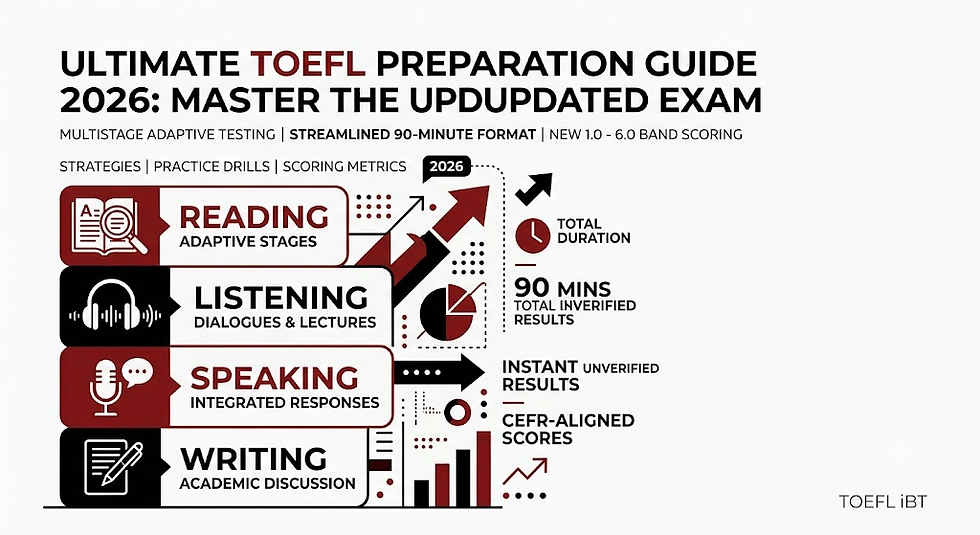
However, taking the exam in 2026 requires understanding a significantly transformed test structure. ETS introduced updates designed to make the test shorter, adaptive, and more reflective of everyday academic and real-world communication. With an overall testing time cut to approximately 90 minutes, new question types across all four sections, and a revamped scoring framework, understanding the current structure is essential for success.
This comprehensive TOEFL exam syllabus 2026 guide details section-by-section requirements, recent format changes, scoring benchmarks, preparation strategies, and frequently asked questions.
At-a-Glance: TOEFL iBT Exam Structure in 2026
The TOEFL iBT (Internet-Based Test) is administered in a single, uninterrupted 90-minute session with no scheduled breaks. The exam tests four core communication skills in a fixed order: Reading, Listening, Speaking, and Writing.
Section | Approx. Duration | Number of Tasks / Items | Key Focus & Format |
Reading | ~30 Minutes | ~50 Items | Multistage adaptive; practical & short academic passages |
Listening | ~29 Minutes | ~47 Items | Multistage adaptive; conversations, announcements & talks |
Speaking | ~8 Minutes | 11 Items / 2 Task Types | Fixed format; instant sentence repetition & interview tasks |
Writing | ~23 Minutes | 12 Items / 3 Task Types | Fixed format; sentence building, email, & academic forum response |
Total | ~90 Minutes | ~120 Total Items | No scheduled break between sections |
Detailed Section-Wise Breakdown of the TOEFL Syllabus
1. Reading Section
The Reading section measures your ability to understand written English across both daily scenarios and academic contexts. Delivered via a multistage adaptive engine, the difficulty of your second reading module dynamically adjusts based on your accuracy in the first module.
Timing: ~30 Minutes
Total Items: ~50 Questions/Tasks
Format: Multistage Adaptive
Task Types in Reading:
Complete the Words: You are given short academic or informational paragraphs with incomplete words. You must complete the words logically using context clues and grammatical understanding.
Read in Daily Life: Analyze short, non-academic everyday texts such as emails, announcements, notices, schedules, or online forum posts to answer practical comprehension questions.
Read an Academic Passage: Read shorter academic excerpts (around 200 words) from university-level topics (humanities, natural sciences, social sciences) and answer multiple-choice comprehension questions covering main ideas, direct details, context vocabulary, and logical inferences.
2. Listening Section
The Listening section evaluates how well you comprehend spoken English in academic environments and routine campus life scenarios. Like Reading, the Listening section uses an adaptive testing module. Audio tracks feature native English accents (American, British, Australian, or Canadian) and play only once.
Timing: ~29 Minutes
Total Items: ~47 Questions/Tasks
Format: Multistage Adaptive
Task Types in Listening:
Listen and Choose a Response: Listen to a quick prompt or single-sentence query and select the most appropriate response.
Listen to a Conversation: Listen to informal or administrative exchanges (approx. 2–3 minutes) between students, academic advisors, campus staff, or librarians, followed by multiple-choice questions.
Listen to an Announcement: Brief campus updates, administrative policy notices, or instructional directions (approx. 30 seconds) followed by concise comprehension questions.
Listen to an Academic Talk: Short lecture excerpts (approx. 100–250 words or 2–3 minutes) on introductory university subjects. Questions test main ideas, supporting details, speaker purpose, tone, and implicit meaning. Note-taking is allowed during audio playback.
3. Speaking Section
The Speaking section assesses your ability to express ideas clearly, naturally, and coherently in spoken English. Unlike earlier formats, this section eliminates long preparation delays and relies on direct, interactive response prompts.
Timing: ~8 Minutes
Total Items: 11 Items across 2 Task Types
Format: Non-adaptive, automated response recording
Task Types in Speaking:
Listen and Repeat (7 Items): You hear short spoken sentences and must repeat them verbatim into the microphone immediately after the tone sound. This tests speech fluency, pronunciation, intonation, and short-term working memory.
Take an Interview (4 Items): You participate in a simulated conversational interview. An automated prompt asks open-ended personal, academic, or opinion-based questions. You receive immediate response windows (approx. 45 seconds per response) to deliver clear, structured answers without extended preparation timers.
4. Writing Section
The Writing section measures your proficiency in drafting structured, grammatically accurate English text. Tasks range from basic syntactic construction to functional business communication and online academic debate.
Timing: ~23 Minutes
Total Items: 12 Items across 3 Task Types
Format: Fixed timer per task pool
Task Types in Writing:
Build a Sentence (10 Items): Unscramble jumbled words and clauses to construct grammatically sound, natural English sentences.
Write an Email (1 Task): You are given a specific situational scenario (e.g., requesting a deadline extension from a professor or inquiring about housing policies) and must draft a clear, appropriately toned email response in approximately 7 minutes.
Writing for an Academic Discussion (1 Task): Respond to a professor’s discussion prompt in an online academic forum. You must express and support your opinion while synthesizing or countering views expressed by other students in the prompt thread (approx. 10 minutes; target length 100+ words).
Major Changes: Legacy TOEFL vs. Current 2026 Format
Understanding how the current exam compares to earlier iterations helps candidates avoid outdated practice materials:
Parameter | Legacy TOEFL iBT Format | Current 2026 TOEFL iBT Format |
Total Test Time | ~2 to 3 hours | ~90 minutes of active testing |
Adaptivity | Fixed linear questions across all sections | Multistage adaptive engine in Reading & Listening |
Reading Tasks | Long passages (700+ words) with 10 questions each | Short passages, "Complete the Words", and everyday texts |
Speaking Tasks | 4 Integrated/Independent tasks with prep timers | "Listen & Repeat" and "Take an Interview" (no prep lag) |
Writing Tasks | Integrated Essay + Academic Discussion | Sentence Building + Email Writing + Academic Discussion |
Scoring Scale | 0 to 120 Total Score | Primary 1–6 Band Scale (0–120 converted score provided) |
Understanding the 2026 TOEFL Scoring System
ETS utilizes a 1–6 Band Scale aligned directly with the Common European Framework of Reference for Languages (CEFR). Each section receives a score from 1 to 6, and your overall score is the average of all four sections, rounded to the nearest half band.
Band 6.0: Expert / C2 Level Proficiency
Band 5.0 – 5.5: Advanced / C1 Level Proficiency
Band 4.0 – 4.5: Competent / B2 Level Proficiency
Band 3.0 – 3.5: Intermediate / B1 Level Proficiency
Note on Score Reporting: To accommodate institutional transitions, ETS provides a dual score report. Test-takers receive their primary 1–6 Band score along with a converted legacy score on the traditional 0–120 scale on their official score reports.
Strategic Preparation for the TOEFL Exam Syllabus 2026 Guide
To maximize your performance on the updated test, align your preparation strategy with the new task mechanics:
Practice Speed and Adaptivity: Because Reading and Listening use adaptive modules, performing accurately in Module 1 is vital. A high score in Module 1 routes you to higher-band question sets in Module 2.
Master Contextual Vocabulary & Spelling: The "Complete the Words" reading items test spelling accuracy and real-time contextual recognition. Practice root words, prefixes, and academic vocabulary daily.
Train Instant Oral Recall: The Speaking section's "Listen and Repeat" items test immediate imitation without prep time. Practice shadowing native speakers using academic podcasts or news clips.
Develop Everyday Writing Fluency: Practice writing concise, polite, professional emails within 5–7 minutes. Ensure correct greeting, clear intent, cohesive structure, and formal sign-offs.
Take Timed Full-Length Mocks: Since there are no breaks during the 90-minute exam, build endurance by completing 90-minute practice tests in a quiet, single-sitting environment.
Frequently Asked Questions (FAQs)
Q1: What are the biggest changes outlined in the TOEFL exam syllabus 2026 guide?
As detailed in our TOEFL exam syllabus 2026 guide, the primary changes include a shortened 90-minute overall duration, adaptive testing modules in Reading and Listening, brand-new question formats (like "Complete the Words", "Listen & Repeat", and "Write an Email"), and a primary scoring framework based on a 1–6 band scale.
Q2: How long are TOEFL scores valid?
TOEFL scores remain valid for exactly two years from your test date. You can send your official scores to universities as long as they remain valid on the date of your application.
Q3: Can I take the TOEFL exam from home in 2026?
Yes. ETS offers both the authorized test center version and the TOEFL iBT Home Edition. Both test options follow the identical syllabus, question formats, adaptive engine, and scoring scale.
Q4: Is there a penalty for wrong answers in the new TOEFL format?
No. There is no negative marking for incorrect choices in any section of the TOEFL exam. If you are uncertain about an answer, always make an educated guess rather than leaving a response blank.
Q5: How soon will I receive my TOEFL results?
Test-takers typically receive their official electronic score reports within 3 to 4 business days (up to 72 hours in many regions) following their test date.
Next Steps: Start Your TOEFL Preparation Today
Ready to schedule your exam or begin official practice? Access official testing resources, register for upcoming test dates, and download prep material directly through the official ETS portals below:
Official TOEFL Registration & Account Creation: ETS TOEFL Main Portal
Official Free Practice Tests & Sample Questions: ETS TOEFL Preparation Hub



Comments