
TOEFL iBT Explained: The Complete Guide to TOEFL iBT Exam Structure, Scoring, and Preparation for 2026
- Sairam Joshi
- 4 days ago
- 7 min read

Achieving English language proficiency is a crucial step for international students and professionals aiming to study or work in English-speaking environments worldwide. The Test of English as a Foreign Language Internet-Based Test (TOEFL iBT) remains the gold standard of academic English testing. Accepted by over 13,000 universities and institutions across 160+ countries—including top destinations like the United States, Canada, the United Kingdom, Australia, and New Zealand—a strong TOEFL score unlocks global academic and career opportunities.
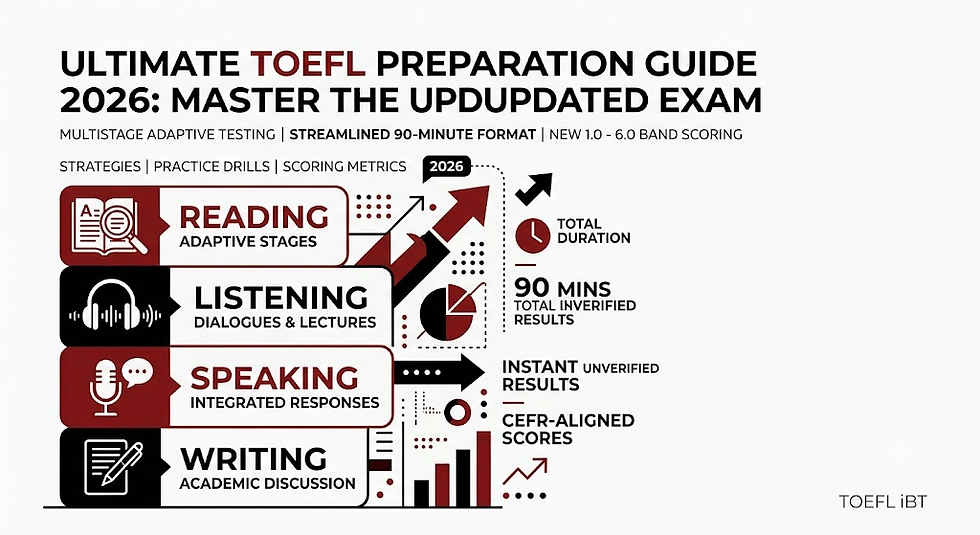
The Educational Testing Service (ETS) introduced significant updates to the TOEFL iBT. The exam is now a streamlined, 90-minute assessment featuring multistage adaptive testing, shorter practical tasks, and faster score delivery within 72 hours. Whether you are planning your study-abroad journey or updating your qualifications, this complete guide to TOEFL iBT breaks down every element of the exam, from format updates and section breakdowns to scoring scales, registration costs, and proven study techniques.
What is the TOEFL iBT? Key Overview & 2026 Format Updates
The TOEFL iBT evaluates all four academic core communication skills: Reading, Listening, Speaking, and Writing. Unlike general English tests, TOEFL iBT focuses specifically on university-level tasks—simulating real classroom discussions, academic lectures, and campus life interactions.
Major Structural Enhancements
ETS streamlined the testing experience to make the exam more efficient and stress-free without compromising its academic rigor:
90-Minute Total Duration: The total exam time has been reduced to approximately 90 minutes (1.5 hours) in a single continuous sitting with no scheduled break.
Multistage Adaptive Testing (MST): The Reading and Listening sections utilize a two-module adaptive structure. Performance on Module 1 (Stage 1) determines the difficulty level of Module 2 (Stage 2).
Accelerated Results Delivery: Test-takers now receive their official score reports online within 72 hours of exam completion, down from the previous 4–8 business days.
Dual Reporting System: Scores are reported on both the traditional 0–120 total scale (0–30 per section) and the 1.0–6.0 CEFR-aligned band scale during the transition period running through 2028.
TOEFL iBT Test Structure: Section-by-Section Breakdown
The four sections of the TOEFL iBT always follow a fixed order: Reading → Listening → Speaking → Writing. Here is a comprehensive look at what to expect in each section.
1. Reading Section (~35 Minutes | ~20 Questions)
The Reading section measures your ability to understand and analyze university-level textbooks and academic passages. It is divided into two adaptive modules:
Module 1 (Stage 1): Features short foundational items such as Complete the Words alongside brief daily-life context prompts.
Module 2 (Stage 2): Adapts based on your accuracy in Module 1. It presents either a standard or higher-level academic passage accompanied by traditional reading comprehension items.
Common Reading Question Types:
Factual Information & Negative Factual: Identifying explicit facts or verifying false statements based on the text.
Vocabulary in Context: Defining words as used in the passage context.
Inference & Rhetorical Purpose: Determining unstated conclusions or why the author included specific details.
Insert Text: Placing a missing sentence logically within a paragraph.
2. Listening Section (~29 Minutes | ~28 Questions)
The Listening section evaluates your comprehension of spoken English in academic and campus settings. Audio materials incorporate authentic accents from the United States, Canada, the United Kingdom, and Australia.
Structure: Consists of two adaptive modules containing short conversations, campus announcements, and academic lectures.
Task Types:
Choose a Response: Fast-paced everyday campus exchanges.
Short Conversations: Dialogues between students and professors or university staff.
Academic Talks & Lectures: Professorial mini-lectures covering scientific, artistic, or historical concepts.
Because audio tracks play only once, active note-taking is critical for success in this section.
3. Speaking Section (~16 Minutes | 4 Tasks)
The Speaking section assesses your ability to speak English effectively in academic environments. Your spoken responses are digitally recorded and scored by a combination of AI speech technology and certified ETS human raters.
Task 1: Listen and Repeat: Tests baseline pronunciation, sentence rhythm, and acoustic clarity.
Tasks 2–4: Take an Interview & Integrated Speaking:
Integrated Reading/Listening/Speaking: You read a short text, listen to a lecture or conversation, and summarize or argue a stance using evidence from both sources.
Take an Interview: Interactive prompts where you answer direct follow-up questions within fixed response windows (typically 45–60 seconds per turn).
4. Writing Section (~20 Minutes | 3 Tasks)
The Writing section focuses on concise, structured, and communicative academic expression. A single section timer runs for 20 minutes across three distinct tasks:
Task 1: Build a Sentence: Demonstrates grammatical accuracy, proper word order, and clause organization.
Task 2: Write an Email: Evaluates your ability to draft a clear, polite, and purposeful message in response to a practical scenario.
Task 3: Writing for an Academic Discussion: Requires you to state and support an opinion in an online university class forum in response to a professor's prompt and classmates' comments.
TOEFL iBT Exam Structure Summary
Section | Approximate Duration | Number of Tasks / Items | Core Skills Evaluated |
Reading | ~35 Minutes | ~20 Questions (2 Modules) | Vocabulary, passage analysis, inference |
Listening | ~29 Minutes | ~28 Questions (2 Modules) | Audio comprehension, main ideas, speaker stance |
Speaking | ~16 Minutes | 4 Tasks (~7 response turns) | Spoken clarity, synthesis, conversational response |
Writing | ~20 Minutes | 3 Tasks | Sentence structure, practical email writing, opinion formulation |
Total Test | ~90 Minutes | Full Battery | Comprehensive English Proficiency |
Understanding TOEFL iBT Scoring Systems
Understanding your score report is essential when establishing target scores for university applications. ETS employs a dual reporting model during the current transition period running through 2028.
The Traditional Scale (0–120 Points)
Each section is scored on a raw-to-scaled range of 0 to 30 points, yielding a cumulative total score of 0 to 120 points.
Top Ivy League & Competitive Universities: Typically require a total score of 100+ (with minimum sectional scores of 25 in each skill).
Standard Graduate Programs: Generally target scores between 80 and 90.
Undergraduate Admissions: Typically accept scores between 71 and 80.
The CEFR 1.0–6.0 Band Scale
To align closely with the Common European Framework of Reference for Languages (CEFR), ETS reports section performance on a 1.0 to 6.0 band scale:
Band 5.5 – 6.0: Proficient / Advanced User (CEFR C1–C2 Equivalent; Traditional sectional equivalent 25–30).
Band 4.0 – 5.0: Upper-Intermediate User (CEFR B2 Equivalent; Traditional sectional equivalent 17–24).
Band 3.0 – 3.5: Intermediate User (CEFR B1 Equivalent; Traditional sectional equivalent 11–16).
Your Complete Guide to TOEFL iBT Preparation and Proven Test Strategies
Achieving your target score requires structured preparation focused on test mechanics, time management, and active skill application. Follow these field-tested strategies:
Step 1: Master Multistage Adaptive Logic
Because the Reading and Listening sections use multistage adaptive routing, your accuracy on Module 1 directly sets your score ceiling. Prioritize high accuracy in Module 1 to unlock the higher-difficulty Module 2 path.
Step 2: Practice Active Note-Taking
In the Listening and Integrated Speaking sections, audio clips are played only once. Train yourself to write short, organized notes using shorthand, symbols, and abbreviations (e.g., "w/" for with, "gov" for government, "↑" for increase). Focus on capturing main ideas, cause-and-effect relationships, and contrast signals (e.g., however, on the other hand).
Step 3: Optimize Your Writing Pacing
With 20 total minutes allocated across three writing tasks:
Dedicate 3–4 minutes to Build a Sentence.
Spend 5–6 minutes on Write an Email.
Allocate 10 minutes to Writing for an Academic Discussion.
Practicing QWERTY keyboard typing speed is essential to comfortably complete all tasks within the time limit.
Step 4: Take Full-Length Timed Practice Tests
Complete at least three full-length official mock exams in a single 90-minute sitting without pauses. This builds mental endurance and familiarizes you with seamless section transitions.
TOEFL iBT Registration, Exam Options, and Fee Structure
Exam Formats: Test Centre vs. Home Edition
ETS provides two official delivery modes for the TOEFL iBT:
TOEFL iBT Test Centre: Delivered at secure Prometric test centers globally on dedicated desktop equipment.
TOEFL iBT Home Edition: Delivered on your personal computer monitored 24/7 by a live proctor via ProctorU. Note: Ensure your computer meets strict hardware, system, and room requirements before registering.
TOEFL iBT Fees Overview
Service / Item | Standard Fee (USD) | Approximate Fee (INR) | Key Details |
Standard TOEFL iBT Registration | $205 USD | ₹16,900 INR | Includes test & official reporting to up to 4 institutions |
Late Registration Charge | $40 USD | ₹3,900 INR | Applies within 7 days of test date |
Rescheduling Fee | $60 USD | ₹5,900 INR | Must request at least 4 full days prior |
Additional Score Report | $25 USD / recipient | ₹1,950 INR | Per additional university after initial 4 |
Speaking/Writing Score Review | $80 USD | ₹7,900 INR | Requested within 30 days of testing |
Frequently Asked Questions (FAQs)
Q1. Why is reading a complete guide to TOEFL iBT essential before booking your exam date?
Reading a complete guide to TOEFL iBT is vital because ETS streamlined the test structure into a 90-minute adaptive test featuring brand-new question types such as Listen and Repeat, Build a Sentence, and Write an Email. Understanding these format specifics prevents surprises on test day and ensures your study plan directly aligns with current scoring rubrics.
Q2. How long are TOEFL iBT scores valid for university admissions?
TOEFL iBT scores remain officially valid for two years from your test date. Institutions will not verify score reports older than two years.
Q3. How fast will I receive my official score report?
Official TOEFL iBT scores are posted online in your ETS account within 72 hours (3 calendar days) after completing the exam.
Q4. What is the difference between TOEFL iBT and IELTS Academic?
While both test academic English proficiency, TOEFL iBT is entirely computer-delivered and emphasizes American and international academic environments. IELTS Academic offers paper-based and computer options and features a face-to-face Speaking section with a human examiner.
Q5. Can I retake the TOEFL iBT if I do not reach my target score?
Yes, you can take the TOEFL iBT as many times as you like. The only requirement is a mandatory 3-day waiting period between test dates.
Ready to Begin Your TOEFL iBT Prep Journey?
Securing your target score on the TOEFL iBT is one of the most impactful steps toward studying abroad at top global institutions. With proper familiarity with the 90-minute adaptive format, focused task practice, and official study tools, you can approach test day with complete confidence.
Register for the TOEFL iBT: Create your official account and book your test slot on the official ETS TOEFL Website.
Schedule Your Exam Date: Choose between test centers or Home Edition via the official ETS Registration Portal.
Access Official Practice Resources: Practice with authentic prep materials at ETS TOEFL Test Prep.



Comments