
The Ultimate 60-Day TOEFL Study Plan for High Scores in 2026
- Sairam Joshi
- 4 days ago
- 6 min read


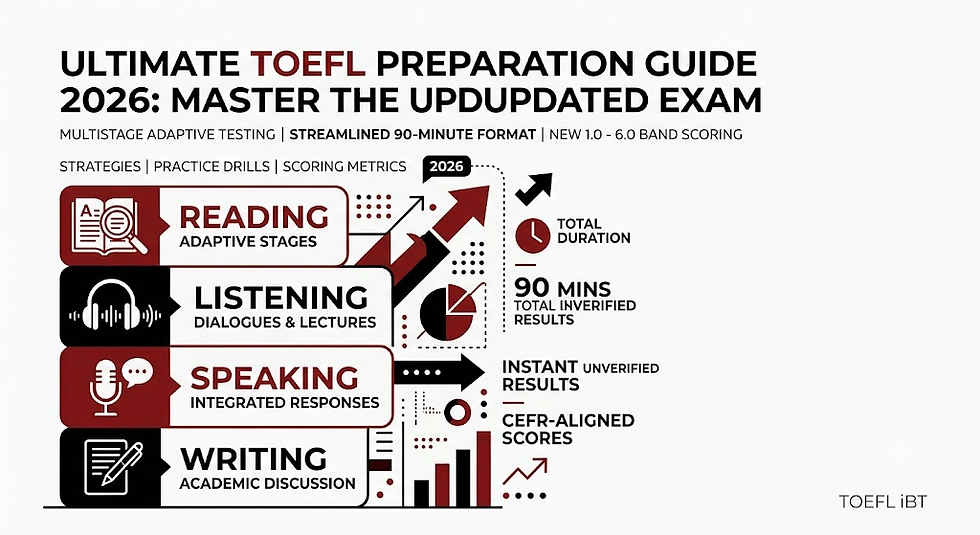
Achieving a top score on the TOEFL iBT requires more than generic English proficiency—it demands a targeted strategy aligned with the latest test structure. ETS updated the TOEFL iBT format to an agile, approximately 90-minute examination featuring multistage adaptive testing, streamlined task types, and faster score reporting within 72 hours.
Whether aiming for an Ivy League graduate program, a medical residency, or an international visa, this comprehensive guide delivers a step-by-step roadmap to master every section of the test over eight weeks.
Why a 60-Day TOEFL Study Plan Yields Top Scores
A two-month timeline offers the ideal balance for test preparation. It provides sufficient duration to address structural weaknesses without inducing burnout or study fatigue.
Targeted Skill Acquisition: 60 days allows you to dedicate two full weeks to foundational mechanics, four weeks to section-specific techniques, and two final weeks to exam-day simulation.
Adaptive Test Familiarization: Because the Reading and Listening sections utilize multistage adaptive routing—where your performance in Module 1 dictates the difficulty ceiling of Module 2—a structured timeline lets you train specifically for high-accuracy performance under timed conditions.
Active Vocabulary Retention: Committing academic vocabulary and contextual collocations to memory requires spaced repetition over several weeks rather than last-minute cramming.
Key Updates to the TOEFL iBT Format
Understanding the modern exam layout is vital before beginning your preparation. ETS has streamlined the test into a faster, single-sitting exam without a mandatory scheduled break.
TOEFL Section | Total Time | Question/Task Count | Key Features & Tasks |
Reading | ~35 minutes | ~20 questions | Adaptive 2-module structure; "Complete the Words", Daily Life, and Academic Passages. |
Listening | ~29 minutes | ~28 questions | Adaptive 2-module structure; "Choose a Response", Announcements, Conversations, and Academic Talks. |
Speaking | ~16 minutes | 4 tasks (~7 turns) | Rapid response windows; "Listen and Repeat" and "Take an Interview" tasks. |
Writing | ~20 minutes | 3 tasks | "Build a Sentence", "Write an Email", and "Write for an Academic Discussion". |
Note: In addition to the traditional 0–120 total score scale, test-takers receive scores on a simplified CEFR-aligned 1–6 band scale, with official score delivery accelerated to within 72 hours of test completion.
The 60-Day TOEFL Study Plan: Step-by-Step Breakdown
Phase 1: Days 1–15 — Baseline Diagnostic & Core Mechanics
The primary objective during the first two weeks is establishing your baseline score, diagnosing specific skill deficits, and mastering fundamental task rules.
Day 1: Diagnostic Assessment
Take an official ETS practice test under timed conditions.
Record your raw section scores and note where timer pressure affected your performance.
Establish a score target based on your prospective university or professional requirements (e.g., 100+ total on the traditional scale or Band 5.0+ on the CEFR scale).
Days 2–7: Grammar, Mechanics & Vocabulary Foundations
Focus Area: Academic word roots, prefixes, suffixes, and contextual spelling.
Daily Action Plan (2 Hours/Day):
Spend 45 minutes studying 30 high-frequency academic words using spaced-repetition flashcards.
Practice the "Complete the Words" Reading drill—train to recognize lexical patterns in partial word scaffolds under 60 seconds per item.
Review complex sentence structures (relative clauses, inverted conditionals, passive voice) to prepare for the "Build a Sentence" Writing task.
Days 8–15: Passive Listening & Active Reading Integration
Daily Action Plan (2 Hours/Day):
Read two academic articles daily from sources like Scientific American, National Geographic, or The Economist. Summarize the main ideas in 3–4 sentences.
Listen to 15-minute academic podcasts or university lectures. Practice taking shorthand notes focusing exclusively on main ideas, transitional cues (e.g., however, consequently, furthermore), and speaker attitude.
Complete 3 sets of "Read in Daily Life" and "Choose a Response" short items to build baseline pacing.
Phase 2: Days 16–30 — Section Mastery & Adaptive Routing Strategy
Phase two concentrates on mastering section-specific question types and understanding how the multistage adaptive testing system impacts overall performance.
Days 16–22: Reading & Listening Deep Dive
Because Module 1 accuracy dictates whether you are routed to the higher-scoring path in Module 2, initial precision is critical.
Reading Strategy (Days 16–19):
Master passage skimming techniques: read the first and last sentences of paragraphs to capture overall structure before diving into detailed questions.
Dedicate time to "Read an Academic Passage" questions, training to identify factual information, negative factual claims, inferences, and vocabulary in context.
Target Pace: Budget under 60 seconds for fill-in items so you retain 105 seconds per item for full academic passage questions.
Listening Strategy (Days 20–22):
Practice note-taking using a two-column method: Main Points on the left, Supporting Details/Examples on the right.
Drills: Solve 4 sets of "Listen to an Academic Talk" and "Listen to an Announcement" daily. Avoid re-reading notes during audio playback; focus entirely on active auditory processing.
Days 23–30: Speaking & Writing Mechanics
Speaking Tasks (Days 23–26):
Focus on the "Listen and Repeat" task by practicing clear pronunciation, natural rhythm, and sentence stress.
Prepare for the "Take an Interview" task. Practice delivering structured 45-to-60-second spoken responses using a clean model: Direct Answer + Reason 1 + Brief Example + Concise Conclusion.
Use a digital voice recorder. Analyze your recordings for filler words (um, ah, like), pacing, and coherence.
Writing Tasks (Days 27–30):
Build a Sentence: Practice converting fragmented ideas into grammatically sound sentences within 2 minutes per prompt.
Write an Email: Practice crafting functional, professional correspondence (e.g., requesting a course extension, asking a professor for research clarification) within a 4-minute window.
Academic Discussion Task: Spend 10 minutes drafting a concise 100–120 word response that contributes a clear perspective to an online professor-led class discussion.
Phase 3: Days 31–45 — Advanced Task Execution & Speed Optimization
With structural mechanics established, phase three turns toward speed, time management, and error elimination under timed exam conditions.
Days 31–37: Timed Sectional Sprints
Monday & Wednesday (Reading & Writing Sprints):
Complete 2 timed Reading modules (35 minutes total).
Complete 1 timed Writing section (20 minutes total for all 3 tasks).
Review all incorrect answers. Log errors in an Error Tracking Journal specifying whether the mistake was due to vocabulary, misreading, or timing pressure.
Tuesday & Thursday (Listening & Speaking Sprints):
Complete 2 timed Listening modules (29 minutes total).
Complete 1 full Speaking module (16 minutes total).
Ensure response windows are strictly observed—the Speaking recorder stops automatically when time expires.
Days 38–45: Writing Refinement & Speaking Fluency
Writing Polish: Focus on transition phrases (consequently, on the other hand, in contrast, to illustrate). Aim for varied syntax by combining short simple sentences into compound-complex structures.
Speaking Fluency: Practice speaking continuously without hesitation. Train with background ambient noise to simulate test center conditions.
Phase 4: Days 46–60 — Full Mock Exams & Test-Day Conditioning
The final two weeks focus on stamina, exam environment simulation, and fine-tuning test strategies.
Days 46–52: Full-Length Practice Exams
Take two complete, timed 90-minute practice tests on Day 47 and Day 50.
Replicate exact test conditions: sit at a clean desk, turn off mobile devices, use a single scratchpad, and complete all four sections without taking unscheduled pauses.
Review performance using both scoring scales to track progress toward your required university threshold.
Days 53–58: Targeted Weak-Spot Elimination
Dedicate 1.5 hours daily to your lowest-performing section based on mock exam results.
Re-test specific question types where accuracy falls below 80%.
Review your vocabulary list one final time to solidify key terms.
Days 59–60: Final Taper & Exam Readiness
Day 59: Light review of template structures for Speaking and Writing tasks. Avoid taking full practice tests to prevent mental fatigue.
Day 60: Rest completely. Organize required identification documents (valid passport), verify test center address or set up your home testing workspace according to ETS requirements, and ensure a full night's sleep.
Essential Prep Tools & Recommended Resources
Maximizing the effectiveness of your study schedule requires high-quality preparation materials.
Official ETS Practice Online (TPO): The primary source for authentic exam questions that match the latest adaptive routing algorithms and scoring models.
Speech Analysis Software: AI feedback tools or recording software to measure words-per-minute, pause frequency, and pronunciation accuracy for Speaking tasks.
Grammar & Sentence Builders: Online editing platforms to analyze syntax variety and error frequency in your "Write an Email" and "Academic Discussion" practice drafts.
Frequently Asked Questions (FAQs)
Is a 60-day TOEFL study plan enough to score 100+ or Band 5.0+?
Yes, a structured 60-day TOEFL study plan provides sufficient time for candidates with intermediate English skills (CEFR B2 level) to achieve scores of 100+ on the traditional scale or Band 5.0+ on the updated scale. By dedicating 1.5 to 2 hours daily over 8 weeks, test-takers can systematically master all four sections, adjust to the adaptive testing layout, and build necessary speed.
How has the new test timing affected study schedule planning?
The modern exam runs for approximately 90 minutes in a single sitting without scheduled breaks. Because the exam is shorter and faster, your study plan must emphasize pacing and immediate accuracy—especially in the initial adaptive modules of Reading and Listening, which set your potential score ceiling.
How do I practice for the Reading and Listening adaptive modules?
Practice by completing multi-module sets under realistic time constraints. Focus on achieving maximum accuracy on Module 1 items to ensure you are routed to the advanced Module 2 path.
What is the best way to prepare for the "Write for an Academic Discussion" task?
Practice writing 100–120 word responses within a 10-minute limit. Your response should state a clear position, provide a supporting reason, give a personal or hypothetical example, and directly reference or build upon the discussion points provided in the prompt.
Conclusion & Next Steps
Executing a structured preparation timeline transforms an overwhelming exam into a series of manageable daily goals. By following this 60-day framework, mastering the 90-minute adaptive test format, and practicing with official prep materials, you position yourself for success on test day.
Ready to begin your preparation journey?
Set your exam date and complete your registration via the Official ETS TOEFL iBT Registration Portal.
Log in or set up your student profile through the ETS Account Portal to access practice materials and schedule your test.



Comments