
Navigating US Healthcare System as International Student: Doctors, Urgent Care & ER
- veddixitcs
- Jul 15
- 8 min read

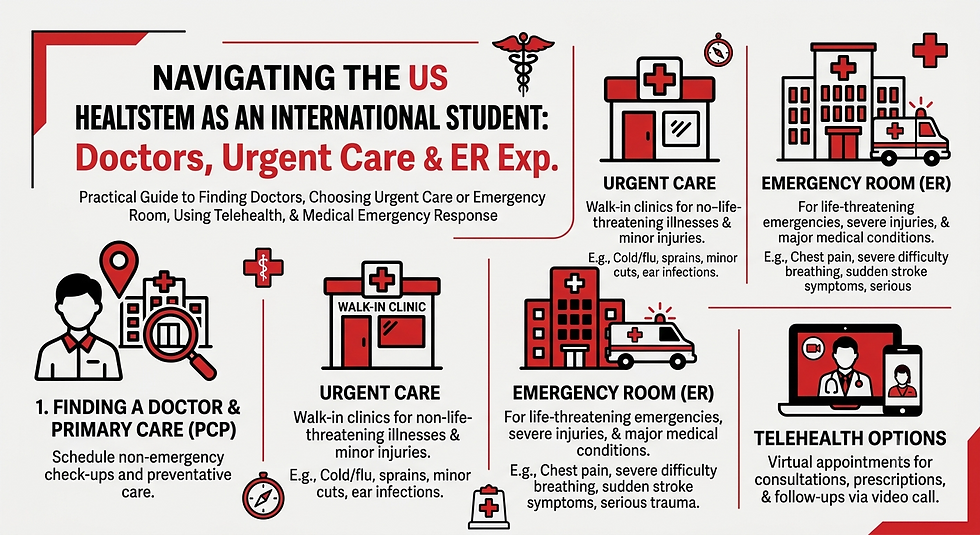
Navigating US Healthcare System as International Student: Doctors, Urgent Care & ER (2026)
Getting sick in a new country is stressful enough without also trying to figure out, mid-fever, whether you're supposed to call a clinic, drive to urgent care, or go to the emergency room. Unlike healthcare systems where the government covers most costs, navigating the US healthcare system means understanding a genuinely different structure — one where the wrong choice can mean paying thousands of dollars more than necessary for the exact same symptoms. Here's a practical, current guide to using US healthcare correctly in 2026.
Why This System Feels So Unfamiliar at First
The American healthcare system differs fundamentally from those in many other countries, where the government pays all or a significant part of an individual's healthcare costs. In the US, medical care is genuinely expensive, and individuals are generally expected to pay for it themselves, with insurance existing specifically to make that cost manageable. Even a straightforward hospital procedure can run into the thousands of dollars, and you'll typically receive separate bills from the hospital itself, from every doctor who examines you, from the lab that runs any tests, and from the pharmacy — a fragmented billing structure that surprises many newcomers expecting a single consolidated invoice.
This is precisely why health insurance is treated as a genuine necessity rather than an optional add-on for international students, and why understanding your specific plan's rules — which doctors and hospitals it recognizes, your copay amounts, and your deductible — matters enormously before you ever actually need care.
Understanding the Four Levels of Care
The single most important mental model to build early is understanding which type of care matches which situation, since each level differs dramatically in cost, wait time, and appropriateness.
1. Campus Health Services — Your First Stop for Almost Everything
Most college and university campuses offer some form of general medical care, ranging from basic first-aid to sophisticated multi-doctor primary care centers with X-rays, lab tests, and specialist access. Campus health services are typically the least expensive option available to you, and during your first week on campus, it's worth bringing a copy of your medical records — including immunization history and any current prescriptions — to your school's health center, since this saves considerable time if you need care later in the semester.
2. Telehealth — Fast, Often Free, and Frequently Underused
Telehealth means receiving medical care remotely via video call, phone, or secure chat rather than visiting a clinic in person, and it has become a mainstream, well-integrated part of US healthcare specifically for international students. Most university Student Health Insurance Plans (SHIPs) now include telehealth as a standard benefit, often at no additional cost through apps like TimelyCare or HealthiestYou, available 24 hours a day, every day of the year. It's genuinely well-suited to common issues: colds, flu symptoms, minor infections, rashes, prescription refills, and general medical questions — studies show diagnostic accuracy for these everyday conditions is comparable between telehealth and in-person care. A useful rule of thumb: if you'd normally book a routine visit with your regular doctor for something, telehealth can very likely handle it just as well, faster and often free.
3. Primary Care Physician (PCP) — For Ongoing, Non-Urgent Care
A primary care physician is a doctor you build an ongoing relationship with over time, generally requiring an appointment scheduled in advance — sometimes weeks ahead, depending on demand. Through student insurance, a typical visit runs around a $30 copay. This is the right choice for non-urgent needs: routine check-ups, managing an ongoing condition, or getting a referral to a specialist, which many insurance plans require before you can see one directly.
4. Urgent Care — The Middle Ground Between a Doctor's Office and the ER
Urgent care centers, sometimes called walk-in clinics, don't require an appointment and are staffed by fully qualified doctors and nurses equipped to treat sore throats, cold or flu symptoms, minor infections, sprains, fractures, and similar non-life-threatening issues, often with on-site X-rays and diagnostics. Through student insurance, this typically runs around a $50 copay, considerably more than a telehealth visit but far less than an emergency room. Without insurance, a cash-pay urgent care visit commonly runs $150–$300. It's worth knowing that if your condition turns out to be more serious than initially apparent — a severe allergic reaction, for example — an urgent care center may refer you directly to the emergency room.
5. Emergency Room — Reserved for Genuinely Life-Threatening Situations
The emergency room is by far the most expensive place to obtain care, with costs that can run into the thousands of dollars even for a relatively brief visit. ERs are specifically equipped to triage and treat life-threatening conditions — trouble breathing, heart attacks, strokes, severe injuries, loss of consciousness. If you or someone with you is facing a genuine emergency, call 911 immediately, which connects you to an operator who can dispatch an ambulance. Hospital emergency rooms are legally required to treat all patients regardless of insurance status or ability to pay, but this doesn't mean the visit is free — you will still be billed, often substantially, unless your condition is genuinely covered as an emergency under your specific plan.
A Practical Cost Comparison Worth Internalizing
Understanding the real cost gap between these options helps make faster, better decisions when you're actually not feeling well:
Telehealth: Often $0 through your university SHIP, or roughly $70–$100 cash-pay without insurance
Primary care visit: Roughly $30 copay through student insurance
Urgent care: Roughly $50 copay through student insurance, or $150–$300 cash-pay without insurance
Emergency room: Can run well into the thousands of dollars, even for conditions that ultimately turn out to be non-emergencies
Given this gap, a genuinely useful habit is defaulting to telehealth first for anything that isn't clearly urgent or severe, since it's frequently free, available around the clock, and appropriate for the large majority of everyday illnesses university students actually experience.
Finding a Primary Care Doctor Off Campus
If you prefer or need care outside your campus health center, private doctors typically see non-emergency patients by appointment during standard business hours, generally 9 a.m. to 5 p.m. Confirming that a specific doctor or clinic accepts your particular insurance plan before booking is essential — seeing an out-of-network provider can mean paying substantially more, or the full cost, out of pocket. Many healthcare professionals in the US are internationally trained, and in larger cities specifically, it's often possible to find a doctor who speaks your native language — it's completely reasonable to ask directly when booking whether a provider speaks your language or has a staff member who can help with translation.
What to Expect During a Doctor's Visit
American medical culture generally expects patients to ask questions about their diagnosis and treatment directly — this is considered normal and even encouraged, rather than something to avoid out of deference to the doctor. If you're nervous about a language barrier or simply want support, bringing a friend to a medical appointment to help listen, ask questions, or provide translation assistance is common and completely acceptable.
Emergency Numbers and What Actually Counts as an Emergency
In any genuine emergency, dial 911 — this connects you to emergency services who can dispatch an ambulance and guide you through immediate next steps. Reserve this specifically for situations involving risk of death or permanent injury: severe difficulty breathing, chest pain or suspected heart attack, signs of stroke, severe bleeding, loss of consciousness, or major trauma. For anything less severe — even something that feels urgent in the moment, like a bad cold, a minor injury, or a persistent headache — telehealth or urgent care will almost always be faster, cheaper, and entirely sufficient.
Understanding Your Insurance Plan Before You Need It
The single most valuable thing you can do before you ever get sick is actually reading your specific health insurance plan's details: which doctors, clinics, and hospitals are in-network, what your copay is for each type of visit, what your deductible is before insurance coverage kicks in, and whether mental health and prescription coverage are included and to what extent. Federal regulations generally require insurers to approve urgent care requests within 72 hours and standard care requests within seven days — useful context if you ever feel a request is being unreasonably delayed.
A Practical Decision Framework
When you're feeling unwell and unsure which option to choose, a simple framework helps:
Is this a genuine emergency — trouble breathing, chest pain, stroke symptoms, severe injury, loss of consciousness? → Call 911 or go directly to the ER.
Is it urgent but not life-threatening — a bad sprain, a high fever, a possible infection needing same-day attention? → Urgent care.
Is it something routine or ongoing — a check-up, a repeat prescription, managing a known condition? → Your primary care physician or campus health center.
Is it a common, everyday illness — a cold, minor rash, sore throat, general medical question? → Telehealth, often free and available immediately.
FAQs About Navigating the US Healthcare System
Q1. What's the difference between urgent care and the emergency room? A: Urgent care treats non-life-threatening issues like sore throats, minor infections, sprains, and cold or flu symptoms, without requiring an appointment, at a fraction of the cost of an ER visit. The emergency room should be reserved specifically for genuinely life-threatening situations — severe injuries, chest pain, difficulty breathing, or loss of consciousness.
Q2. Is telehealth a legitimate substitute for seeing a doctor in person? A: For the large majority of everyday illnesses — colds, minor infections, rashes, general medical questions, prescription refills — yes, and studies show comparable diagnostic accuracy to in-person visits for these common conditions. Complex cases or those requiring a physical examination still need an in-person visit.
Q3. How much does an ER visit typically cost compared to urgent care or telehealth? A: An ER visit can run well into the thousands of dollars, even for conditions that turn out to be non-emergencies, while urgent care through student insurance typically costs around a $50 copay, and telehealth is frequently free through university health plans — understanding this gap helps you choose the right level of care quickly.
Q4. Do I need a referral to see a specialist in the US? A: Often, yes, depending on your specific insurance plan. Many plans require you to see your primary care physician first, who can then refer you to a specialist if needed — check your specific plan's rules, since seeing a specialist without a required referral can result in reduced or no coverage.
Q5. What should I do in a genuine medical emergency in the US? A: Call 911 immediately. This connects you to emergency services who can dispatch an ambulance and guide you through immediate steps. Reserve this specifically for life-threatening situations; for anything less severe, telehealth or urgent care will generally be faster and considerably less expensive.
Ready to Navigate the System Confidently?
Understanding these levels of care before you need them turns a stressful situation into a straightforward decision. Here's where to learn more:
Learn about telehealth access and how to find virtual care: Telehealth.HHS.gov – U.S. Department of Health and Human Services
Check your university's specific campus health center and telehealth benefits through your school's student health services website.
Review your specific health insurance plan's network, copays, and coverage details directly through your insurer's member portal or by calling the number on your insurance card.
That wraps up today's five-part series — scholarships, the F-1 visa interview, resumes and cover letters, changing status or transferring schools, and now navigating US healthcare. If you have a specific healthcare question or situation, share it in the comments below.




Comments