
Top Best German Universities for Engineering: Your 2026 Guide
- Akshada Naik
- 7 days ago
- 4 min read

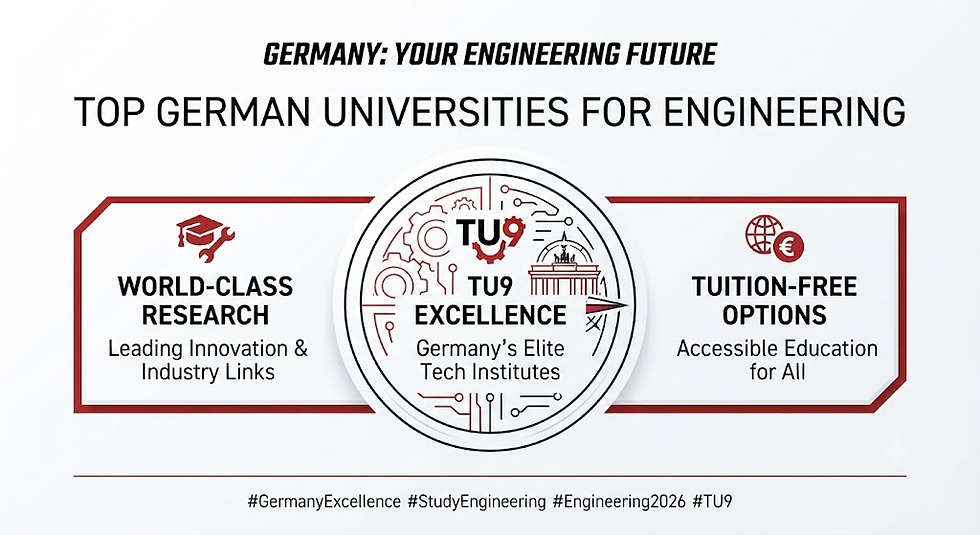
Germany has long been the global gold standard for engineering excellence. With a legacy of industrial precision and a forward-thinking approach to innovation, the country remains a top-tier destination for international students. As we look into best German universities for engineering in 2026, the focus shifts toward research-intensive institutions that bridge the gap between theoretical knowledge and real-world industrial application.
Choosing the right institution is a defining moment for your career. In this guide, we break down why Germany continues to lead the field and which universities should be at the top of your list.
Why Study Engineering in Germany?
Germany’s reputation as an "Engineers' Paradise" is not merely anecdotal; it is built on a unique ecosystem that integrates universities, research centers, and global industrial leaders.
1. Industry-Academia Integration
Unlike many educational systems that remain siloed in theory, top German institutions emphasize practical involvement. For example, the Karlsruhe Institute of Technology (KIT) exemplifies this approach. As a university within the Helmholtz Association, it provides students with unique access to large-scale research sectors, ensuring that what you learn in the lecture hall is immediately applicable to current industry challenges.
2. Research-Driven Education
In 2026, the demand for specialized research is higher than ever. German universities are increasingly investing in "Research Software Engineering" and interdisciplinary labs, where students collaborate on projects involving AI-driven manufacturing, sustainable materials, and green energy solutions.
3. Cost-Effective Excellence
Many public universities in Germany maintain a low-cost or tuition-free model for domestic and international students, charging only a nominal "semester contribution" (often around €140–€300). This accessibility allows students from diverse backgrounds to pursue world-class education without the burden of massive student debt.
Top Best German Universities for Engineering (2026)
When evaluating the best German universities for engineering, it is important to look at both global reputation and specific departmental strengths. While the "TU9" (an alliance of nine leading German Institutes of Technology) consistently dominates, several other institutions are rising quickly in 2026.
The TU9 Alliance Leaders
Technical University of Munich (TUM): Often ranked as the premier engineering school in the country, TUM is renowned for its research output in robotics, automotive engineering, and aerospace.
RWTH Aachen University: Known for its massive focus on production engineering and mechanical systems. It maintains extremely close ties to German manufacturing giants, providing unparalleled internship opportunities.
Karlsruhe Institute of Technology (KIT): A powerhouse in mechanical, electrical, and civil engineering, KIT is a top pick for students who want to be "at the pulse of research."
Rising Stars in Specialized Fields
Technical University of Berlin (TU Berlin): Excellent for urban systems, civil engineering, and architecture.
University of Stuttgart: Famous for its close proximity to the automotive heartland of Germany (Mercedes-Benz, Porsche), making it ideal for mechanical and automotive engineering students.
Admission Requirements and Process
Applying to a top university in Germany requires meticulous planning. By 2026, the process has become more digitized, but the documentation requirements remain strict.
Core Documentation
Academic Transcripts: Records of your previous studies, often requiring official translation.
Language Proficiency: Most English-taught programs require IELTS or TOEFL scores. For German-taught programs, a DSH (Deutsche Sprachprüfung für den Hochschulzugang) or TestDaF certificate is mandatory.
APS Certificate (for specific countries): If you are an applicant from regions like India, ensure your APS certification is up to date, as this is a strict prerequisite for visa and enrollment processing.
Proof of Insurance: All students in Germany must carry health insurance. You will need to provide proof of a German statutory or private insurance plan during enrollment.
Key Deadlines
Deadlines are notoriously strict in Germany.
Winter Semester: Generally opens in May, with deadlines in mid-July.
Summer Semester: Generally opens in December, with deadlines in mid-January.
Tip: Always check your specific program’s page, as Master’s and specialized degree deadlines often differ from general Bachelor’s intake dates.
FAQ: Studying in Germany
What are the best German universities for engineering?
The best German universities for engineering are generally members of the TU9 alliance, including TUM, RWTH Aachen, and KIT. These universities provide the perfect mix of high-level research and direct industry connections.
Is engineering in Germany tuition-free?
Most public universities in Germany do not charge tuition fees for international students, though you must pay a mandatory semester contribution fee. This fee often covers your public transport pass and administrative services.
Can I work while studying in Germany?
Yes, international students are permitted to work a limited number of hours (typically up to 140 full days or 280 half days per year). Many engineering students also find "Werkstudent" (working student) positions in local tech firms, which is a fantastic way to gain professional experience while finishing your degree.
How do I start my application?
You should begin by checking the university’s official international office portal. Ensure your documents are translated and legalized well in advance, as securing a student visa can take several weeks or months.
Start Your Engineering Journey Today
Germany’s commitment to academic rigor and industrial innovation makes it the ultimate destination for aspiring engineers. Whether you aim to design the next generation of electric vehicles or lead breakthroughs in green energy, the environment in German universities will give you the tools to succeed.
Ready to apply? Here are your next steps:
Search for Programs at TUM – Explore top-tier research opportunities.
Check RWTH Aachen Admissions – Get familiar with their application portal.
Visit the DAAD Database – Use the official German Academic Exchange Service to find the perfect course for your profile.


Comments