
Life After Graduation: US OPT CPT Guide –
- veddixitcs
- Jul 17
- 7 min read

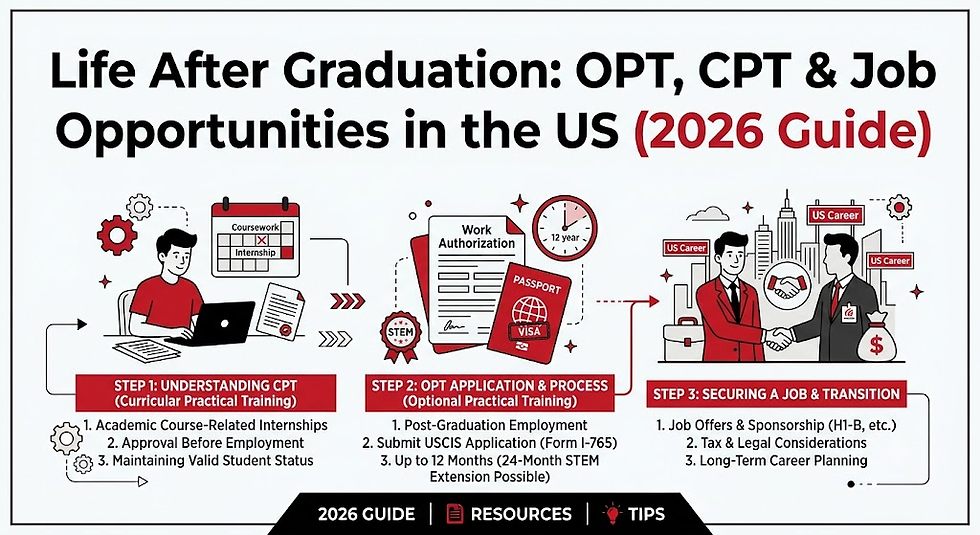
OPT, CPT & Job Opportunities in the US (2026 Guide)
Graduating from a U.S. university is a significant milestone, but for many international students, it marks the beginning of an exciting new journey rather than the end of their education. One of the biggest advantages of studying in the United States is the opportunity to gain valuable work experience through Curricular Practical Training (CPT) and Optional Practical Training (OPT).
In 2026, employers continue to seek graduates with practical experience, technical expertise, and global perspectives. Understanding how CPT, OPT, STEM OPT extensions, and long-term employment pathways work can help international students build successful careers in the United States.
This comprehensive US OPT CPT Guide explains everything you need to know about post-graduation employment opportunities, visa regulations, job prospects, salary expectations, and career planning in 2026.
Why Work Experience Matters After Graduation
Today's employers value candidates who combine academic knowledge with real-world experience.
Benefits of working after graduation include:
Building practical industry skills
Expanding professional networks
Improving long-term career prospects
Increasing earning potential
Gaining international work experience
Strengthening future visa or immigration applications
Many students use OPT and CPT as stepping stones toward full-time employment.
Understanding CPT (CurricularPractical Training)
Curricular Practical Training (CPT) allows eligible F-1 international students to gain work experience while still completing their academic program.
Unlike OPT, CPT must generally be directly related to the student's major and form part of the academic curriculum.
Examples include:
Internships
Cooperative education programs
Clinical placements
Required practical training
Industry-sponsored projects
Key Features of CPT
Available before graduation.
Must be authorized by the student's Designated School Official (DSO).
Must relate directly to the field of study.
Can be full-time or part-time, depending on program requirements and authorization.
Many universities encourage students to complete internships through CPT to improve employability before graduation.
Who Is Eligible for CPT?
Eligibility requirements typically include:
Valid F-1 student status.
Enrollment in a SEVP-certified institution.
Authorization from the university's international student office.
Practical training that is integral to the academic program.
Specific eligibility rules and timing can vary by institution and program, so students should consult their DSO.
Understanding OPT (Optional Practical Training)
Optional Practical Training (OPT) allows eligible international students to work in the United States in positions directly related to their field of study.
OPT is one of the most valuable benefits available to F-1 students because it provides an opportunity to gain professional experience after graduation.
Types of OPT
Pre-Completion OPT
Students may be eligible to work before completing their degree in qualifying circumstances, subject to authorization and applicable regulations.
Post-Completion OPT
Most international students apply for post-completion OPT after graduation.
This option allows graduates to begin working for eligible employers in roles related to their academic discipline.
OPT Duration
Standard OPT allows eligible graduates to work for:
Up to 12 months
Students graduating from qualifying STEM (Science, Technology, Engineering, and Mathematics) programs may be eligible to apply for an additional 24-month STEM OPT extension, allowing for up to 36 months of total OPT, subject to current U.S. immigration rules.
STEM OPT Extension
The STEM OPT extension continues to be particularly valuable in 2026 because of strong demand for professionals in technical fields.
Eligible disciplines often include:
Computer Science
Artificial Intelligence
Cybersecurity
Mechanical Engineering
Electrical Engineering
Civil Engineering
Mathematics
Statistics
Biotechnology
Data Science
Students must meet specific eligibility requirements, and employers participating in STEM OPT must comply with applicable program regulations.
OPT Application Process
Although details may change over time, the general process typically includes:
Request OPT recommendation from your Designated School Official (DSO).
Receive an updated Form I-20 with the OPT recommendation.
Submit the required application to U.S. Citizenship and Immigration Services (USCIS).
Await approval.
Receive employment authorization before beginning eligible work.
Students are encouraged to apply well in advance of graduation because processing times can vary.
Best Industries Hiring International Graduates
Several industries continue to recruit international graduates in 2026.
Technology
Major employers recruit graduates for:
Software Engineering
AI Development
Cloud Computing
Cybersecurity
Data Analytics
Product Management
Healthcare
Growing demand exists for:
Public Health
Biomedical Research
Healthcare Administration
Medical Technology
Pharmaceutical Research
Finance
Career options include:
Investment Banking
Financial Analysis
Risk Management
FinTech
Asset Management
Engineering
Engineering graduates remain highly sought after in:
Aerospace
Automotive
Construction
Renewable Energy
Manufacturing
Robotics
Business & Consulting
Graduates pursue careers in:
Strategy Consulting
Marketing
Operations
Human Resources
Supply Chain Management
Business Analytics
Why the US OPT CPT Guide Is Essential for Career Planning
Understanding the US OPT CPT Guide is essential for international students who want to maximize their career opportunities after graduation. By planning internships through CPT, applying for OPT on time, and targeting industries with strong demand, graduates can build valuable professional experience and improve their long-term employment prospects in the United States.
Life After Graduation: OPT, CPT & Job Opportunities in the US (2026 Guide)
Highest-Paying Jobs for International Graduates in 2026
The U.S. job market continues to offer strong opportunities for graduates with in-demand skills, particularly in STEM, healthcare, finance, and business.
Software Engineer
Average Salary: $110,000–$170,000 per year
Common employers:
Google
Microsoft
Amazon
Apple
Meta
Data Scientist
Average Salary: $115,000–$180,000
Key skills:
Python
SQL
Machine Learning
Statistics
Data Visualization
Artificial Intelligence Engineer
Average Salary: $130,000–$210,000
AI professionals remain among the highest-paid graduates due to increasing adoption of generative AI, automation, and intelligent systems across industries.
Cybersecurity Analyst
Average Salary: $100,000–$160,000
Demand continues to rise as organizations strengthen digital security and regulatory compliance.
Mechanical & Electrical Engineer
Average Salary: $90,000–$150,000
Opportunities exist in:
Manufacturing
Electric vehicles
Renewable energy
Aerospace
Robotics
Financial Analyst
Average Salary: $85,000–$140,000
Major employers include investment banks, consulting firms, insurance companies, and multinational corporations.
Industries with Strong Hiring Demand
Several sectors continue to actively recruit graduates in 2026:
Artificial Intelligence
Machine Learning
Cloud Computing
Semiconductor Engineering
Cybersecurity
Renewable Energy
Biotechnology
Healthcare
FinTech
Supply Chain & Logistics
Consulting
Advanced Manufacturing
Students with technical skills, internship experience, and strong communication abilities are generally more competitive in these fields.
Transitioning from OPT to H-1B
Many international graduates aim to continue working in the U.S. after completing OPT by pursuing an H-1B visa through employer sponsorship.
Typical pathway:
Graduate from a U.S. university.
Gain work experience through OPT.
Secure employment with an employer willing to sponsor an H-1B petition.
If approved through the applicable H-1B process, continue employment under H-1B status.
Because immigration regulations can change, students should regularly review the latest guidance from U.S. Citizenship and Immigration Services (USCIS).
Job Search Tips for International Students
Finding a job requires preparation and persistence.
Start Early
Begin networking and applying for internships months before graduation. Early planning often leads to more opportunities.
Build a Strong Resume
Highlight:
Academic achievements
Technical skills
Projects
Research
Leadership experience
Internships
Certifications
Tailor your resume for each position rather than sending the same version everywhere.
Optimize Your LinkedIn Profile
Recruiters frequently use LinkedIn to identify candidates.
Include:
Professional photo
Clear headline
Skills
Projects
Certifications
Work experience
Recommendations (when available)
Engage with industry content and connect with alumni and professionals in your field.
Attend Career Fairs
University career fairs provide opportunities to:
Meet recruiters
Learn about internships
Discover graduate roles
Build professional networks
Career services offices can also assist with resume reviews and mock interviews.
Resume & Interview Tips
Resume Best Practices
Keep the layout clean and professional.
Quantify achievements where possible.
Use action verbs.
Focus on relevant experience.
Proofread carefully to eliminate errors.
Interview Preparation
Practice answering questions about:
Technical knowledge
Problem-solving
Teamwork
Leadership
Behavioral scenarios
Career goals
Research each employer before your interview and prepare thoughtful questions about the role and organization.
Networking Strategies
Professional networking can significantly improve job prospects.
Effective approaches include:
Joining university alumni groups.
Participating in student organizations.
Attending conferences and workshops.
Volunteering at professional events.
Engaging with recruiters on LinkedIn.
Connecting with professors and research mentors.
Many job opportunities arise through professional connections rather than public job postings.
Career Trends in 2026
The employment landscape continues to evolve with advances in technology and changing workforce needs.
Artificial Intelligence
AI-related positions remain among the fastest-growing careers, spanning industries from healthcare and finance to manufacturing and education.
Cybersecurity
Organizations continue investing heavily in cybersecurity talent due to increasing digital threats and regulatory requirements.
Sustainability
Demand is growing for professionals specializing in renewable energy, environmental engineering, climate science, and sustainable business practices.
Digital Healthcare
Healthcare organizations are expanding the use of digital technologies, increasing opportunities in health informatics, telemedicine, biomedical engineering, and data analytics.
Cross-Functional Skills
Employers increasingly value candidates who combine technical expertise with communication, leadership, adaptability, and problem-solving abilities.
Why Following the US OPT CPT Guide Matters
Understanding the US OPT CPT Guide helps international students make informed decisions about internships, employment authorization, career planning, and long-term professional development. By using CPT strategically during their studies and applying for OPT on time after graduation, students can strengthen their resumes and improve their chances of securing rewarding positions in the U.S. job market.
Planning early, staying informed about immigration requirements, and developing in-demand skills can make a significant difference in career success.
Frequently Asked Questions (FAQs)
What is the US OPT CPT Guide for international students?
The US OPT CPT Guide explains how eligible F-1 students can gain practical work experience through Curricular Practical Training (CPT) during their studies and Optional Practical Training (OPT) before or after graduation. It also covers career planning, employment opportunities, and key immigration considerations.
What is the difference between CPT and OPT?
CPT is generally used while a student is still enrolled in an academic program and must be directly connected to the curriculum. OPT allows eligible students to gain work experience related to their field of study, often after graduation.
Can international students work after graduation?
Yes. Eligible F-1 students may work under post-completion OPT. Graduates in qualifying STEM fields may also be eligible to apply for a STEM OPT extension, subject to current regulations.
Which industries hire the most international graduates?
Technology, artificial intelligence, cybersecurity, engineering, finance, healthcare, consulting, biotechnology, and renewable energy continue to be among the strongest hiring sectors.
Is networking important for finding jobs?
Absolutely. Building relationships with professors, alumni, recruiters, classmates, and industry professionals can significantly improve access to internships and full-time employment opportunities.
Final Thoughts
Life after graduation offers exciting opportunities for international students who plan strategically. Practical training through CPT and OPT can provide valuable professional experience, strengthen resumes, and improve competitiveness in the global job market.
Success depends on more than academic performance. Students who develop technical expertise, communication skills, leadership experience, and professional networks are often better positioned to secure rewarding careers.
Staying informed about university policies and current U.S. immigration regulations is essential for making the most of available opportunities.
Call to Action
Ready to start your career journey in the United States? Explore these official resources:
Study in the States (DHS): https://studyinthestates.dhs.gov/
U.S. Citizenship and Immigration Services (USCIS): https://www.uscis.gov/
EducationUSA: https://educationusa.state.gov/
O*NET Career Explorer: https://www.onetonline.org/
LinkedIn Jobs: https://www.linkedin.com/jobs/
Indeed Careers: https://www.indeed.com/
Research your career options early, work closely with your university's international student office and career services, build practical experience through internships, and prepare a strong job search strategy to maximize your opportunities in the U.S. job market in 2026.


Comments