
GMAT Eligibility Criteria 2026: Complete Guide to Age, Education & Attempt Limits
- Sairam Joshi
- Jul 29
- 8 min read

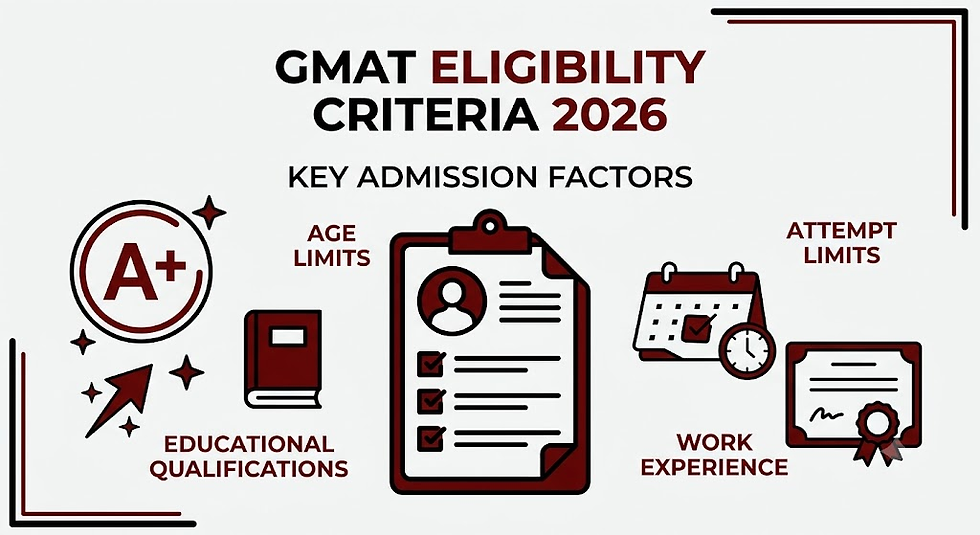
Navigating the path toward an MBA or specialized master's degree can feel like a daunting journey, but understanding your prerequisites shouldn't be. If you are planning to sit for the Graduate Management Admission Test (GMAT) in 2026, you will be pleased to learn that the Graduate Management Admission Council (GMAC) maintains one of the most open and accessible registration policies in higher education.
While individual business schools set strict academic and professional hurdles for prospective students, GMAC’s rules for actually registering and taking the exam are straightforward. Whether you are an undergraduate senior aiming for early deferral programs, a mid-career professional eyeing an Executive MBA, or an international applicant mapping out your timeline, knowing the exact rules ensures your preparation remains stress-free and compliant.
This comprehensive manual breaks down everything you need to know about age limits, degree expectations, identification rules, attempt limits, and retake schedules for 2026.
Core Overview of GMAC Testing Requirements
Before diving into the granular details, it helps to distinguish between test eligibility and admission eligibility.
Test Eligibility (Set by GMAC): Determines who is legally and operationally permitted to schedule and sit for the GMAT exam.
Admission Eligibility (Set by Business Schools): Determines whether your GPA, undergraduate degree, professional work history, and test score qualify you for acceptance into a specific degree program.
GMAC keeps test eligibility deliberately broad to encourage global talent from every background to apply. Below is an immediate snapshot of the primary standards governing test takers worldwide.
Criterion | GMAC Official Requirement |
Minimum Age | 18 years (13–17 permitted with written parental/guardian consent) |
Maximum Age | No upper age limit |
Educational Qualification | No minimum degree or GPA required by GMAC |
Work Experience | Zero years required |
Nationality & Language | Open to all nationalities; test is conducted in English |
Attempt Limit (12 Months) | Maximum of 5 attempts in any rolling 12-month window |
Lifetime Attempt Limit | No lifetime cap |
Retake Waiting Period | Minimum 16 calendar days between test attempts |
Key Breakdown: GMAT Eligibility Criteria 2026
When evaluating the GMAT eligibility criteria 2026, GMAC focuses primarily on age verification, identification authenticity, and testing integrity rather than academic prerequisites. Let's examine how each primary pillar impacts your test planning.
1. Age Limits and Consent Policies
Age is one of the few strict parameters GMAC enforces. However, the rules are broad enough to accommodate young scholars as well as seasoned industry leaders.
Adult Candidates (18+ Years Old)
If you are 18 years of age or older on the date of your exam, you face no age-related restrictions. You do not need secondary authorization, parental signatures, or special permission. You simply create an account on mba.com, select your preferred format and location, present your government-issued ID, and sit for the test.
Minor Candidates (13–17 Years Old)
Candidates between the ages of 13 and 17 can take the GMAT, but specific safeguard protocols apply:
Parental/Guardian Form: You must download and complete the official GMAC Parental Consent/Authorization Form available on mba.com. This must be signed by a parent or legal guardian and submitted to GMAC for approval prior to scheduling your test date.
In-Person Requirement: Candidates under 18 years old are strictly restricted to taking the test at an official physical test center. Minor candidates are not permitted to take the online version of the GMAT due to privacy regulations regarding remote proctoring and video recording.
Upper Age Limit
There is no maximum age ceiling for the GMAT. Applicants in their 30s, 40s, 50s, and beyond regularly take the GMAT when applying for Executive MBA (EMBA) programs, specialized master’s degrees, or doctoral studies.
Educational Prerequisites & Work Experience Reality
A major source of confusion among prospective business school students is whether they must finish their undergraduate studies before attempting the GMAT.
Key Takeaway: GMAC does not require a high school diploma, a bachelor's degree, or a minimum GPA to register for the test. You can take the GMAT as a college freshman, a graduating senior, or a working professional.
Degree Requirements Across Global Business Programs
Although GMAC does not screen for academic degrees, almost all accredited graduate business programs require applicants to hold a recognized bachelor’s degree (or its international equivalent) by the time they matriculate.
Final-Year Students: Undergraduate seniors are in an ideal position to take the GMAT. Because GMAT scores remain valid for 5 years, testing while your analytical and quantitative skills are fresh allows you to store your score and apply whenever you reach your desired career stage.
Academic Backgrounds: Business schools welcome candidates from all majors—engineering, humanities, fine arts, sciences, business, or law. The test evaluates quantitative reasoning, verbal reasoning, and data insights rather than domain-specific business knowledge.
Work Experience: Test vs. Application
You do not need any full-time work experience to take the GMAT. However, application expectations vary based on the degree path you choose:
Traditional Full-Time MBA: Most top-tier business programs prefer candidates with 2 to 5 years of post-graduation professional experience.
Deferred MBA Programs: Designed specifically for final-year college seniors with zero full-time experience. You take the GMAT, secure admission before graduating, work for 2–4 years, and then join the program.
Master in Management (MiM) / Master in Finance: These programs are structured for early-career individuals or recent graduates with 0 to 2 years of work experience.
Attempt Limits, Retake Policies, and Gap Regulations
To maintain exam security and ensure a fair testing environment for all candidates, GMAC enforces strict attempt thresholds and mandatory waiting intervals.
Rolling 12-Month Attempt Limit
You may take the GMAT up to 5 times within any rolling 12-month period. It is essential to understand that this limit operates on a rolling window, not a traditional calendar year.
Example: If you take your first exam on March 15, 2026, that attempt remains on your 12-month record until March 15, 2027. You cannot reset your count simply because a new calendar year begins.
Lifetime Attempt Limit Policy
In past years, GMAC maintained a lifetime cap of 8 attempts. However, under current guidelines, candidates are allowed to sit for the exam up to 5 times in any rolling 12-month period without a restrictive lifetime cap, provided all test administration and scheduling rules are strictly respected.
The 16-Day Waiting Rule
If you decide to retake the GMAT to improve your score, you must wait at least 16 calendar days between attempts. This waiting period applies regardless of whether you take the exam at a physical test center or online.
You cannot bypass the 16-day gap by switching test modalities (e.g., taking the test at a center on day 1 and online on day 5). GMAC's centralized registration engine links both delivery options under your single mba.com profile.
Perfect Score Restriction
If you achieve a perfect score on the GMAT (an 805 on the GMAT Focus Edition), GMAC policy prohibits you from retaking the exam for 5 years.
Valid Identification & Name Matching Rules
Failing to meet GMAC's identification requirements is one of the most common reasons candidates are turned away on test day without a refund.
Essential ID Criteria
Your primary identification document must strictly meet all of the following conditions:
Original Document: No photocopies, digital IDs, notarized copies, or smartphone images are accepted under any circumstances.
Government-Issued: Must be issued by a recognized government authority.
Current & Valid: Expired identification documents are rejected immediately.
Complete Details: Must include your full legal name written in Roman characters, date of birth matching your account, a recognizable recent photograph, and your signature.
Warning on Name Matching: The first name, middle name(s), and last name on your mba.com registration profile must match your physical ID character for character. Missing middle names, transposed names, or maiden/married name discrepancies will result in test forfeiture.
Test Center vs. Online GMAT Eligibility Differences
Candidates in 2026 can choose between taking the GMAT at an authorized Pearson VUE test center or via an online proctored session at home. While both formats feature identical scoring, structure, and question types, they differ slightly in candidate eligibility and environment controls.
Format Comparison Matrix
Feature | Physical Test Center | Online Proctored Exam |
Minimum Age | 13 years (with parental consent) | 18 years (no minors permitted) |
Typical Fee (USD) | ~$275 (varies regionally) | ~$300 (varies regionally) |
Location Availability | 110+ countries | Global (except restricted regions) |
Scratchpad Equipment | Provided double-sided laminated booklet | Physical whiteboard + online digital board |
Technical Requirement | Provided by test center | Personal computer, webcam, 2+ Mbps internet |
Counts Against 5/Year Cap? | Yes | Yes (combined count) |
Testing Accommodations Eligibility
GMAC is committed to making the GMAT accessible to candidates with documented medical, physical, learning, or sensory disabilities.
Available Accommodations
Candidates who qualify for testing accommodations may receive:
Additional testing time (50% or 100% extra time).
Additional or extended rest breaks.
Reader or recorder assistants in test centers.
Special ergonomic equipment or enlarged screen fonts.
How to Apply for Accommodations
Register on mba.com: Create your profile, but do not schedule or pay for your exam date yet.
Submit Documentation: Complete the GMAC Accommodation Request Form and submit official medical documentation outlining your diagnosis and recommended accommodations.
Wait for Approval: The review process typically takes 3 to 4 weeks. Once GMAC approves your request, you will receive instructions on how to schedule your tailored appointment.
Strategic Planning: When Should You Take the GMAT?
Because your score remains valid for 5 full years, deciding when to take the test comes down to your personal bandwidth and career strategy.
Early Career Advantages: Taking the GMAT while in college or immediately after graduation eliminates the stress of balancing 60-hour work weeks with study schedules later on.
Application Deadlines: Always aim to complete your exam at least 2 to 3 months before your target business school's Round 1 or Round 2 deadline. This buffer leaves room for a retake if needed while keeping your focus on essays and recommendations.
Frequently Asked Questions (FAQ)
What are the main GMAT Eligibility Criteria 2026 for international students?
The GMAT eligibility criteria 2026 for international candidates require you to be at least 18 years old (or 13–17 with parental consent), hold a valid international passport that matches your name on mba.com, and adhere to the retake limit of 5 attempts per rolling 12 months. There are no specific degree, GPA, or nationality prerequisites.
Can I take the GMAT if I have a low GPA or a backlogged degree?
Yes. GMAC does not verify your GPA, background, or backlog status prior to letting you sit for the test. A strong GMAT score can often serve as an effective balance to a lower undergraduate GPA when admissions committees evaluate your application.
Is work experience mandatory to fulfill GMAT eligibility?
No, work experience is not mandatory for taking the GMAT. While top MBA programs generally prefer applicants with professional experience, GMAC permits anyone who meets the basic age and ID rules to sit for the exam.
What happens if my name on my passport differs slightly from my mba.com account?
If your registration name does not match your government ID exactly, test administrators will deny you entry to the exam center or block your online test launch. You must update your profile on mba.com at least 48 hours before your scheduled appointment.
How many times can I retake the GMAT in 2026?
You can take the GMAT up to 5 times within a rolling 12-month period, with a mandatory 16-calendar-day waiting period between consecutive attempts.
Ready to Start Your GMAT Journey?
Understanding eligibility is the first step toward achieving your business school goals. Now that you know you meet the age, identification, and attempt criteria, it’s time to take concrete action toward your target score.
Essential Links & Official Resources
Create Your Account & Register: Visit the official mba.com Registration Portal to set up your profile and book your test date.
Log In to Manage Appointments: Access your existing schedule via the mba.com Login Page.
Explore Official GMAC Assessments: Learn more about test structures and score reporting on the GMAC Official Website.



Comments