
Elevating Your Application: How to Build a Strong Profile for Canadian Universities Analysis
- shraddhagolecs
- 6 days ago
- 7 min read

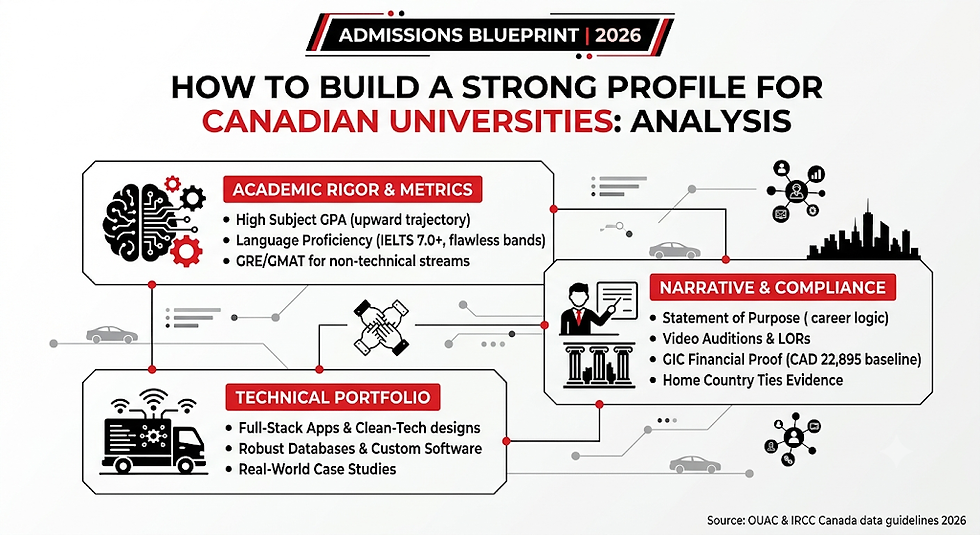
The international admission system in 2026 demands far more than basic academic benchmarks. Following sweeping regulatory updates by Immigration, Refugees and Citizenship Canada (IRCC), universities across the country have adjusted their enrollment metrics. For ambitious students looking to secure entry into premier institutions like the University of Toronto, McGill, or the University of Waterloo, the evaluation process is highly competitive. Elite grade point averages remain critical, but they now function merely as a baseline entry requirement. Admission committees look closely at holistic profiles to identify leaders, innovators, and problem-solvers who can thrive under intense academic pressure.
This detailed how to build a strong profile for Canadian universities analysis breaks down the four structural pillars of a competitive portfolio: academic strategies, technical project development, narrative writing mastery, and crucial immigration alignment metrics for the 2026 enrollment cycle.
1. The First Pillar: Maximizing Academic Rigor and Standardized Metrics
Canadian universities place a higher premium on your continuous undergraduate or secondary grade point average (GPA) than many other global study destinations. Because the vast majority of Canadian public institutions do not require or even look at broad aptitude metrics like the GRE or GMAT for standard technical streams, your day-to-day academic transcripts bear the entire weight of your academic evaluation.
                  [THE ACADEMIC PERFORMANCE ENGINE]
                                  │
         ┌────────────────────────┴────────────────────────┐
         ▼                                                 ▼
[Core Subject GPA Focus]                   [Language Facility Thresholds]
• High weights on advanced modules     • Minimum IELTS Academic: 6.5+
• Upward trajectory trend lines        • Competitive STEM Goals: 7.0+
• Rigorous elective selection          • Individual band tracking priority
Strategic GPA Optimization
Admissions boards do not simply glance at your final cumulative GPA; they conduct a thorough course-by-course review of your transcripts. They check for:
Core Course Performance: If you are applying for an advanced Computer Engineering or Software track, committees evaluate your performance in core theoretical computer science modules, discrete mathematics, and operating systems.
The Trajectory Trend: A transcript showing a lower GPA in the first year followed by a steady upward climb in the second and third years reads much better than a declining trend line.
Prerequisite Strength: Missing specific prerequisites or scoring below institutional cutoffs in mandatory advanced classes can prompt an automatic file rejection, regardless of your overall average.
Flawless English Language Proficiency Tracking
Unlike systems that accept simple passing scores, Canadian visa officers and university departments examine individual sub-scores—reading, listening, speaking, and writing.
IELTS Academic: A baseline score of 6.5 with no individual band below 6.0 is standard for mid-tier schools. However, competitive engineering, computer science, and management programs regularly require an overall score of 7.0 or higher.
TOEFL iBT: Competitive entry pathways typically require a minimum score of 100 overall, paired with strong sub-scores in written expression.
2. H3: Actionable Blueprints to Build a Strong Profile via Technical Projects
When evaluating applicants with similar academic averages, admission committees turn to your real-world project portfolios to differentiate your file. To build a strong profile, your extracurricular engagement must shift away from passive club memberships and focus on creating functional, real-world solutions. High-value engineering and computer science programs look for technical milestones that prove you can apply classroom theory to complex, practical challenges.
┌────────────────────────────────────────────────────────-┐
│             PORTFOLIO ADVANTAGE CONFIGURATION           │
├───────────────────────────────-┬────────────────────────┤
│ Full-Stack Architecture        │ Smart Care Platforms   │
│ Clean Technology Infrastructure│ Solar-Powered E-Cars   │
│ Relational Systems Design      │ Student Mgmt Systems   │
│ Community Health Prototyping   │ Camp Registration Hubs │
└────────────────────────────────────────────────────────-┘
Building Elite Full-Stack Applications
Admissions officers evaluate your technical agility through your ability to build complete web applications. Portfolios that show a deep understanding of full-stack development—such as building responsive web layouts or debugging complex back-end architectures like Java Servlets—stand out far more than basic coding exercises. For instance, developing an end-to-end Smart Medicine and Care Companion platform that connects users with medical schedules showcases your practical development skills, version control habits, and readiness for fast-paced co-op environments.
Designing Sustainable Systems
With sustainability taking center stage globally, demonstrating design skills in clean technology gives your application a significant edge. Structuring detailed engineering reports for projects like a solar-powered electronic car highlights your ability to design efficient energy storage systems, manage power conversion constraints, and solve complex green-tech engineering problems.
Developing Robust Databases and Custom Software
Proving you can design stable data systems is key for any advanced software path. Showcasing projects like a Student Attendance Management System—complete with detailed entity-relationship (ER) diagrams and clean relational database structures—proves you can organize complex data efficiently.
Similarly, creating real-world case studies for a Health Camp Registration System demonstrates that you know how to gather functional user requirements, design clear data flows, and build secure, user-facing registration software.
3. Mastering the Narrative: SOPs, LORs, and Video Profiles
Once your technical milestones and academic credentials are in place, your next priority is presenting them effectively through your application documents. Top-tier Canadian institutions use broad-based admissions models that evaluate your communication skills, emotional intelligence, and resilience.
[Academic Transcript Engine] ──► [Narrative Statements (SOP)] ──► [Timed Video Auditions]
                                                                         │
                                                                         ▼
[Holistic Selection Verdict] ◄─── [Verified Recommendations (LOR)] ◄─────┘
Writing a Logical Statement of Purpose (SOP)
Your SOP must avoid vague cliches like "I have loved computers since childhood" and instead follow a clear, professional narrative. It should lay out a clear path: your current academic background, the specific technical challenges you have tackled, why you need to study at this specific institution, and your clear long-term career goals. Address any shifts in your academic path directly, explaining your choices with clear professional logic.
Securing Authentic Letters of Recommendation (LOR)
A high-quality LOR should read as an authentic evaluation of your skills, not a generic template. Give your academic recommenders at least four weeks' notice, providing them with your resume, project portfolios, and transcripts. The best letters highlight specific moments where you showed leadership, critical thinking, or unique research skills in the classroom or lab.
Navigating Timed Video Profiles
Elite faculties, such as Toronto Engineering and UBC Sauder, require real-time video interviews submitted through specialized portals. These sessions typically feature short, timed prompts that assess your problem-solving skills under pressure.
Preparation: Record practice responses to develop a clear, structured communication style.
Environment: Film in a quiet, distraction-free space with clean lighting and a neat, neutral background.
Delivery: Dress professionally, sit up straight, look directly into the camera, and present your ideas clearly and concisely.
4. The 2026 Structural Compliance Matrix: IRCC Realities
A brilliant academic profile can still face a visa refusal if your financial and legal documentation is unorganized. For the 2026 calendar year, visa officer training logs reveal a strict focus on financial transparency and long-term home country ties.
┌────────────────────────────────────────────────────────┐
│             2026 VISA OFFICER EVALUATION MATRIX        │
├───────────────────────────────┬────────────────────────┤
│ Capped Study Permit Spaces    │ 309,670 Total Units    │
│ Provincial Attestation Letter │ Mandatory for Undergrad│
│ Core GIC Capital Threshold    │ CAD 22,895 Liquid Asset│
│ Key Refusal Trigger           │ Sudden Unverified Funds│
└────────────────────────────────────────────────────────┘
Verifying Your Financial Foundation
Holding a valid letter of acceptance is only part of the equation; you must back it up with clear financial documentation. International students studying outside Quebec must purchase a Guaranteed Investment Certificate (GIC) worth CAD 22,895 from an approved bank.
Crucially, visa officers look closely at the source of these funds. Depositing a sudden lump sum into an account right before purchasing your GIC can raise immediate red flags. You need to show a clear, documented history of your funds—such as stable family income, long-term savings accounts, or verified education loan disbursements.
Establishing Home Country Ties
Under current immigration rules, your profile must prove that you have strong ties to your home country. You can demonstrate this by providing property deeds in the family name, evidence of local family businesses, or documentation of stable parental employment. Showing these clear connections reassures visa officers that you have a viable, long-term plan to return home after your studies.
Technical Performance Matrix: Profile Evaluation Milestones
This detailed reference table provides a quick guide to how admissions committees evaluate different elements of your application.
Profile Component | Entry Level Requirements | Highly Competitive Benchmarks | Strategic Impact on Admissions |
Academic GPA Metrics | Equivalent to B or 75–85% average. | Equivalent to A/A+ or 90%+ average. | Serves as the primary filter for competitive programs. |
Language Facility Tests | IELTS: 6.5 (No band below 6.0). | IELTS: 7.5+ (High writing scores). | Prevents application delays and strengthens visa files. |
Technical Portfolio | Basic coding tasks or classroom projects. | Full-stack apps, clean-tech designs. | Differentiates your application from similar GPA profiles. |
Application Narrative | Generic, template-based statements. | Highly focused, original career logic. | Explains your academic goals and career direction clearly. |
Financial GIC Proofs | CAD 22,895 baseline amount. | Fully verified, clear source history. | Crucial for securing study permit approval. |
Admissions Board Insight "A truly competitive profile is built on clear progression. The most impressive applicants are those who can talk about their mistakes, explain what they learned from a failed project, and show exactly how they plan to use their skills to make an impact in the industry."— Global Education Policy Council
FAQ Section
What is the most important takeaway from this how to build a strong profile for Canadian universities analysis?
Our comprehensive how to build a strong profile for Canadian universities analysis reveals that top institutions use a balanced, holistic evaluation process. While maintaining a high GPA is essential, securing an admission offer requires building a portfolio of practical, real-world technical projects, writing a clear, professional statement of purpose, and providing completely transparent financial documentation.
Can I use letters of recommendation from family members on my university profile?
No. Official letters of recommendation must come from high school teachers, college professors, research mentors, or professional managers who have directly supervised your work or academic projects. Universities explicitly state that references from family members are not accepted.
Are international master's degree applicants required to provide a Provincial Attestation Letter (PAL)?
No. Under current 2026 IRCC regulations, students applying for master's and doctoral degree programs at public institutions are fully exempt from the national study permit cap and do not require a Provincial Attestation Letter (PAL). The PAL requirement applies primarily to undergraduate and college diploma programs.
What is the minimum language score required for competitive engineering programs?
While mid-tier university options accept a minimum overall IELTS score of 6.5, highly competitive engineering and computer science programs generally require an overall score of 7.0 or higher, with strong performance across all individual bands.
Secure Your Academic Future via Authority Outlets
Staying ahead of shifting deadlines, checking official Designated Learning Institution (DLI) codes, and tracking real-time visa updates requires relying entirely on verified government and university resources. To keep your counseling team, student group, or personal timeline updated on application windows and financial changes, make sure to save our resource directory.
Access officially verified application tools, visa guidelines, and central registries through these trusted channels:
To confirm a university's official DLI registration, evaluate your PGWP work eligibility, and review updated visa rules, visit the Immigration, Refugees and Citizenship Canada (IRCC) Official Portal.
To access the centralized application platform for universities in Ontario, check out key deadlines, and review document submission instructions, visit the Ontario Universities' Application Centre (OUAC) Hub.
To research regional academic standards, explore international student work rights, and check out national accreditation policies, explore the Council of Ministers of Education, Canada (CMEC) Platform.
For a practical look at structuring your resume, formatting your project achievements, and organizing your portfolio for admissions committees, check out this Profile Building for Engineering Students Video. This resource offers a clear, step-by-step breakdown of how to present your technical skills effectively.



Comments