
How to Apply for an Apprenticeship in the UK for 2027
- Akshada Naik
- 2 days ago
- 6 min read

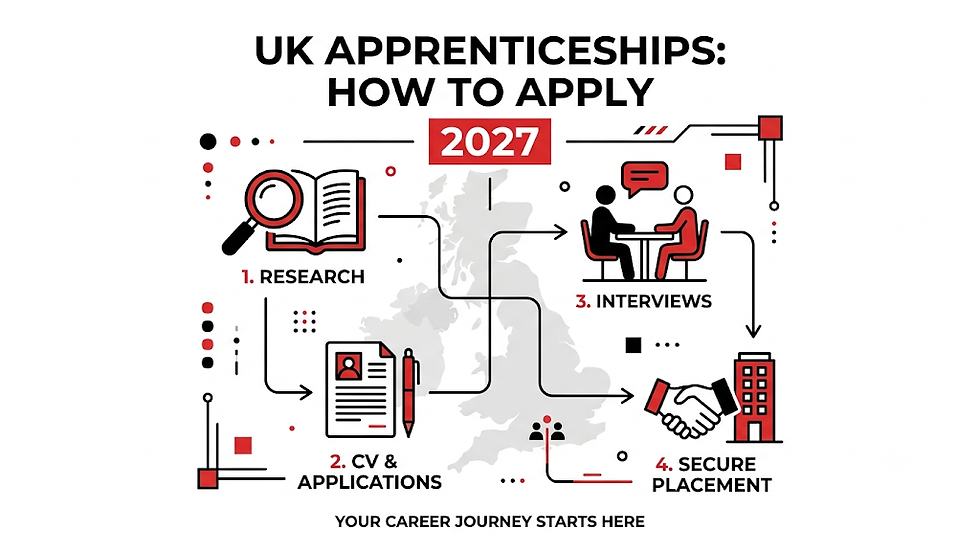
The UK landscape for career development is shifting rapidly. As traditional university pathways face rising tuition costs and intense job market competition, apprenticeships have emerged as a premier route to long-term professional success. Offering a unique combination of hands-on work experience, structured learning, and a steady income, apprenticeships allow you to build a career without the burden of student debt.
As we look toward the 2027 intake, the apprenticeship ecosystem in the United Kingdom is undergoing its most significant evolution in years. Guided by newly implemented funding frameworks and the introduction of fast-tracked training modules, there has never been a better time to plan your journey.
This comprehensive guide breaks down everything you need to know about navigating the system, utilizing new policy updates, and mastering the step-by-step process of how to apply for an apprenticeship.
The 2026–2027 Apprenticeship Landscape: What’s New?
To secure an apprenticeship for the 2027 academic year, it is vital to understand how the system is currently structured. Recent reforms introduced by the Department for Education (DfE) and the Department for Work and Pensions (DWP) have dramatically reshaped how programs are funded, designed, and delivered.
The Rise of Higher and Degree Apprenticeships
The trend toward higher-level qualifications is stronger than ever. Recent government data indicates that higher apprenticeships (Level 4 to Level 7) make up roughly 40% of all apprenticeship starts, with degree-level apprenticeships (Levels 6 and 7) seeing massive year-on-year growth. Conversely, traditional intermediate (Level 2) starts have declined. Employers increasingly use the apprenticeship framework to recruit highly skilled talent in technical sectors like engineering, finance, software development, and management.
Key Policy and Funding Reforms
If you are planning your application for 2027, several key regulatory changes implemented during the 2026/27 academic year will work in your favor:
Free Training for Under-25s: For non-levy-paying employers (typically small-to-medium enterprises), the government now funds 100% of the training and assessment costs for apprentices aged 16 to 24. This change has made small businesses incredibly eager to hire young apprentices, opening up thousands of localized vacancies.
The Launch of "Apprenticeship Units": Designed for ultra-rapid upskilling, the government rolled out bite-sized "Apprenticeship Units". These short, high-intensity courses (ranging from 30 to 140 tutor-led hours over 1 to 16 weeks) focus on emerging sectors like Artificial Intelligence (AI) leadership, green energy, and advanced welding.
Stricter Support for English and Maths: If you do not already hold a grade 4 (C) or above in GCSE English and Maths, your training provider must establish an active, tutor-supported learning plan from day one to help you achieve these credentials alongside your main qualification.
Understanding the Apprenticeship Levels
Apprenticeships in the UK are categorized by levels, which correspond to traditional educational milestones:
Apprenticeship Level | Equivalent Educational Qualification | Typical Entry Requirements |
Intermediate (Level 2) | GCSEs (5 passes at grade 4–9 / A*–C) | None (basic numeracy and literacy preferred) |
Advanced (Level 3) | A-Levels / BTEC National | 3+ GCSEs, including English and Maths |
Higher (Levels 4, 5 & 6) | Foundation Degree / Higher National Diploma | Level 3 qualification (A-Levels or equivalent) |
Degree (Levels 6 & 7) | Bachelor’s or Master’s Degree | 2–3 A-Levels or Level 3 equivalent, plus GCSEs |
Regardless of the level you select, you will spend roughly 80% of your time doing practical, paid work with your employer, and 20% participating in structured "off-the-job" training with an approved university, college, or training provider.
How to Apply for an Apprenticeship: A Step-by-Step Guide for 2027
Applying for an apprenticeship is identical to applying for a professional, competitive job. Unlike university applications through UCAS, there is no single, unified national deadline or centralized portal that covers every single vacancy. Instead, positions are advertised year-round by individual employers.
To secure your dream placement for 2027, follow this systematic step-by-step application blueprint.
Step 1: Research and Choose Your Industry
Before you look at vacancies, pinpoint the sector you wish to enter. In 2026 and 2027, the most highly sought-after sectors experiencing massive employer demand include:
Digital Technology: Software engineering, cybersecurity, data analytics, and AI specialists.
Engineering and Manufacturing: Particularly green energy systems, electric vehicle technology, and aerospace.
Business, Administration, and Law: Accounting, project management, and legal services (which remain the most popular apprenticeship choices overall).
Step 2: Set Up Accounts on Key Application Portals
To ensure you do not miss out on live vacancies, register on the primary UK government databases and set up automated search alerts:
Find an Apprenticeship (England): The official government portal (GOV.UK Find an Apprenticeship).
Apprenticeships.scot (Scotland): For opportunities located in Scotland.
Careers Wales / Apprenticeships (Wales): For opportunities in Wales.
Apprenticeships Northern Ireland: For opportunities in NI.
UCAS Hub: UCAS increasingly lists higher and degree apprenticeships alongside traditional university courses, allowing you to compare both pathways simultaneously.
Step 3: Target Employer Websites Directly
Many of the UK's largest and most prestigious apprenticeship employers—such as the National Grid, PwC, Deloitte, Rolls-Royce, and AstraZeneca—do not rely solely on government portals. They host recruitment campaigns directly on their own early careers portals.
Pro Tip: Recruitment for highly competitive September 2027 intakes often begins as early as October to November 2026. Start checking the careers pages of your target companies during the autumn of 2026 to register your interest early.
Step 4: Tailor Your CV and Cover Letter
Because you are applying for a job, your CV needs to look immaculate. Since you may have limited professional work experience, structure your CV to highlight transferable skills:
Academic Achievements: Highlight relevant coursework, projects, or STEM subjects.
Extracurricular Activities: Include sports teams, volunteering, or youth clubs that demonstrate teamwork, leadership, and reliability.
Technical Skills: Detail any self-taught skills, such as coding, graphic design, or online certifications.
Personal Statement: Write a compelling, concise summary explaining why you want to learn through an apprenticeship rather than a classroom-only route.
Step 5: Master the Multi-Stage Interview Process
Large employers utilize rigorous, multi-stage assessment processes to filter applicants. Be prepared to navigate:
Online Aptitude Tests: Situational judgment, numerical reasoning, or critical thinking games.
Video Interviews: Pre-recorded video platforms where you answer timed questions on screen.
Assessment Centers: Group exercises, individual presentations, and face-to-face interviews designed to test how you collaborate with others.
Crucial Tips for a Winning 2027 Application
To stand out in an increasingly crowded applicant pool, implement these strategic tips during your preparation:
Align Your CV with the Job Specification: Scan the job description for key terms (e.g., "problem-solving," "communication," "attention to detail") and ensure those exact words appear in your CV.
Demonstrate Commercial Awareness: Research the company thoroughly before your interview. Understand their core products, their competitors, and any major challenges facing their industry (such as the transition to net-zero carbon emissions).
Showcase Passion Over Experience: Employers do not expect you to be a fully finished professional—that is what the apprenticeship is for. They are looking for trainability, curiosity, and a genuine enthusiasm for the sector.
Spread Your Risk: Do not put all your eggs in one basket. Apply for a mix of highly competitive multinational schemes and lesser-known local opportunities.
Frequently Asked Questions (FAQs)
Q1: What is the age limit for starting a UK apprenticeship?
A: There is no upper age limit! You can apply for an apprenticeship at any point in your career as long as you are aged 16 or over, live in the UK, and are not in full-time education. In fact, DfE statistics show that over 50% of apprenticeship starts are by learners aged 25 and over.
Q2: How do I know how to apply for an apprenticeship if I am still in school?
A: If you are currently finishing your GCSEs or A-Levels, the best way to understand how to apply for an apprenticeship is to create a profile on the GOV.UK Find an Apprenticeship service, check the "early careers" portals of major employers during autumn, and consult with your school's careers advisor.
Q3: Do I have to pay for my own training or university fees?
A: No. Under UK law, the cost of your training and education is entirely co-funded by the government and your employer. You will never be asked to pay tuition fees, and you will receive a monthly salary for your work.
Q4: Can I apply for an apprenticeship if I already have a university degree?
A: Yes! You can legally undertake an apprenticeship even if you already hold a university degree, provided the apprenticeship is in a completely different subject area and will allow you to acquire substantive new professional skills.
Take the Next Step Toward Your Future
Securing an apprenticeship for the 2027 intake requires early planning, a polished resume, and a proactive attitude. By starting your research today, you can position yourself ahead of the competition and transition smoothly into a rewarding, paid career path.
Ready to find your perfect opportunity? Explore these official, working UK portals to launch your search:
Search Live Vacancies: Create your candidate profile and browse thousands of active placements on the National Apprenticeship Service Portal.
Get Personalized Career Advice: Speak to a certified advisor about your options on the National Careers Service.
Compare Higher & Degree Apprenticeships: Search higher education alternatives and dual pathways directly on the UCAS Apprenticeship Hub.
Explore Engineering & Technical Roles: Learn about industry-leading, high-yield technical programs by visiting the National Grid Careers Directory.




Comments