
Study in Germany 2027: Master the Admission Process for International Students

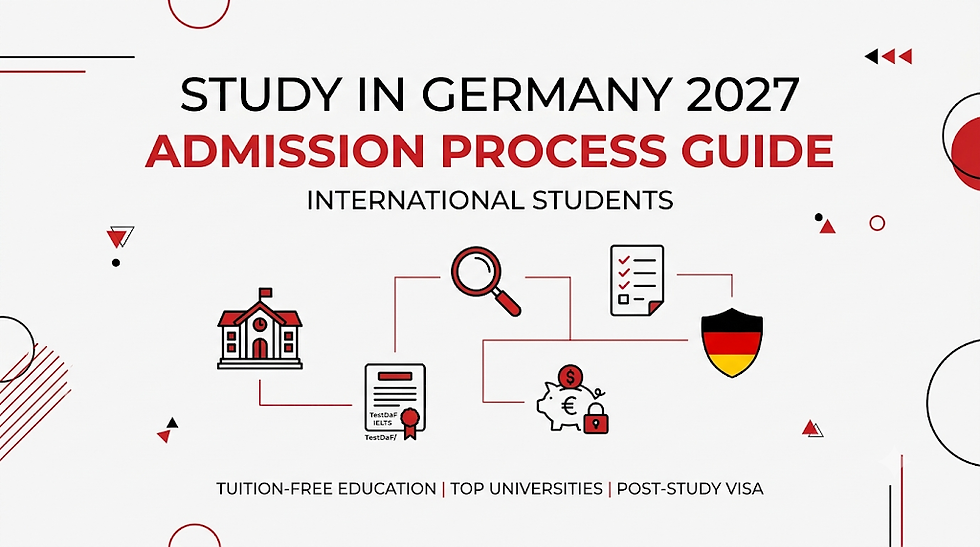
The dream of studying in Europe often leads directly to Germany—and for good reason. Renowned for its world-class public universities, tuition-free education model, vibrant student cities, and excellent post-study work opportunities, Germany remains a magnet for global talent.
As we look toward the 2027 academic intakes, the competition is expected to reach record highs. To secure a spot at a top German institution, prospective students must navigate a highly structured, bureaucratic, and time-sensitive journey.
This comprehensive guide breaks down everything you need to know about preparing your application, meeting the latest requirements (such as the mandatory APS certificate and updated blocked account balances), and navigating the step-by-step admission process for international students.
Why Choose Germany for Your Higher Education in 2027?
Germany is one of the few global study destinations that has actively preserved its tuition-free policy at public universities for both domestic and international students. While some federal states (like Baden-Württemberg) or specific specialized programs charge nominal fees, the vast majority of public universities only require a small semester contribution (typically between €150 and €350). This fee covers administrative costs and often includes a public transit ticket ("Semesterticket") for the entire region.
Beyond the financial advantages, studying in Germany in 2027 places you at the heart of technological innovation, research excellence, and economic stability. Furthermore, international graduates are entitled to an 18-month post-study work visa, allowing them plenty of time to launch a career in Europe's largest economy.
Key Academic Intakes and Deadlines
Before diving into documentation, you must align your preparation with Germany's academic calendar. German universities operate on a two-semester system:
+------------------+-------------------------+----------------------+-----------------------+
| Semester         | Standard Term Duration | Application Opens    | Deadline (Usually)    |
+------------------+-------------------------+----------------------+-----------------------+
| Winter Semester  | October to March        | Early May            | July 15th             |
| Summer Semester  | April to September      | Early November       | January 15th          |
+------------------+-------------------------+----------------------+-----------------------+
Note: Many universities set earlier deadlines (up to 8 weeks ahead) for highly competitive master's programs, preparatory courses (Studienkolleg), or students requiring preliminary evaluation documents. Always verify deadlines directly with your chosen university’s International Office.
Understanding the Admission Process for International Students
When seeking entry into a German university, your school-leaving certificate or previous university transcripts are evaluated to determine if they meet the German higher education entry qualification, known as the Hochschulzugangsberechtigung (HZB).
The HZB Assessment: Do Your Credentials Qualify?
The first step in the admission process for international students is checking whether your foreign qualifications are recognized as equivalent to the German Abitur (the qualification earned by German high school graduates). You can easily check your country's degree equivalence using:
The Anabin Database (an official German portal that classifies foreign academic institutions and degrees).
The DAAD Database on Admission Requirements.
If your high school diploma is not deemed equivalent, you cannot apply for direct entry to a bachelor's program. Instead, you must complete a one-year foundation program called a Studienkolleg. At the end of this preparatory year, you will sit for the Feststellungsprüfung (FSP) exam, which qualifies you to apply to German universities.
The 15 vs. 16-Year Education Rule for Master's Applicants
For postgraduate applicants, most German universities traditionally expect a four-year bachelor's degree (totaling 16 years of formal education). If you hold a three-year bachelor's degree, direct entry can be highly challenging, though some universities now offer bridge programs, pre-master's courses, or accept applicants based on extensive professional experience or high GRE/GMAT scores.
Step-by-Step Guide to Applying for 2027 Intake
Once you understand how your academic background fits into the German framework, you can begin the formal application process.
Step 1: Find the Right Course and Check Restrictions
Use the DAAD International Programs database to search for courses. Pay attention to whether your chosen program has a Numerus Clausus (NC).
NC (Admission-Restricted): High-demand courses where university seats are limited. Admission is highly competitive and determined by your GPA, motivational letter, and entry test scores.
Non-NC (No Admission Restrictions): If you meet the basic minimum eligibility criteria, you are virtually guaranteed a seat.
Step 2: Fulfill Language Proficiency Standards
Depending on your program's language of instruction, you must provide recognized language certificates:
For English-Taught Programs: Most universities require a minimum IELTS band score of 6.5 or a TOEFL iBT score of 88.
For German-Taught Programs: You will need advanced proficiency verified through examinations such as the TestDaF (usually Level 4 in all parts) or the DSH (minimum DSH-2).
Step 3: Secure Your APS Certificate (If Applicable)
If you are applying from certain countries, such as India, China, or Vietnam, obtaining an APS Certificate (Akademische Prüfstelle) is a mandatory prerequisite. The APS verification process authenticates your academic documents directly through the German Embassy. Because this step is mandatory before you can submit university applications or apply for your student visa, you should start the APS process at least 4–6 months in advance.
Step 4: Choose the Correct Application Channel
Depending on the university and your country of origin, you will submit your applications through one of three pathways:
1. Uni-Assist
Most international students submit their documents via Uni-Assist, a centralized portal that evaluates international school and university certificates for equivalence to German standards. Uni-Assist charges a processing fee (typically €75 for your first application and €30 for each subsequent application).
2. Direct University Application
Some German universities handle their own admissions internally. In this case, you will apply directly on the university's online registration portal.
3. Hochschulstart (DoSV)
If you are applying for highly restricted undergraduate programs (like medicine, pharmacy, or dentistry) that use the Dialogue-Oriented Service Procedure (DoSV), you must register on Hochschulstart.
Proving Financial Resources: The 2027 Blocked Account (Sperrkonto)
To secure a German student visa, you must legally prove that you have sufficient funds to cover your living costs for your first year of study. The most common and accepted way to do this is by opening a Blocked Account (Sperrkonto).
Important Financial Update: For the 2026/2027 academic periods, the required minimum balance for a German blocked account is €11,904 per year (or €992 per month).
This amount is pegged directly to Germany's Federal Training Assistance Act (BAföG) rates and is updated periodically to match inflation. When you arrive in Germany, you will be allowed to withdraw a maximum of €992 each month to cover rent, food, health insurance, and leisure.
Leading Approved Blocked Account Providers
Ensure you only use providers officially recognized by the German Federal Foreign Office. Popular providers that offer fast, completely digital setups include:
Fintiba: Highly popular, 100% online setup, and offers integrated health insurance packages.
Expatrio: Budget-friendly option with an award-winning value package containing blocked account setup, health insurance, and a free current account.
Coracle: Another digitized provider known for its quick processing times and low administrative fees.
Comprehensive Document Checklist
Having all your documents translated, certified, and digitally scanned in advance is the key to a stress-free application process. Use this checklist as your guide:
Document Type | Details / Description | Mandatory For |
High School / Degree Certificates | Officially certified copies and transcripts (with certified translations in English/German if the originals are in another language) | All Applicants |
Language Certificates | Valid IELTS/TOEFL for English-taught courses, or TestDaF/DSH for German-taught courses | All Applicants |
APS Certificate | Verification document from the German Embassy’s Academic Evaluation Centre | Applicants from India, China, Vietnam |
Passport & Portrait Photos | Copy of a valid passport and recent passport-sized photos | All Applicants |
Statement of Purpose (SOP) | A well-written motivation letter outlining your academic goals and why you chose Germany | Most Universities |
Letters of Recommendation (LORs) | Letters from former professors or professional employers | Mainly Postgraduate / Master’s Applicants |
Curriculum Vitae (CV) | A tabbed, chronological CV (preferably using the Europass format) | All Applicants |
Frequently Asked Questions (FAQs)
Q1: Can I study in Germany completely in English?
A: Yes! Public universities offer thousands of English-taught programs, particularly at the Master's level. However, learning basic conversational German is highly recommended to help you navigate daily life and access local job opportunities.
Q2: How does the admission process for international students change if my degree is not recognized?
A: If your school-leaving certificate does not grant you direct entrance qualification (HZB), the admission process for international students requires you to enroll in a preparatory course called Studienkolleg. You will study relevant subjects and German language for two semesters before taking the Feststellungsprüfung (FSP) to qualify for full university entry.
Q3: When should I open my blocked account for 2027?
A: You should open your blocked account and deposit the required €11,904 as soon as you receive your letter of admission from a German university. You will need the official "blocking confirmation" document from the provider to schedule and attend your student visa interview.
Q4: Can I work part-time while studying in Germany?
A: Yes. International students from non-EU/EEA countries are permitted to work up to 140 full days (or 280 half days) per calendar year. This allows you to earn extra pocket money while pursuing your degree.
Take the First Step Toward Germany Today
Securing admission in Germany is a journey that rewards meticulous planning and attention to detail. By starting your preparation early—ideally in the summer of 2026 for the 2027 intakes—you can smoothly compile your documents, secure your language scores, and submit a winning application.
Ready to begin your German academic journey? Explore these official resources to start planning:
Search for Programs: Browse thousands of English and German courses on the DAAD International Programs Database.
Evaluate Your Qualifications: Check if your degree matches German requirements on the Anabin Database or through Uni-Assist.
Plan Your Relocation: Explore career options and student visa requirements on the official government portal Make it in Germany.


Comments