
US University Admission Process: A Step-by-Step Guide for International Students (2026)
- veddixitcs
- Jul 7
- 5 min read

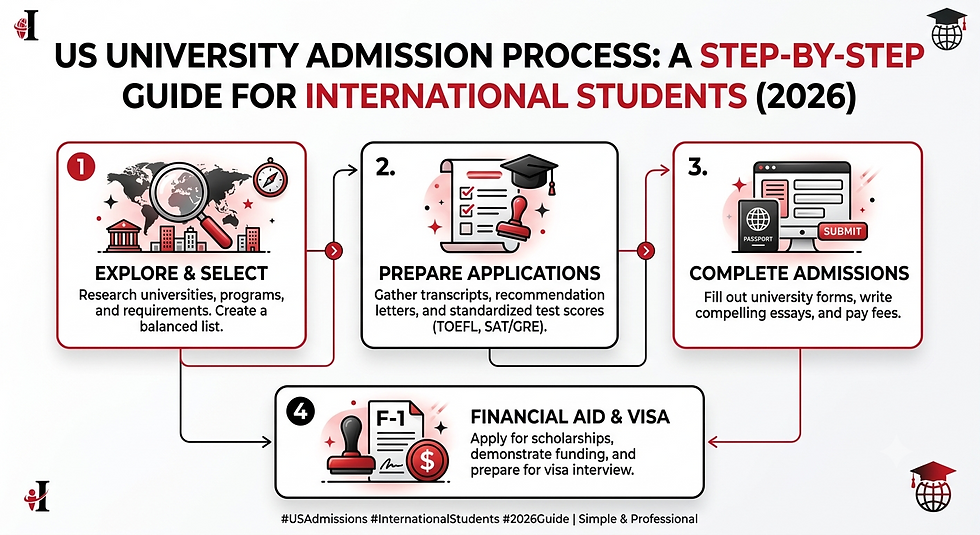
US University Admission Process: A Step-by-Step Guide for International Students (2026)
Getting into a US university isn't just about good grades — it's about timing, documentation, and understanding a system that runs very differently from most other countries. With deadlines shifting earlier every year and visa scrutiny increasing, the US university admission process in 2026 rewards students who plan 12–18 months ahead, not those who scramble a few weeks before deadlines.
Here's a complete, step-by-step breakdown of exactly what that process looks like right now.
Step 1: Start Early — Ideally 12 to 18 Months Ahead
This is the single biggest piece of advice from every counselor and admissions expert right now. The college application process should begin at least 12–18 months before the intended start of your program, with early planning ensuring you complete tests, essays, recommendations, and other requirements without last-minute pressure.
Why the urgency? In 2026, many deadlines fall earlier than in past years, and admissions counselors are increasingly treating the process as a rolling, year-round journey rather than a single deadline sprint.</cite> Missing a deadline can genuinely cost you an entire year.
Step 2: Choose Your Intake — Fall, Spring, or Summer
US universities admit students across three main intakes:
Fall Intake (August/September) — >This is the most preferred intake among international students, offering access to popular flagship courses, the greatest availability of financial aid and scholarships, and the widest range of job and internship opportunities.
Spring Intake (January) — A solid backup option for students who miss Fall deadlines, though it comes with slightly fewer internship and scholarship opportunities since most are allocated in the Fall cycle.Popular universities offering Spring intake include NYU, USC, University of Illinois Urbana-Champaign, Purdue, and Northeastern.
Summer Intake (May/June) — The least common option, generally reserved for short-term, certificate, or research-based programs.
Step 3: Understand the Application Rounds
Within the Fall intake specifically, you'll typically choose between:
Round | Timing | Binding? | Best For |
Early Decision (ED) | Nov 1–15 | Yes | Students 100% sure of their top choice |
Early Action (EA) | Nov 1–15 | No | Students who want an early answer but flexibility |
Regular Decision (RD) | Jan–Feb | No | Most applicants; more time to prepare |
Rolling Admissions | Ongoing | No | Students applying later; reviewed as received |
<cite index="12-1">Early Decision requires a binding commitment to enroll if admitted, and top schools like Stanford GSB, Wharton, and Harvard Business School even run multiple rounds — R1 in September, R2 in January, and R3 in March/April for MBA programs.</cite> Meanwhile, <cite index="16-1">regular decision deadlines typically fall in January or February, while rolling admissions extend into spring until spots are filled.</cite>
Step 4: Shortlist Universities Strategically
With <cite index="17-1">over 5,300 universities across the country offering a wide range of academic opportunities</cite>, narrowing your list is critical. Consider:
Program fit and rankings in your specific field
Location and cost of living
Public vs. private vs. liberal arts vs. community college (each has different costs, class sizes, and aid structures)
Need-blind admission policies — <cite index="19-1">schools like Harvard, Yale, Princeton, MIT, and Amherst are among the few that offer need-blind admissions, meaning your ability to pay doesn't factor into the admission decision.</cite>
Step 5: Prepare Standardized Tests
Depending on your program, you'll likely need one or more of:
SAT/ACT (undergraduate)
GRE/GMAT (graduate/MBA — though many programs have gone test-optional)
TOEFL/IELTS/Duolingo English Test (English proficiency for non-native speakers)
Note that <cite index="17-1">standardized test scores are an important part of the application process at many US universities, but their weight varies by institution, and some have implemented test-optional policies</cite> — so check each university's current requirements rather than assuming.
Step 6: Build Your Application Package
A typical US application for international students includes:
Academic transcripts (with GPA conversion if your country uses a different scale)
Standardized test scores
The Common Application Essay — <cite index="19-1">a 650-word personal essay chosen from seven set prompts</cite>
Letters of recommendation — <cite index="19-1">most universities require two to three letters, typically two from subject teachers and one from a school counselor or principal</cite>
Extracurricular activities and achievements — <cite index="19-1">US universities value well-rounded students, with a focus on depth of involvement rather than joining many activities superficially</cite>
Financial documentation proving your ability to fund your education (required for the visa stage later)
Many students also apply through the Common Application — a platform that lets you apply to multiple universities using one core profile, saving significant time.
Step 7: Apply for Scholarships and Financial Aid Early
<cite index="17-1">Many US universities provide scholarships and financial assistance to international students based on academic performance, talent, and financial need, with external scholarship programs also sponsored by governments, organizations, and foundations.</cite> Because <cite index="17-1">scholarship deadlines vary and competition can be fierce</cite>, apply for aid at the same time as your admission application — don't treat it as a separate, later step.
Step 8: Track Decisions and Respond On Time
Decision timelines generally look like this for Fall intake:
ED/EA decisions: Mid-December
RD decisions: March–April
Rolling admissions: <cite index="13-1">Generally 4–8 weeks after you submit your application</cite>
Once accepted, you'll receive your I-20 form, which is required to begin your F-1 student visa application — the next major milestone in your journey.
Application Trends International Students Should Watch in 2026
The US university admission process has become noticeably more front-loaded and competitive:
<cite index="15-1">Top universities including MIT, Harvard, Stanford, Yale, Columbia, and University of Chicago maintain early action and early decision deadlines in November, with regular decision deadlines running into January–March.</cite>
Universities are increasingly offering rolling and multiple intake options, so a missed Fall deadline no longer means waiting a full year — Spring and Summer intakes are legitimate alternatives.
Visa processing delays mean admitted students should start their F-1 visa paperwork the moment they receive their I-20, rather than waiting until closer to the semester start.
FAQs About the US University Admission Process
Q1. How far in advance should international students start the US university admission process? A: Most counselors recommend starting 12–18 months before your intended intake — this gives you time for standardized tests, essays, recommendation letters, and financial documentation without last-minute stress.
Q2. What's the difference between Early Decision and Early Action? A: Early Decision is binding — if accepted, you must enroll. Early Action is non-binding, letting you apply early, get a faster answer, and still compare offers from other schools before deciding.
Q3. Do I need the SAT or GRE to apply to US universities in 2026? A: It depends on the university and program. Many schools have adopted test-optional policies, but competitive programs may still require or strongly recommend scores, so always check each university's current policy.
Q4. Can international students get financial aid or scholarships in the US? A: Yes. Aid is more limited for international students than domestic ones, but many universities offer merit- and need-based scholarships, and some — including a small group of Ivy League and liberal arts schools — offer need-blind admissions.
Q5. What happens after I'm accepted into a US university? A: You'll receive an I-20 form from the university, which you'll then use to apply for your F-1 student visa — the next essential step before you can travel and enroll.
Ready to Begin Your Application?
The US university admission process rewards early, organized applicants. Here's where to go next:
📝 Apply to multiple universities in one place: The Common Application
🎓 Search official program details and admissions requirements: EducationUSA – U.S. Department of State
💰 Explore verified scholarship opportunities for international students: Federal Student Aid – International Students
Not sure which intake or application round fits your timeline best? Share your target year in the comments, and we'll help you map it out in our next post on the F-1 visa process.


Comments