
The New Economic Era: Life After Graduation in Canada Analysis
- shraddhagolecs
- 4 days ago
- 7 min read


Completing a university degree as an international student marks a massive milestone, but it also opens a complex new chapter. In 2026, navigating the transition from student life to the professional workforce requires clear strategic planning. The Canadian immigration landscape has undergone significant changes over the past two years. Sweeping updates from Immigration, Refugees and Citizenship Canada (IRCC) have fundamentally altered work permit eligibility, language requirements, and permanent residency (PR) pathways.
For ambitious graduates—particularly those in high-demand fields like computer engineering, software development, or clean technology—succeeding in Canada requires looking beyond the classroom. It demands a thorough understanding of current regulatory requirements, an optimized career strategy, and a proactive approach to professional compliance.
This detailed life after graduation in Canada analysis evaluates the modern workforce realities, updated Post-Graduation Work Permit (PGWP) frameworks, and key strategies for building a stable, long-term career path.
1. Navigating the 2026 PGWP Regulatory Architecture
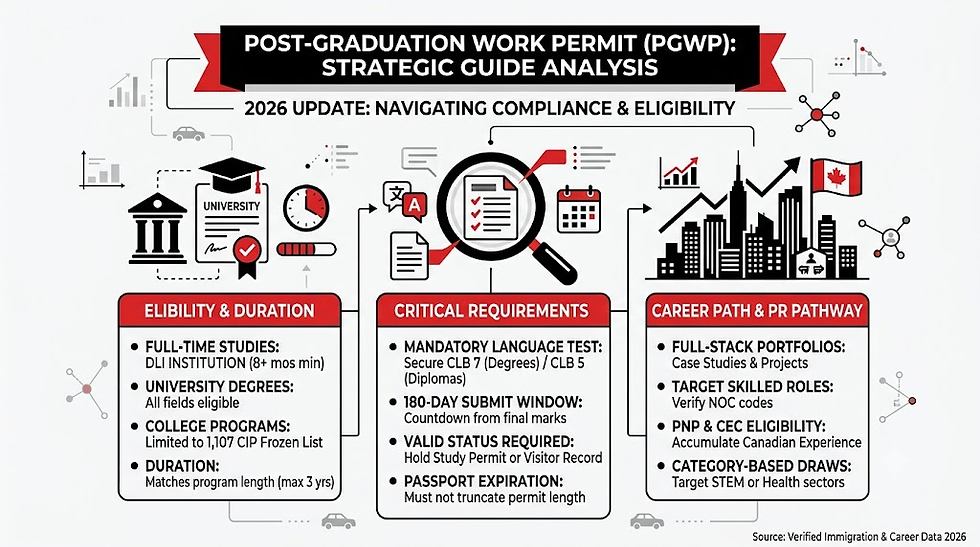
The Post-Graduation Work Permit (PGWP) remains the essential bridge for global students looking to gain local corporate experience and eventually transition to permanent residency. However, in 2026, securing a work permit is no longer automatic upon graduation. IRCC enforces precise eligibility filters that applicants must navigate perfectly.
                    [THE MODERN PGWP COMPLIANCE ENGINE]
                                     │
            ┌────────────────────────┴────────────────────────┐
            ▼                                                 ▼
     [DEGREE GRADUATES]                               [NON-DEGREE GRADUATES]
• Bachelor's, Master's, or Ph.D. level  • College diplomas and certificates
• Fully exempt from field-of-study lists     • Must align with frozen 1,107 CIP codes
• Strict requirement: CLB 7 in all abilities    • Strict requirement: CLB 5 in all abilities
• Maximum 3-year work permit window       • Directly tied to labor shortage areas
The Hard Language Mandate
The most significant operational shift for graduates is the mandatory language test requirement. Every PGWP application submitted in 2026 must include a valid English or French language test score (such as IELTS General Training, PTE Core, or CELPIP), taken in person and valid within a two-year window.
Degree-Level Grads: Graduates with a university bachelor’s, master’s, or doctoral degree must score a minimum of Canadian Language Benchmark (CLB) 7 across all four abilities (Reading, Writing, Listening, and Speaking). This equals an IELTS General score of 6.0 in every single band.
Non-Degree Grads: Graduates holding college diplomas or certificates must secure at least a CLB 5 across all four abilities (equivalent to IELTS General: Reading 4.0, Writing 5.0, Listening 5.0, Speaking 5.0).
Operational Note: To clear up user confusion regarding where to upload these documents, the IRCC portal includes a dedicated language-test submission slot within the digital application framework. Missing or expired language test scores result in immediate application rejections.
The 2026 Field-of-Study Freeze
For students graduating from non-degree college programs, PGWP eligibility depends entirely on their Classification of Instructional Programs (CIP) code. In a key regulatory update, IRCC officially froze its list of eligible educational programs for the duration of 2026.
The frozen registry includes 1,107 eligible programs targeting structural labor shortages across six priority sectors:
Healthcare and Social Services
Science, Technology, Engineering, and Math (STEM)
Skilled Trades and Infrastructure
Sustainable Agriculture
Transport Logistical Hubs
Education Systems
Crucially, university degree graduates remain fully exempt from these field-of-study restrictions. If you complete a formal Bachelor of Engineering or Bachelor of Science degree, your program is automatically eligible for a PGWP, providing solid stability for university career paths.
2. H2: Actionable Career Blueprints: Life After Graduation in Canada Analysis
Securing your work permit is only the first step. Translating your academic credentials into a competitive corporate role requires understanding how the local job market operates. This focused life after graduation in Canada analysis outlines the core strategies needed to build a standout professional profile.
Building an High-Value Technical Portfolio
In a highly competitive employment market, holding a degree is simply the baseline requirement. Corporate hiring managers prioritize applicants who can demonstrate real-world, practical problem-solving skills. Building a strong technical portfolio while at university is the most effective way to stand out.
┌────────────────────────────────────────────────────────┐
│             PORTFOLIO ADVANTAGE CONFIGURATION          │
├───────────────────────────────┬────────────────────────┤
│ Full-Stack Architecture       │ Smart Care Companions  │
│ Clean Technology Design       │ Solar-Powered E-Cars   │
│ Relational Systems Database   │ Attendance Management  │
│ System Requirements Blueprints│ Health Camp Platforms  │
└────────────────────────────────────────────────────────┘
Full-Stack Application Layouts: Developing complete, functional applications—such as a Smart Medicine and Care Companion platform that coordinates medical schedules—showcases your practical skills in software architecture and code debugging to potential employers.
Clean-Tech Engineering Documentation: If you are targeting the expanding green energy sector, having comprehensive engineering reports on complex systems, like a solar-powered electronic car, highlights your ability to navigate modern energy constraints and sustainable design challenges.
Relational Database Systems: Showcasing a complete Student Attendance Management System—backed by detailed Entity-Relationship (ER) diagrams and clean relational tables—proves you can design stable, secure data infrastructure.
Functional Requirements Prototyping: Providing end-to-end documentation for software, such as a Health Camp Registration System, demonstrates that you know how to gather functional specifications and build user-focused, secure production platforms.
Navigating the 180-Day Compliance Window
The transition timeline after your final semester requires careful tracking. You have a strict 180-day window to apply for your PGWP after receiving official written confirmation of your graduation (such as a final transcript or graduation letter).
If your study permit expires while you are waiting for your final marks, you must either apply to change your status to a visitor or leave the country and apply from abroad. Applying inside Canada while holding valid status allows you to work full-time under implied status while IRCC processes your work permit, ensuring a seamless transition into the workforce.
3. The Path to Permanent Residency: 2026 Realities
For many international graduates, gaining local work experience is a stepping stone toward permanent residency. However, the Express Entry system in 2026 requires a highly focused immigration strategy.
[PGWP Approved Base] ──► [1 Year Continuous NOC Exp] ──► [Category-Based Draws Target]
                                                                  │
                                                                  ▼
[Permanent Residence (PR)] ◄─── [Provincial Nomination (+600)] ◄──┘
The Rise of Category-Based Express Entry
The days of relying solely on general Comprehensive Ranking System (CRS) draws are gone. In 2026, IRCC focuses heavily on Category-Based Selection Draws, which invite candidates with specific occupational experience or language skills, often at much lower CRS cutoffs.
STEM & Healthcare Categories: Candidates with at least one year of continuous, full-time experience in priority fields (like software engineering, data analysis, or medical technologies) regularly receive invitations at lower score thresholds than general draws.
The French-Language Advantage: Demonstrating strong proficiency in French remains one of the most effective ways to fast-track your permanent residency. French-language category draws regularly issue invitations at significantly lower CRS cutoffs, making optional language courses a highly valuable investment during your studies.
Maximizing Provincial Nominee Programs (PNP)
If your federal Express Entry scores fall below competitive thresholds, Provincial Nominee Programs (PNP) offer an excellent alternative. Individual provinces manage dedicated streams tailored specifically for international graduates from local universities. Securing a provincial nomination adds a massive 600 points to your Express Entry profile, virtually guaranteeing an Invitation to Apply (ITA) for permanent residency in the very next draw.
Technical Performance Matrix: 2026 Graduation Transition Milestones
This reference table outlines the essential requirements and timelines international students must manage when transitioning from university to the Canadian workforce.
Transition Milestone | Key 2026 Requirement Parameters | Strategic Moving Window | Impact on Long-Term Success |
Language Proficiency Verification | University Degrees: CLB 7 baseline. College Diplomas: CLB 5 baseline. | Book test 120–150 days before graduation. | Mandatory document; missing tests lead to immediate application refusal. |
PGWP Application Window | Must apply within 180 days of receiving your final graduation confirmation. | Submit online via the IRCC portal from inside or outside Canada. | Maintains legal stay; enables full-time work under implied status. |
Field-of-Study Alignment | Degrees: Fully Exempt. Diplomas: Must match the frozen list of 1,107 programs. | Confirmed via specific CIP codes during enrollment. | Determines work permit eligibility for non-degree pathways. |
Federal Express Entry Eligibility | Requires 1 year of continuous, skilled work experience under eligible TEER codes. | Tracked through daily payroll and employer verification logs. | Opens pathways to permanent residency via Canadian Experience Class (CEC). |
Provincial Nominations (PNP) | Varies by province; typically requires a valid regional job offer or local degree. | Initiated immediately upon securing a compliant corporate role. | Adds 600 points to your CRS score, securing your PR invitation. |
Immigration Advisory Note "Successful life after graduation in Canada requires moving away from last-minute planning. Treat your post-graduation work permit and employment strategy as a single, unified roadmap that begins on your very first day of university."— Council for Global Talent & Compliance
FAQ Section
What is the most important takeaway from this Life After Graduation in Canada Analysis?
Our comprehensive life after graduation in Canada analysis highlights that navigating the post-study landscape successfully requires managing strict new compliance rules. Applicants must secure valid, in-person language test scores (CLB 7 for degrees, CLB 5 for diplomas), keep track of the strict 180-day application window, and focus on building high-value project portfolios to stand out in priority economic sectors.
Can I apply for my post-graduation work permit at a Canadian border crossing?
No. IRCC has officially ended the process of applying for a PGWP at the border (a practice commonly known as "flagpoling"). All post-graduation work permit applications must be submitted online through the official IRCC portal, either from within Canada or from your home country.
Do co-op placements completed during university count toward Express Entry work experience?
No. Work experience gained during your studies—including mandatory co-op terms, laboratory placements, and internships—does not count toward the one-year experience requirement for the federal Canadian Experience Class (CEC) stream. Your skilled work experience begins accumulating only after you receive formal confirmation of graduation and transition to a valid work status.
What happens to my work permit length if my passport expires next year?
IRCC cannot issue a work permit that outlasts the validity of your passport. If your passport is set to expire before the maximum length of your eligible PGWP (e.g., a three-year permit), your work permit will be shortened to match your passport date. It is highly recommended to renew your passport well before submitting your final work permit application.
Track Compliance Architecture via Authority Portals
Staying ahead of application deadlines, checking official Designated Learning Institution (DLI) codes, and monitoring real-time Express Entry draws requires relying entirely on verified government resources. Save our verified directory to keep your planning timeline accurate and updated:
To check official PGWP eligibility, track real-time processing windows, and review language test submission updates, visit the Immigration, Refugees and Citizenship Canada (IRCC) Official Portal.
To track recent Express Entry draw scores, review category-based selection priorities, and calculate your CRS points, check out the IRCC Express Entry Selection Registry.
To explore provincial immigration pathways, check out regional labor shortage lists, and learn about international graduate allocation caps, visit the Council of Ministers of Education, Canada (CMEC) Information Center.
For a practical look at navigating these immigration steps, updating your documents correctly, and avoiding common application mistakes, check out this comprehensive Post-Graduation Work Permit (PGWP) Canada Step-by-Step Guide. This video provides an excellent, detailed breakdown of how to manage your transition smoothly and protect your status in Canada.

Comments