
Navigating the Shift: A Strategic PGWP Guide Analysis for International Graduates
- shraddhagolecs
- 4 days ago
- 7 min read

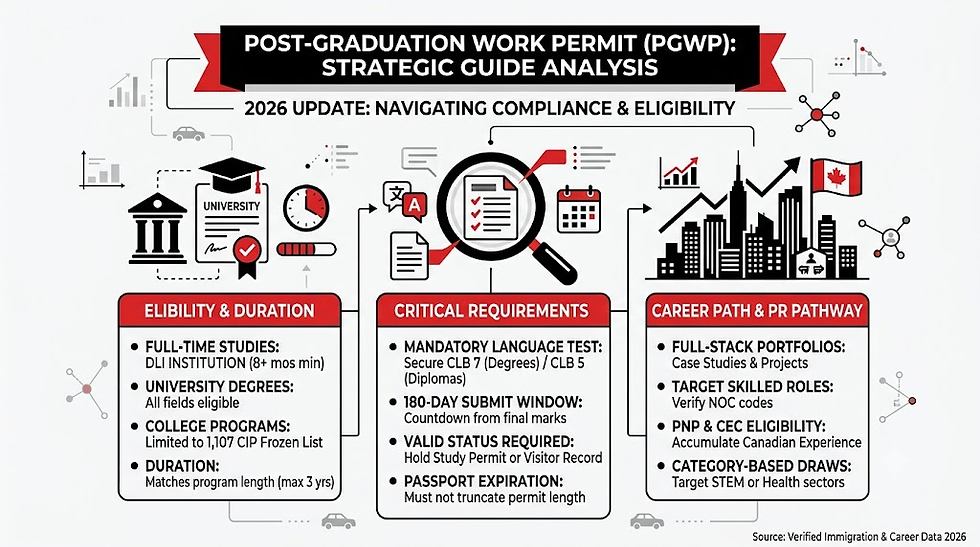
Securing a Post-Graduation Work Permit (PGWP) is often the defining milestone for international students looking to transition from academic life into the Canadian corporate workforce. As an open work permit, the PGWP offers the unique freedom to work for almost any employer, in any professional role, anywhere across Canada’s provinces. However, entering the workforce in 2026 requires a comprehensive approach to compliance. Sweeping policy overhauls executed by Immigration, Refugees and Citizenship Canada (IRCC) mean that securing an open work permit is no longer an automatic next step after graduation.
From strict language proficiency thresholds to structural freezes on eligible fields of study for non-degree certifications, the evaluation rules have transformed significantly. For students building highly specialized portfolios—such as full-stack applications like a Smart Medicine and Care Companion platform, green technology designs like solar-powered electronic cars, or robust relational architectures like a Student Attendance Management System—understanding the administrative roadmap is crucial.
This deep-dive strategic PGWP guide analysis delivers the concrete parameters, technical metrics, and procedural safeguards required to protect your post-study work authorization and build a secure pathway toward permanent residency.
1. The Core 2026 Regulatory Pillars: Language and Program Requirements
The modern PGWP evaluation engine relies on a strict dual-requirement framework. While the core foundations of the program remain intact—such as requiring full-time studies at an authorized Designated Learning Institution (DLI) for a minimum of eight months—new rules require applicants to carefully verify their specific program tier and language skills.
                  [THE 2026 PGWP COMPLIANCE ROADMAP]
                                  │
         ┌────────────────────────┴────────────────────────┐
         ▼                                                 ▼
 [UNIVERSITY DEGREE GRADS]                        [COLLEGE DIPLOMA GRADS]
 • Bachelor's, Master's, or PhD         • Advanced Diplomas & Certificates
 • Exempt from field-of-study list      • Must match frozen 1,107 CIP list
 • Language: Minimum CLB 7 baseline     • Language: Minimum CLB 5 baseline
 • Maximum 3-year permit window         • Directly tied to labor shortages
The In-Person Language Verification Mandate
A key change for recent graduates is the mandatory submission of an approved, in-person language test score (such as IELTS General Training, PTE Core, or CELPIP) directly with the work permit application.
University Degree Tiers: Graduates holding a formal university bachelor’s, master’s, or doctoral degree must prove a minimum of Canadian Language Benchmark (CLB) 7 across all four language abilities: Reading, Writing, Listening, and Speaking.
College and Non-University Tiers: Graduates finishing traditional college diplomas or advanced certificates must secure at least a CLB 5 across all four distinct categories.
Operational Portal Insight To avoid processing delays, pay close attention to the digital layout of the IRCC submission platform. The portal features a dedicated language-test data field designed specifically to capture your test results. Uploading expired results, failing to match the minimum score in even a single ability category, or leaving this field blank will result in an immediate application refusal.
The 2026 Field-of-Study Program Freeze
For students pursuing non-degree pathways, such as college diplomas or post-graduate certificates, eligibility depends entirely on their specific program classification. In a major regulatory decision, IRCC officially froze its active list of eligible educational fields for the duration of 2026.
The active list includes 1,107 eligible educational programs, classified by the Classification of Instructional Programs (CIP) system. These programs are strictly aligned with long-term labor shortages across six vital sectors:
Science, Technology, Engineering, and Math (STEM)
Healthcare and Social Services
Skilled Trades and Local Infrastructure
Transport Logistical Networks
Sustainable Agriculture
Education Systems
Crucially, university degree graduates remain fully exempt from these field-of-study lists. If you complete a formal university degree program, your field of study does not limit your permit eligibility, providing exceptional stability for long-term career planning.
2. Actionable Timeline Management: Protecting Your 180-Day Window
A key takeaway from this strategic PGWP guide analysis is that timing is everything. You have a strict 180-day moving window to submit your work permit application. This countdown begins the exact day your institution issues your final marks or formal graduation confirmation letter, not the day of your formal convocation ceremony.
[Final Marks Issued] ──► [180-Day Application Countdown] ──► [Submit Online in Canada]
                                                                      │
                                                                      ▼
[Full-Time Corporate Onboarding] ◄── [Authorized Implied Status] ◄────┘
The Transition Strategy
Maintain Your Legal Status: If your study permit is set to expire while you wait for your final university grades, you must take immediate action. You need to apply for a visitor record to remain in Canada legally, or leave the country and submit your application from abroad.
Leverage Implied Status: If you submit your online PGWP application from inside Canada while holding a valid, active study permit, you enter an authorized period called implied status. This legal cushion allows you to begin working full-time for your chosen company immediately while IRCC processes your permit, ensuring a smooth transition into the corporate world.
Avoid Flagpoling: IRCC has officially ended the practice of processing post-graduation work permits at border crossings. All applications must be submitted digitally via the online portal. Attempting to flagpole at the border can result in unnecessary delays and compliance issues.
3. Designing a Career Portfolio for Permanent Residency Success
Securing a work permit is an excellent milestone, but the ultimate goal for many graduates is transitioning to permanent residency (PR). Given the high Comprehensive Ranking System (CRS) scores required in the Express Entry pool, you must structure your work experience strategically.
┌────────────────────────────────────────────────────────┐
│               EXPRESS ENTRY CRS SCORE BOOST            │
├───────────────────────────────┬────────────────────────┤
│ Canadian Degree Bonus         │ Up to +30 CRS Points   │
│ 1-Year Continuous Skilled Work│ Up to +80 CRS Points   │
│ Target Language Level (CLB 9) │ Up to +124 CRS Points  │
│ Provincial Nomination (PNP)   │ Massive +600 CRS Points│
└────────────────────────────────────────────────────────┘
Building High-Value Technical Assets
In today's competitive job market, standing out to premium employers requires building a verifiable technical portfolio. Demonstrating practical, hands-on experience is key to landing coveted roles in high-demand fields:
System Integration Architecture: Building fully functional applications—such as an automated Smart Medicine and Care Companion platform or secure Health Camp Platforms—showcases your ability to gather requirements and develop secure, production-ready software.
Relational Database Design: Creating complete data systems, like a Student Attendance Management System backed by clean Entity-Relationship (ER) diagrams, proves you can manage and secure complex corporate data infrastructure.
Clean Technology Engineering: Developing detailed project documentation, such as structural calculations for a solar-powered electronic car, positions you perfectly for high-growth opportunities in the expanding green infrastructure sector.
Targeting Express Entry and Provincial Streams
Once you land a skilled role, focus on accumulating at least one year of continuous, full-time work experience. This milestone unlocks the federal Canadian Experience Class (CEC) pathway.
Additionally, align your career path with Category-Based Selection Draws (focusing on STEM or healthcare roles) or target Provincial Nominee Programs (PNP) tailored for local graduates. Securing a provincial nomination adds a massive 600 points to your Express Entry profile, virtually guaranteeing an Invitation to Apply (ITA) for permanent residency.
Technical Performance Matrix: 2026 PGWP Operational Standards
To help you keep track of these requirements, this detailed reference table outlines the essential criteria and rules you must follow when preparing your application.
Analytical Parameter | University Degree Framework | College Diploma Pathway | Critical Application Risks |
Field-of-Study Focus | Fully Exempt (All majors eligible) | Must match the frozen list of 1,107 CIP codes | Choosing an unaligned certificate leads to immediate permit denial. |
Language Benchmarks | CLB 7 across all four abilities | CLB 5 across all four abilities | Missing the score in even one category results in prompt rejection. |
Maximum Permit Length | Up to 3 Years (Master's programs included) | Matches program length (Up to 3 years for 2+ year programs) | Allowing your passport to expire early can truncate your permit length. |
Submission Channels | Online Portal Delivery Only | Online Portal Delivery Only | Flagpoling at land border crossings is permanently banned. |
Work Authorization | One-time lifetime permit window | One-time lifetime permit window | Dropping to part-time study status without approval voids eligibility. |
Strategic Planning Note "The absolute most common mistake graduates make is waiting until they receive their final grades to check their documentation. Successful integration into the Canadian workforce requires evaluating your passport validity, language tests, and employment strategy months before your final semester ends."— Global Mobility & Migration Analysis Group
FAQ Section
What is the purpose of this Strategic PGWP Guide Analysis?
This strategic PGWP guide analysis highlights that international graduates in 2026 must treat their post-study work applications as part of a careful, compliance-first roadmap. Applicants must secure valid language test scores, verify program eligibility against active CIP code lists, track their 180-day deadlines, and build professional networks to access hidden job markets.
Can I combine the lengths of two separate college diploma programs to get a longer work permit?
Yes, you can combine two eligible programs to secure a longer work permit, provided both individual programs are at least 8 months long, meet all DLI requirements, and align with active field-of-study rules. You must submit your application within 180 days of completing your final program and ensure you have not previously applied for a PGWP, as you only get one per lifetime.
Does my part-time student work experience count toward my Express Entry permanent residency application?
No. Skilled work experience gained while you are actively enrolled as a full-time student—including co-op placements, internships, or part-time off-campus jobs—does not count toward the one-year skilled work requirement for the federal Canadian Experience Class (CEC) stream. Your eligible experience begins accumulating only after you complete your program and enter valid full-time work status.
What should I do if my passport is set to expire during my post-graduation work permit window?
IRCC will not issue a work permit that outlasts the validity of your passport. If your passport is nearing its expiration date, it is highly recommended to renew it before submitting your final application to ensure you receive the maximum work permit length you are eligible for.
Connect with Official Canadian Resource Registries
Protecting your status and building a successful career requires relying entirely on verified government resources and official information hubs. Avoid unverified student forums or advice from unauthorized sources, and manage your transition through official channels:
To check official PGWP eligibility criteria, track current processing windows, and review language test rules, visit the Immigration, Refugees and Citizenship Canada (IRCC) Official Hub.
To check which programs qualify at verified institutions, review active Designated Learning Institution parameters, and verify CIP listings, explore the IRCC Designated Learning Institution Registry.
To track recent Express Entry draw scores, review category-based selection priorities, and calculate your CRS points, check out the IRCC Express Entry Selection Portal.
Structure Your Career Roadmap Today
Ready to turn these insights into a successful post-graduation journey? Don't leave your immigration deadlines or employment planning to the last minute.
Take a proactive step toward organizing your career path by reviewing the step-by-step submission tutorials, required documents checklists, and portal walkthroughs available on the IRCC Post-Graduation Work Permit Application Guide, and give yourself a clear advantage as you enter the Canadian workforce today!
For a complete visual walkthrough of the digital application process inside the online portal, check out this comprehensive PGWP Application Guide 2026 Tutorial Video. This video provides an excellent, detailed look at where to upload your language test results and how to complete the application forms accurately to prevent avoidable processing delays.


Comments