
Why the SAT Exam Is Important for Studying Abroad: A 2026 Guide
- h vasgare
- 4 days ago
- 5 min read


The landscape of international education is shifting rapidly. As we navigate the 2026 admissions cycle, many students are asking a critical question: "Is the SAT still relevant?" With the rise of "test-optional" policies during the pandemic, the global perception of standardized testing became slightly blurred. However, the data for 2026 tells a different, more nuanced story.
For students aspiring to study in the United States, the United Kingdom, Canada, Australia, or even top-tier Indian institutions, the importance of SAT exam scores has not diminished—in many ways, it has intensified. As universities return to more rigorous academic standards, the SAT has reclaimed its position as a vital tool for showcasing your potential on a global stage.
Understanding the Importance of SAT Exam in 2026
The SAT is no longer just an "entrance test." It is a standardized yardstick that allows admissions officers to compare apples to apples in a diverse, global applicant pool. Whether you are coming from a CBSE, ISC, State Board, IB, or A-Level curriculum, your high school grades are inherently subjective. An "A" in one school might not carry the same weight as an "A" in another.
The importance of SAT exam results lies in their ability to provide an objective, standardized metric that measures your college readiness in reading, writing, and mathematics. In 2026, as competition for top-tier universities continues to climb, having this objective data point can be the difference between an acceptance letter and a rejection.
The Return to "Test-Required" Policies
The most significant trend for 2026 is the reversal of the test-optional movement. Elite institutions, including Harvard, Yale, MIT, Dartmouth, and Brown, have officially reinstated or maintained mandatory SAT/ACT requirements. These universities have found that standardized test scores are powerful predictors of a student’s success in their first year of rigorous college-level coursework.
If you are aiming for the "Ivies" or other top-30 global institutions, submitting a strong score is no longer optional—it is a core requirement of your application.
Beyond Admissions: Why the SAT Matters
While admission is the primary goal, the SAT offers benefits that extend deep into your university experience and financial planning.
1. Unlocking Merit-Based Scholarships
For international students, the cost of studying abroad is often the largest hurdle. Did you know that your SAT score can act as a direct gateway to financial aid? Many universities, particularly in the U.S., use automated systems where specific SAT score ranges trigger automatic merit-based scholarships.
A high score—typically above 1300 or 1400—can distinguish you from thousands of other qualified candidates, potentially securing thousands of dollars in tuition waivers. Skipping the test to go "test-optional" might save you a few hours of study, but it could cost you a significant portion of your financial aid package.
2. Standardizing Your Academic Profile
If your high school GPA is slightly lower than your target university’s average, a strong SAT score provides an excellent "safety net." It serves as evidence that you possess the analytical and quantitative skills necessary to thrive in challenging academic environments, effectively compensating for any inconsistencies in your secondary school transcript.
3. Boosting Your Competitive Edge
Even at universities that remain "test-optional," submitting a score can significantly improve your chances. Admissions data from the 2025–26 cycle shows that students who submitted strong test scores were admitted at materially higher rates than those who did not. In an era where application numbers are reaching record highs, a 1450+ score acts as a "value-add" that captures an admissions officer's attention.
Navigating the Digital SAT Experience
The test you take in 2026 is vastly different from the versions of the past. The Digital SAT is fully adaptive, meaning the difficulty of the second module depends on your performance in the first.
Format: The test is held on the Bluebook™ app, is approximately 2 hours and 14 minutes long, and focuses on concise reading passages and integrated math problems.
Accessibility: With the transition to digital, the test is now more accessible than ever, allowing students to use their own devices or center-provided hardware.
Preparation: Because the test is adaptive, practicing with the official Bluebook app is critical. Understanding the pacing and the style of the questions is now more important than raw memorization.
Country | Importance of SAT | Typical Competitive Range |
USA | High (Often Required) | 1300–1550+ |
UK | Moderate/High (Contextual) | 1200–1400+ |
Canada | Moderate/High (Academic Context) | 1200–1400+ |
Australia | Moderate (Entry Equivalent) | 1200–1400+ |
Frequently Asked Questions (FAQ)
1. Is the importance of SAT exam still high for students applying in 2026?
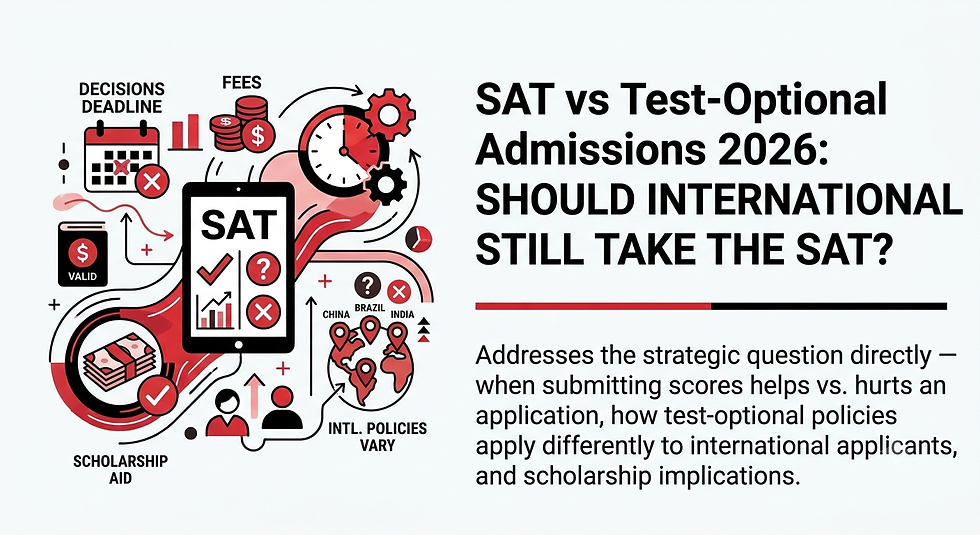
Yes. Despite the existence of "test-optional" policies, the importance of SAT exam scores has surged in 2026. Top universities are increasingly reinstating testing requirements, and for the remaining institutions, a high score remains one of the most effective ways to distinguish your application and qualify for merit-based scholarships.
2. Can I get into a top university without taking the SAT?
While it is technically possible to apply to some universities without an SAT score, your odds are statistically lower. Most competitive programs—especially in STEM and Economics—use the SAT to verify your academic readiness. Without it, your application carries less "objective" data, placing more pressure on your extracurriculars and essays to be perfect.
3. What is considered a "good" SAT score in 2026?
A "good" score is subjective based on your target university. However, to remain competitive for top-50 universities globally, a score in the 1400+ range is generally recommended. If you are aiming for the Ivy League or equivalent, you should target 1500+.
4. How do I prepare for the Digital SAT?
Start by downloading the official Bluebook app from the College Board. Use the practice tests to familiarize yourself with the adaptive format. Focus on mastering the "Evidence-Based Reading and Writing" and "Math" sections, and aim to complete your testing block early in your final year of high school.
Final Thoughts: Should You Take the Test?
The data is clear: for international students, the SAT is a strategic asset. It is an investment that provides an objective benchmark of your potential, helps you bypass the subjectivity of different international grading systems, and, most importantly, keeps your financial aid options open.
Do not let myths about "test-optional" policies deter you. In an increasingly competitive global education market, having a strong SAT score in your back pocket is the smartest move you can make for your future.
Start Your Journey Today
Ready to conquer the SAT and secure your spot at a world-class university? Take the first step by building your personalized study plan.
Download the Official Bluebook App – Start your practice journey.
Register for the SAT – Check the 2026 test dates and secure your center.
Explore Scholarship Opportunities – Learn how to leverage your future score for financial aid.
Need expert guidance on your study abroad application? Connect with our counselors to build a winning profile that goes beyond just test scores.



Comments