
When Should You Start Preparing for the SAT? A Grade-by-Grade Roadmap
- Diksha Bhapkar
- Jul 22
- 8 min read

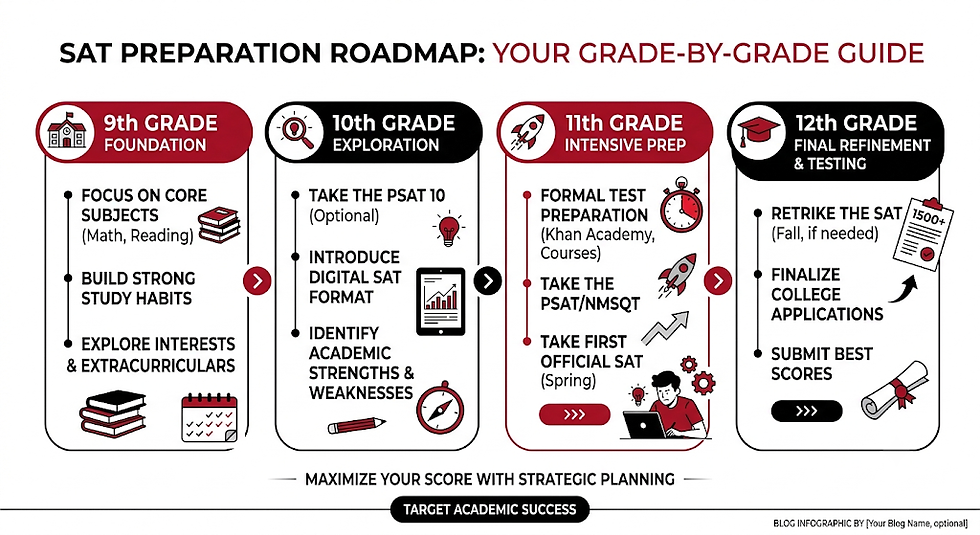
Choosing the exact moment to begin your standardized test preparation is one of the most consequential decisions you will make during your high school career. With higher education institutions continuing to reinstate standardized test requirements and elite universities heavily weighing test scores for merit-based financial aid, knowing when should you start preparing for the SAT can give you a decisive advantage in the college admissions landscape.
The modern Digital SAT features a streamlined structure, an adaptive testing model, a built-in graphing calculator, and a shorter overall testing window of two hours and fourteen minutes. While the updated format is generally more student-friendly, it penalizes last-minute cramming and rewards deliberate, long-term preparation. This comprehensive, grade-by-grade roadmap will guide you step by step through every stage of high school, ensuring you build an effective, low-stress strategy tailored to your score goals.
Understanding the Digital SAT Environment
Before determining your personal preparation schedule, it is essential to understand the specific test format you will face on exam day. The exam is administered entirely on digital devices through the official College Board Bluebook application and is divided into two main sections:
Reading and Writing: Consisting of two modules total, featuring 54 questions over 64 minutes. Passages are concise, ranging from 25 to 150 words, and cover topics across literature, science, history, and the humanities.
Math: Consisting of two modules total, featuring 44 questions over 70 minutes. The math section allows full calculator access throughout, including an integrated Desmos graphing utility.
Because the exam uses a computer-adaptive model, your performance on the first module of a section determines the difficulty level of the questions you receive in the second module. Achieving access to the higher-difficulty second module is mandatory if you wish to unlock upper-tier scores. Consequently, building foundational accuracy early in your study process is crucial.
When Should You Start Preparing for the SAT? The Grade-by-Grade Roadmap
8th and 9th Grade: Establishing Core Academic Foundations
For eighth graders and high school freshmen, launching into formal standardized test prep is almost always premature. Starting intensive drill sets or taking multiple full-length practice tests at this age frequently leads to burnout long before test scores actually matter for college applications.
However, your performance in ninth grade lays the academic groundwork for your future test performance. Rather than focusing on test mechanics, concentrate on building core academic skills:
Master Algebra I and Geometry Concepts: Math concepts account for half of your total composite SAT score. Focus on gaining a deep, conceptual understanding of linear equations, systems, functions, and fundamental geometric principles in your school classes.
Cultivate Active Reading Habits: The exam tests your ability to extract meaning, analyze arguments, and decipher vocabulary within short, dense passages. Reading high-level non-fiction publications, scientific reports, and classical literature for 15 to 20 minutes each day naturally improves reading speed and comprehension.
Complete the PSAT 8/9 if Offered: If your school offers the PSAT 8/9, take it without special preparation. Treat it purely as an informative baseline assessment to identify naturally strong areas and potential skill gaps.
At this stage, your best strategy is simply earning top marks in challenging core academic courses.
10th Grade: Developing Strategic Awareness and Establishing Baselines
Sophomore year serves as the bridge between general academic skill-building and intentional test awareness. This is the ideal time to assess where you stand without putting unnecessary pressure on your schedule.
Fall Semester: Focus on Classwork and PSAT 10
During the autumn of tenth grade, stay focused on your academic coursework, particularly Algebra II or Geometry. If your school offers the PSAT 10 in the spring or late winter, register for it. The PSAT 10 matches the exact formatting, timing, and digital interface of the actual SAT, offering an accurate snapshot of your starting capabilities.
Winter Semester: Take an Unassisted Diagnostic Exam
If you do not take the PSAT 10, download the official College Board Bluebook app and take a full-length, timed practice test at home. Complete this diagnostic test without using external resources, extra time, or outside assistance.
Spring and Summer: Analyze Results and Fill Core Gaps
Review your diagnostic score report in detail. Instead of focusing solely on your composite number, examine the breakdown of missed questions:
Are your errors stemming from unfamiliar math concepts, such as advanced trigonometry or quadratic functions?
Are you missing reading questions due to vocabulary limits or pacing issues?
Are you losing points on grammar rules, such as punctuation placement or subject-verb agreement?
If your baseline score sits more than 200 points below your target goal, use the summer between tenth and eleventh grade to dedicate one to two hours per week to targeted skill reviews.
11th Grade: The Primary Execution Window
Junior year is the primary operational period for SAT preparation. By eleventh grade, your math coursework in school aligns directly with the upper-level content tested on the exam, making your study efforts significantly more effective.
Junior Year SAT Execution Timeline

[September - October]  ---> Take official PSAT/NMSQT exam
[November - January]   ---> Begin 3 to 5 hours per week of structured preparation
[March or May]         ---> Take your 1st official SAT exam
[June - August]        ---> Review performance, target weak spots, prepare for retake
Phase 1: The PSAT/NMSQT (October)
Take the PSAT/NMSQT in October of your junior year. Unlike earlier practice tests, this specific test administration matters directly: top performers can qualify for National Merit Scholarship recognition, which brings significant prestige and potential financial aid opportunities.
Phase 2: Structured Preparation (November through February)
Beginning in late autumn, commit to three to five hours of structured study per week. Divide your time between content mastery and practical testing strategies:
Practice using the built-in Desmos calculator efficiently to solve complex systems and function problems quickly.
Learn specific timing benchmarks for both modules in Reading and Writing so you never run out of time on long passages.
Complete targeted drills on missed question types rather than taking continuous practice tests without review.
Phase 3: First Official Sitting (March or May)
Schedule your first official test sitting for March or May of your junior year. Taking the exam during the spring provides a genuine testing experience while leaving plenty of time to review your results and retake the exam if necessary.
Phase 4: Summer Refinement (June through August)
Once your score report arrives, evaluate your performance against your target benchmark. If you reached your goal, your testing journey is complete. If you fall short, spend six to eight weeks during the summer focusing specifically on the remaining error patterns identified in your score breakdown.
12th Grade: Final Polish and Strategic Retakes
By the time senior year arrives, your preparation should consist of minor adjustments and final retakes rather than building foundational knowledge from scratch.
Target August or October Test Dates: Sitting for the August or October test dates allows you to submit updated scores before Early Action and Early Decision deadlines in early November.
Utilize Superscoring Rules: A significant majority of colleges and universities utilize superscoring, meaning they combine your highest individual Reading/Writing score and Math score across different test dates to create your highest possible composite total. If your Math score is already high, you can tailor your final retake preparation almost exclusively toward boosting your Reading and Writing section.
Key Factors That Influence Your Personal Timeline
While the grade-by-grade roadmap provides a reliable blueprint, individual circumstances vary. Adjust your timeline according to these four critical factors:
The Gap Between Baseline and Target Scores: A student seeking a 50-point increase may only need four to six weeks of light practice. Conversely, a student aiming for a 200-point jump should plan for three to six months of regular, focused study.
Your Current Math Coursework: Because the exam features topics through Advanced Math and Algebra II, students who complete Algebra II in tenth grade can safely take the SAT earlier than students taking Algebra II in eleventh grade.
Your Rigor and Extracurricular Commitments: If your fall semester of junior year is packed with varsity sports, drama productions, or multiple Advanced Placement courses, shift your heavy preparation window to the winter or summer months when your schedule is clear.
College Application Deadlines: Students applying for early admission programs must wrap up all testing by October of senior year at the absolute latest, whereas regular decision applicants have until December or January.
Comparison of Common Test Preparation Strategies
Strategy Type | Ideal Starting Point | First Official Exam Date | Best Suited For |
Early Track | Summer before 10th grade | Spring of 10th grade or Fall of 11th grade | Students aiming for elite tier scores or early application commitments |
Standard Track | Summer before 11th grade | March of 11th grade | The majority of students balancing academics and extracurricular activities |
Compact Track | Winter of 11th grade | May or June of 11th grade | Students with heavy autumn commitments or strong initial baseline scores |
How to Build an Efficient SAT Study Schedule
Regardless of when you start, following a structured workflow yields the best results per hour invested:
Step One - Baseline Assessment: Complete one full adaptive practice test under strict time constraints using official digital software.
Step Two - Error Analysis: Categorize every missed question into one of three buckets: lack of content knowledge, pacing issue, or simple reading mistake.
Step Three - Targeted Skill Building: Spend 70 percent of your study time addressing specific content weaknesses before taking another full exam.
Step Four - Tool Mastery: Practice digital techniques, such as flagging questions for review, using shortcut functions on Desmos, and eliminating choices with digital strikethrough tools.
Step Five - Simulated Testing: Take a full practice test every two to three weeks to measure actual score growth and build mental stamina.
Frequently Asked Questions
1. When should you start preparing for the sat if you want a top score?
If you are aiming for a top-tier score such as a 1500 or higher, you should start preparing for the SAT during the spring of 10th grade or the summer before 11th grade. Starting early gives you a 6 to 9 month timeline to systematically eliminate skill gaps, master digital tools like Desmos, and comfortably sit for two or three official test dates without facing last-minute application stress.
2. Is 9th grade too early to start studying for the SAT?
Yes, formal test preparation in 9th grade is generally unnecessary and counterproductive. Ninth graders have not yet taken the necessary math courses, such as Algebra II, to cover the full range of test topics. Instead of drilling exam questions, 9th graders should focus on earning strong marks in high school classes and reading challenging non-fiction books to expand their vocabulary naturally.
3. How many total hours of study do most students need?
Most high school students see significant score improvements after completing 40 to 100 hours of focused study spread over 3 to 4 months. Consistent practice of 3 to 5 hours per week yields far better memory retention and skill development than cramming for 20 hours right before test day.
4. How does the Digital SAT format change when I should start prep?
The Digital SAT is shorter than the old paper version, lasting just 2 hours and 14 minutes, but its adaptive design requires precise accuracy on early modules. Because you must navigate digital features, embedded tools, and adaptive difficulty levels, you should start your prep at least 3 months before your exam date to become completely comfortable with testing on a screen.
5. Can I achieve a great score if I only have 1 month to prepare?
While 1 month is enough time to learn the exam format, review basic timing strategies, and take a couple of practice tests, it is rarely enough time to make major adjustments to your core content knowledge. A 1-month timeline works best for students whose baseline diagnostic score is already very close to their target goal.
6. What is the single best month to take the official exam for the first time?
March of junior year is widely considered the single best time for your first official exam attempt. Testing in March allows you to complete the fall semester of your junior year coursework while leaving the May, June, and August testing dates available for retakes before senior year deadlines arrive.
Take Control of Your College Admissions Journey
Understanding when should you start preparing for the SAT is the first step toward reaching your academic potential. By matching your preparation schedule to your personal goals, current course load, and grade level, you can approach test day with confidence and clarity.
Begin your testing journey today by taking advantage of official digital resources:
Download the official testing app and take free diagnostic tests at the official College Board Bluebook portal (https://bluebook.collegeboard.org/).
Access personalized video tutorials and practice skill drills through Khan Academy Official SAT Practice (https://www.khanacademy.org/sat).


Comments