
What Is a Good SAT Score in 2026? Complete Score Guide
- h vasgare
- Jul 14
- 6 min read

Navigating college admissions in 2026 requires a clear, data-backed understanding of standardized testing. With the complete rollout of the Digital SAT and major universities reinstating test-mandatory requirements, applicants must approach the SAT with a strategic target in mind.
Whether you are aiming for an Ivy League institution, looking for state university admission, or seeking high-value merit scholarships, knowing what constitutes a competitive score is essential. This guide covers national average benchmarks, percentile rankings, college tier score ranges, and actionable strategies to help you define and hit your ideal target score.
Defining a Good SAT Score in 2026
At its core, a good SAT score in 2026 is one that meets or exceeds the middle 50% score range of admitted students at your target colleges. Because every institution evaluates candidates differently, a score that guarantees competitiveness at one school might fall below the average at another.
To establish a clear baseline, consider these general score categories:
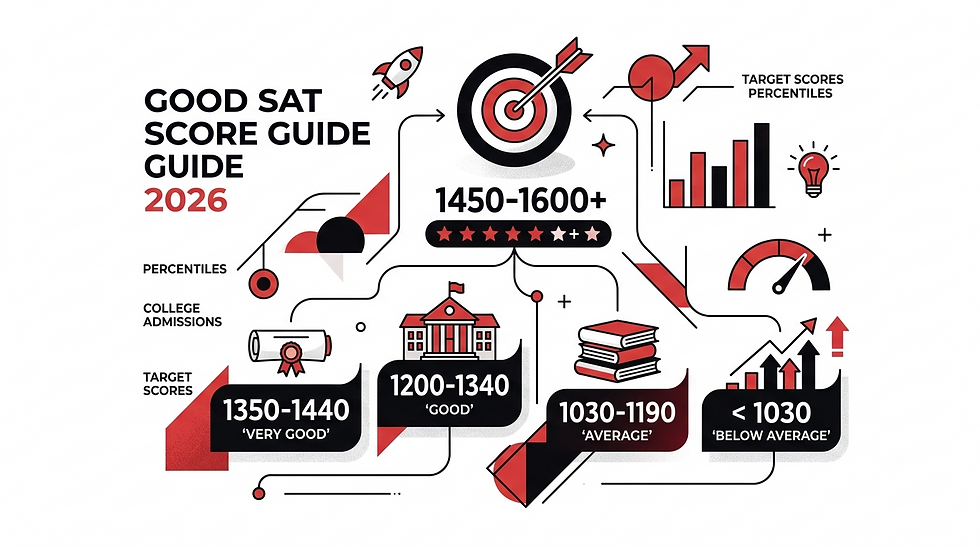
1450 – 1600 (Top 1% to 2%): Exceptional. Scores in this range place you in the highest percentile bracket globally and make you competitive at highly selective institutions, including Ivy League universities and top research institutes.
1350 – 1440 (Top 10%): Excellent. A score in this window significantly outperforms national averages and opens doors to top 50 national universities and selective public flagships.
1200 – 1340 (Top 25%): Good. Scoring above 1200 places you well above the national median, making you a strong candidate for a wide range of competitive four-year colleges.
1030 – 1190 (Average to Above Average): Solid. Scores around 1030 match the national median, making them suitable for many regional state universities and less selective four-year programs.
Below 1030: Below National Average. While still viable for open-enrollment or test-optional institutions, scores in this tier may limit scholarship opportunities and merit-based aid.
Understanding the Digital SAT Structure and Scoring Scale
The SAT is scored on a total scale of 400 to 1600 points, combining results from two core sections:
Reading and Writing (200 – 800 points)
Math (200 – 800 points)
In addition to section scores, the Digital SAT operates on a multistage adaptive testing format administered through the College Board’s official Bluebook application. Each section contains two modules. Your performance on the first module determines the difficulty level of the questions presented in the second module, directly impacting your upper scoring ceiling.
College Board Benchmark Indicators
The College Board sets official College and Career Readiness Benchmarks for each section:
Reading and Writing Benchmark: 480
Math Benchmark: 530
Achieving these benchmark scores indicates a 75% probability of earning a grade of C or higher in first-semester, credit-bearing college courses in related subjects.
2026 SAT Percentiles and Score Distribution
Percentiles show how your total score compares to the broader pool of high school test-takers nationwide. For example, placing in the 85th percentile means you scored equal to or higher than 85% of all students who took the test.
According to recent official College Board reporting data, the national average SAT composite score is 1029 (with section averages of 521 in Reading and Writing, and 508 in Math).
SAT Composite Score | Nationally Representative Percentile | Performance Tier |
1550 – 1600 | 99+ | Elite / Top 1% |
1450 – 1540 | 98 – 99 | Superior |
1350 – 1440 | 90 – 97 | Excellent |
1200 – 1340 | 75 – 89 | Above Average |
1030 – 1190 | 50 – 74 | Average |
900 – 1020 | 25 – 49 | Below Average |
800 – 890 | 10 – 24 | Low |
Key Insight: Scoring a 1350 or higher instantly places you in the top 10% of test-takers nationwide, positioning your application favorably across the majority of U.S. higher education institutions.
SAT Score Ranges for College Admissions Tiers
College admissions officers evaluate SAT scores within the context of their applicant pool. The most practical metric to evaluate when choosing target schools is the middle 50% range (the 25th percentile to the 75th percentile of admitted students).
Below the 25th percentile: The score may lower your admissions odds unless balanced by exceptional academic achievements, athletic recruitment, or unique extracurricular accomplishments.
Between 25th and 75th percentile: You fall squarely within the typical range for admitted students.
At or above the 75th percentile: Your score serves as an academic asset and strengthens your overall profile.
Score Expectations Across University Tiers
University Tier | Example Institutions | Typical 25th – 75th Percentile Range |
Tier 1: Highly Selective & Ivy League | Harvard, MIT, Stanford, Yale, Columbia, Princeton | 1500 – 1580 |
Tier 2: Top 50 National Universities | NYU, University of Michigan, Georgetown, UVA | 1380 – 1520 |
Tier 3: Competitive Public & Private Colleges | Penn State, Indiana University, Pitt, Ohio State | 1200 – 1420 |
Tier 4: Regional Public & State Colleges | Various Regional State Campuses | 1020 – 1220 |
Shift in Testing Policies for 2026
Understanding current standardized testing requirements is critical when planning your application pipeline. Following several years of widespread test-optional policies, multiple leading universities have reinstated mandatory test submission requirements for current admissions cycles.
Institutions that require standard test submissions include:
Massachusetts Institute of Technology (MIT)
Dartmouth College
Yale University
Brown University
California Institute of Technology (Caltech)
University of Texas at Austin
Purdue University
Georgetown University
For schools maintaining test-optional policies, submitting a score at or above the school’s median (50th percentile) remains a proven way to demonstrate academic rigor and boost admission probability.
How to Set Your Personal SAT Score Target
Setting a realistic and impactful target score requires a structured, multi-step approach rather than picking an arbitrary number.
Step 1: Create a Target School List
Compile a list of 8 to 12 universities categorized into reach, match, and safety schools.
Step 2: Research Middle 50% Score Data
Look up the published 25th and 75th percentile SAT scores for each school on your list. Record these figures in a centralized spreadsheet.
Step 3: Identify Your Benchmark Goal
Set your primary target score at or near the 75th percentile of your most selective "match" school. Hitting the 75th percentile maximizes your chances of admission and increases your eligibility for institutional merit scholarships.
Step 4: Take an Official Diagnostic Test
Download the Bluebook app from the College Board and complete a timed, full-length adaptive practice test under real exam conditions to establish your baseline score.
Step 5: Calculate Your Preparation Gap
Subtract your diagnostic score from your target score:
Gap of 50–100 points: Requires approximately 30–40 hours of focused study over 4–6 weeks.
Gap of 100–200 points: Requires approximately 60–80 hours of targeted practice over 2–3 months.
Gap of 200+ points: Requires 100+ hours of prep, structured instruction, and multiple practice test cycles over 3–5 months.
Strategies to Maximize Your SAT Score
To boost your score efficiently, implement these proven preparation techniques:
Master Digital Calculator Functionality: The Digital SAT features an embedded Desmos graphing calculator throughout the entire Math section. Familiarize yourself with keyboard shortcuts and graphic analysis techniques to solve complex algebraic and geometric problems quickly.
Focus on Error Analysis: Keep an error log documenting every missed question during practice sessions. Identify whether mistakes stem from content knowledge gaps, misreading prompts, or time pressure.
Utilize Superscoring to Your Advantage: The majority of colleges "superscore" the SAT, meaning they combine your highest Reading and Writing section score with your highest Math section score across all test dates to create your highest composite score. Plan to take the test 2 to 3 times to maximize your composite total.
Frequently Asked Questions (FAQ)
What is considered a good SAT score in 2026 for competitive colleges?
A good SAT score in 2026 for competitive four-year colleges generally falls between 1350 and 1500. For top 50 national universities, aiming for a score above 1400 ensures your application remains competitive within the applicant pool.
What is a good SAT score in 2026 for Ivy League admissions?
For Ivy League institutions such as Harvard, Yale, Princeton, and Columbia, a good SAT score in 2026 typically ranges between 1500 and 1580. Scoring at or above 1540 puts you in the upper half of admitted applicants for these highly selective programs.
Is 1200 a good SAT score in 2026?
Yes, a score of 1200 is considered a good score. It places you in approximately the 75th percentile globally, meaning you scored higher than 75% of all test-takers nationwide. A 1200 makes you a strong applicant at many public flagships and regional universities.
How many times should I take the test to earn a good SAT score in 2026?
Most students achieve their optimal score on their second or third attempt. Taking the exam 2 or 3 times allows you to build testing stamina, leverage superscoring policies, and address specific section weaknesses identified in earlier attempts.
Do good SAT scores qualify students for merit scholarships?
Yes. Many public and private universities automatically award merit-based tuition discounts and institutional scholarships based on combined GPA and SAT thresholds. High SAT scores can significantly reduce higher education costs.
Essential Resources and Next Steps
Achieving your target SAT score begins with accurate planning and official practice materials. Use the official College Board resources below to kickstart your preparation:
Register for upcoming test dates via the College Board SAT Registration Portal.
Download the official digital test application via the Bluebook App Download Page.
Explore score requirements and college profiles using College Board BigFuture.
Access full-length practice tests and scoring analytics through the SAT Suite of Assessments.


Comments