
UK's Political Landscape: What the Latest Leadership Changes Mean

The UK’s political landscape is experiencing a historic realignment. Less than two years after securing a landslide victory in the 2024 general election, Sir Keir Starmer announced his resignation as Prime Minister on June 22, 2026. Triggered by bruising local election defeats, deep cabinet anxieties, and historic by-election losses to upstart political factions, this sudden departure has plunged Westminster into a profound period of restructuring.
On July 17, 2026, the Labour Party declared Andy Burnham as its new leader following an expedited leadership election. With Burnham poised to officially take over as Prime Minister on July 20, 2026, the country stands on the precipice of a fundamentally different political, social, and economic trajectory.
From the rise of right-wing insurgencies to historic breakthroughs on the progressive left, this blog unpacks the current state of UK's political landscape, evaluates the key players reshaping the state, and analyzes what these leadership transformations mean for citizens, markets, and businesses moving forward.
The Catalyst for Change: Starmer’s Resignation and the Rise of Multi-Party Volatility
Sir Keir Starmer’s tenure began with an overwhelming parliamentary majority, but maintaining structural unity proved difficult amid fiscal constraints and shifting voter priorities. The defining catalyst for the leadership collapse came in mid-2026 following catastrophic local election outcomes and symbolic, back-to-back by-election losses that redrew the Westminster map.
The Runcorn and Helsby By-Election: In a historic shift, Reform UK won the seat after overturning a 14,696-vote Labour majority. The result was widely attributed to intense public dissatisfaction over key government policies, such as reductions in winter fuel payments.
The Gorton and Denton By-Election: In January 2026, the Green Party achieved its first-ever Westminster by-election victory. Green candidate Hannah Spencer defeated both Labour and high-profile Reform UK commentator Matt Goodwin, overturning another massive 13,413-vote Labour majority from 2024.
These structural cracks within typical Labour strongholds shifted public support away from the major parties. According to YouGov voting intention polls from July 2026, Reform UK led the national field at 24%, while the traditional giants—Labour and the Conservatives—slumped into a tie at just 19% each, followed closely by the Greens at 15%. This polling volatility made Starmer's position unsustainable, triggering the rapid transition toward a new administration.
Enter Andy Burnham: The "King of the North" Takes No. 10
Andy Burnham's ascendancy represents an institutional paradigm shift within the government. The former Mayor of Greater Manchester and newly elected MP for Makerfield achieved a commanding victory in the Labour leadership contest, positioning himself as a leader capable of uniting a fractured party.
               [Centralized Westminster Power]
                              │
               ▼ (Burnham's "Manchester Agenda")
  ┌───────────────────────────┼───────────────────────────┐
  ▼                           ▼                           ▼
Meaningful Devolution   Public Services Control     Regional Wealth Equity
Re-Engineering UK's Political Landscape through Devolution
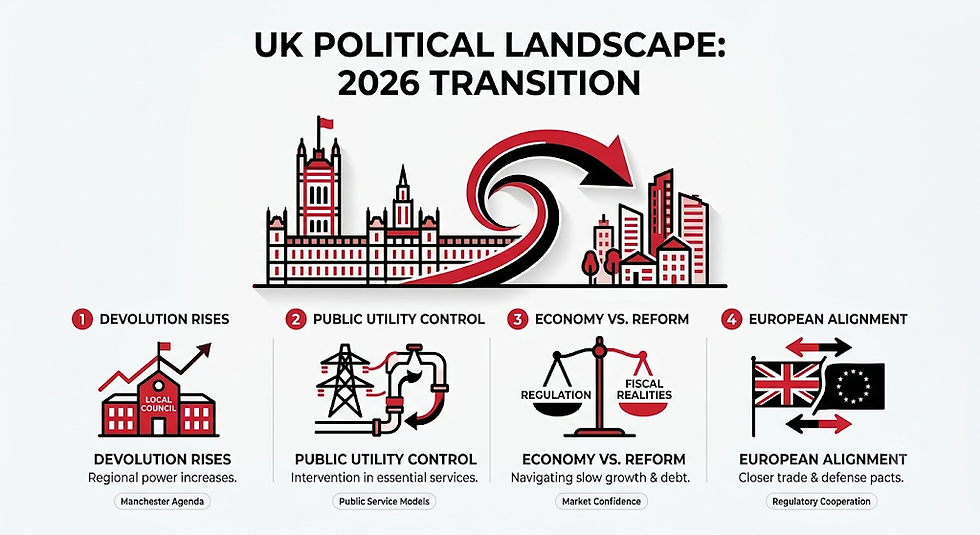
Known popularly as the "King of the North" during his mayoral tenure, Burnham’s primary governing thesis centers on structural decentralization. His core platform, frequently dubbed the "Manchester Agenda," seeks to systematically overhaul traditional Westminster power models by transferring substantial legislative and spending autonomy directly to city-regions and local councils.
Public Control over Infrastructure and Essential Services
Unlike his predecessor, Burnham operates with a more left-of-centre reputation regarding public services. He has explicitly signaled a desire to reassert public control and robust regulation over critical infrastructure sectors including domestic transport networks, affordable housing programs, municipal water systems, and local green energy grids.
Fiscal Realities vs. Expansive Ambitions
While Burnham enters Downing Street backed by MPs eager for expansive public funding, he faces restrictive economic realities: sluggish national growth, high public borrowing, and steep debt-servicing costs. To calm volatile financial markets, Burnham has committed to keeping Chancellor Rachel Reeves’s baseline fiscal frameworks.
However, with Shabana Mahmood positioned as a frontrunner for the Treasury, analysts anticipate that tax reforms—particularly targeted property or wealth restructuring—could be deployed to finance his local regeneration projects.
The Opposition Factor: Kemi Badenoch and the Divided Right
As the governing party recalibrates its policy direction, the official opposition remains deadlocked in an existential battle for the soul of the British right.
The Conservative Stance Under Kemi Badenoch
Serving as the Leader of the Opposition and head of the Conservative Party, Kemi Badenoch faces a dual challenge. She must hold the new Burnham administration accountable for expanding state regulation while simultaneously defending her party's right flank from a surging Reform UK faction. Badenoch’s focus on free-market economics and deregulation contrasts sharply with Burnham's interventionist, devolution-heavy governance model.
The Rising Threat of Reform UK
The structural shifts in the UK's political landscape are heavily driven by the polling strength of Reform UK. Having demonstrated an ability to win over disillusioned working-class voters in traditional industrial heartlands, the populist right presents a continuous electoral challenge to both major parties. Burnham has explicitly noted this dynamic, warning his party that they must deliver tangible structural updates rather than attempting to simply out-maneuver Reform on populist rhetoric.
International Relations: The European Union "Reset"
One of the most significant foreign policy shifts under a Burnham-led government will be the acceleration of the UK's diplomatic relationship with continental Europe.
Accelerated Dialogue: A staunch defender of European integration during the 2016 referendum, Burnham has stated a long-term hope to see the UK eventually rejoin the European Union.
Working Within Red Lines: While rejoining remains a long-term vision rather than an immediate plan, his administration is expected to work rapidly within Labour's established boundaries: no formal re-entry into the single market or customs union, and no formal reopening of the original Brexit text.
Structured Cooperation: Cross-border businesses should prepare for an accelerated push toward mutual regulatory recognition, closer defense pacts, and integrated security frameworks aimed at reducing friction for international trade.
What the Leadership Changes Mean for UK Businesses
The transition from Starmer to Burnham introduces distinct operational opportunities and compliance challenges across the private sector:
Regulatory Compliance and Corporate Governance
Firms operating within the UK should expect heightened supervisory scrutiny. The Burnham administration is anticipated to introduce rigorous standards regarding corporate governance, social equity benchmarks, and consumer outcomes. Sectors with weaker compliance histories will likely face closer oversight from bodies like the FCA and PRA.
Growth Sectors: Fintech, Housing, and Energy
Conversely, the explicit focus on simplifying institutional authorization processes could benefit fintech platforms, wholesale banks, and decentralized asset managers. Furthermore, Burnham’s plans to expand council and social housing infrastructure offer significant pipelines for commercial developers and domestic construction firms capable of aligning with regional development goals.
Frequently Asked Questions (FAQs)
Q1: Who is the current Prime Minister of the United Kingdom in 2026?
Following the resignation of Sir Keir Starmer in June 2026, the newly elected Labour leader Andy Burnham is scheduled to be officially appointed as Prime Minister on Monday, July 20, 2026.
Q2: How are the latest leadership changes transforming the UK's political landscape?
The latest changes have accelerated a transition toward a multi-party system. Sustained local gains by Reform UK and the Green Party have challenged the traditional Labour-Conservative duopoly, while Andy Burnham's "Manchester Agenda" aims to structurally decentralize power away from Westminster through regional devolution.
Q3: What is Andy Burnham’s economic strategy for the UK?
While Burnham has pledged to respect existing fiscal discipline to maintain market confidence, his broader approach leans toward increased public regulation of essential utilities, localized infrastructure funding, and potential structural tax reforms to support regional growth.
Q4: Will the UK rejoin the EU under the new leadership?
While Prime Minister-elect Andy Burnham has expressed a personal hope that the UK will rejoin the EU in the future, his immediate policy focuses on accelerating diplomatic relationships and regulatory alignment within strict boundaries: without rejoining the single market or customs union.
Stay Informed on UK Politics
As Westminster transitions into this new era under a new Prime Minister, staying ahead of fast-moving legislative changes is essential for businesses and citizens alike.
Review live legislative tracking and official announcements directly on the UK Parliament Website.
Monitor evolving public policy shifts and ministerial appointments via the official GOV.UK Portal.
Read independent, real-time polling data and electoral intention breakdowns on the YouGov UK Platform.


Comments