
Top Universities Accepting SAT Scores in 2026: Requirements, Ranges, and Strategy
- h vasgare
- Jul 14
- 7 min read

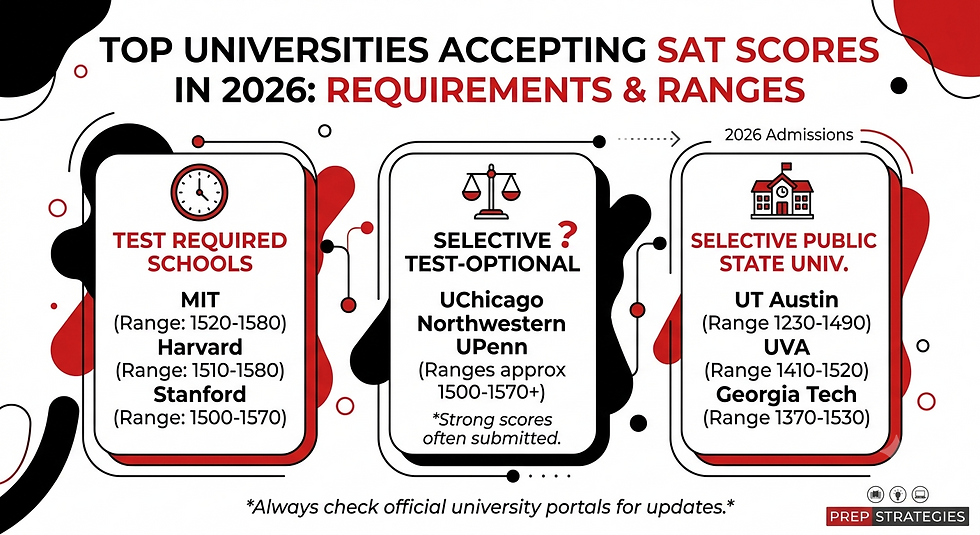
The higher education landscape has reached a pivotal turning point. Over the last two years, the era of universal "test-optional" admissions has rapidly drawn to a close among elite institutions. What began as a temporary measure during the pandemic has given way to rigorous data analysis: top higher education leaders have determined that standardized test scores remain one of the single most reliable predictors of undergraduate academic success.
As a result, major research universities, Ivy League institutions, and selective public flagships have reinstated mandatory SAT/ACT score submission for the 2026–2027 admissions cycle. Whether you are a high school junior mapping out your testing calendar or a senior finalizing your college list, understanding which schools require scores—and what score range you need—is critical to building a competitive application.
This comprehensive guide breaks down the top universities accepting SAT scores in 2026, details published 25th–75th percentile score ranges, and provides actionable admissions strategies to maximize your acceptance odds.
The Great Reversal: Why Top Colleges Brought Back the SAT in 2026
To understand today's testing requirements, it helps to review how admissions policy shifted so quickly. Following multi-year internal research studies conducted at institutions like Dartmouth, MIT, Harvard, and Brown, admissions committees discovered that high school GPAs alone were increasingly difficult to evaluate due to widespread grade inflation.
Researchers found that standardized test scores—particularly when evaluated within the context of a student's high school background—provided essential objective verification of academic readiness.
Key Takeaway from 2026 Admissions Data: Internal studies at elite universities revealed that SAT scores are more strongly correlated with first-year college GPA and graduation rates than high school GPA alone. Consequently, six of the eight Ivy League institutions now mandate standardized test submissions for the 2026 application cycle.
The shift back to testing is not limited to private ivies. Leading STEM powerhouses, mid-Atlantic flagships, and public university systems across states like Texas, Florida, and Georgia have reaffirmed or reinstated standardized testing requirements for 2026 entry.
Detailed Breakdown of Top Universities Accepting SAT Scores in 2026
Navigating individual institutional policies can feel overwhelming. Below is a categorized breakdown of major institutions, their official 2026 testing stance, and their reported middle 50% SAT ranges (25th to 75th percentile) among admitted students.
1. Test-Required Elite Institutions
These universities require all first-year applicants to submit official SAT or ACT scores. For these schools, test scores serve as an essential academic benchmark alongside your transcript.
University | 2026 Testing Policy | Middle 50% SAT Range |
Massachusetts Institute of Technology (MIT) | Test Required | 1520 – 1580 |
California Institute of Technology (Caltech) | Test Required | 1530 – 1570 |
Harvard University | Test Required | 1510 – 1580 |
Yale University | Test Required | 1500 – 1570 |
Stanford University | Test Required | 1500 – 1570 |
Brown University | Test Required | 1490 – 1560 |
Dartmouth College | Test Required | 1490 – 1560 |
University of Pennsylvania (UPenn) | Test Required | 1510 – 1570 |
Cornell University | Test Required | 1470 – 1550 |
Georgetown University | Test Required | 1400 – 1540 |
Johns Hopkins University | Test Required | 1530 – 1560 |
University of Texas at Austin (UT Austin) | Test Required | 1230 – 1490 |
Note: Yale previously operated under a "test-flexible" policy allowing AP or IB subject tests, but transitioned to requiring SAT or ACT scores for all Fall 2026 applicants onward.
2. Selective Test-Optional & Transitioning Universities
While the pendulum has swung toward test requirements at many top-tier schools, several world-class universities remain test-optional for the current cycle. However, applicants should note that even at test-optional institutions, the vast majority of admitted students voluntarily submit strong SAT scores.
University of Chicago: Test-Optional (Middle 50% SAT: 1510–1570)
Duke University: Test-Optional (Middle 50% SAT: 1510–1570)
Northwestern University: Test-Optional (Middle 50% SAT: 1510–1560)
Vanderbilt University: Test-Optional through Fall 2027 entry (Middle 50% SAT: 1510–1560)
Washington University in St. Louis: Test-Optional (Middle 50% SAT: 1500–1570)
Emory University: Test-Optional (Middle 50% SAT: 1480–1540)
Princeton University: Test-Optional for 2026 (Reinstating required testing for Fall 2028 entry; Middle 50% SAT: 1510–1570)
Columbia University: Test-Optional for 2026 (Reinstating required testing starting in the 2027–2028 cycle; Middle 50% SAT: 1510–1570)
3. Top Public Flagships & State Systems
Public universities offer some of the strongest academic programs globally. Testing policies across state flagships vary by regional legislation:
University of Michigan (Ann Arbor): Test-Optional (Middle 50% SAT: 1360–1530)
University of Virginia (UVA): Test-Optional (Middle 50% SAT: 1410–1520)
University of North Carolina at Chapel Hill: Test-Optional for state residents; scores recommended for out-of-state applicants (Middle 50% SAT: 1400–1530).
University of Florida & Florida State University: Test Required by state board policy (UF Middle 50% SAT: 1330–1470).
Georgia Institute of Technology & University of Georgia: Test Required by University System of Georgia policy (Georgia Tech Middle 50% SAT: 1370–1530).
What Score Do You Need? Target Ranges by Tier
When determining your target SAT score, it is essential to contextualize your performance within national percentiles and institutional tiers. The Digital SAT is scored on a 400 to 1600 scale, combining Evidence-Based Reading and Writing (EBRW) and Math sections.
  SAT Composite Score Scale & University Competitiveness (2026)
  +---------------------------------------------------------------+
  |  1520 - 1600  | Top 1% Global Percentile                      |
  |               | Ideal for Tier 1:Ivies, MIT, Caltech, Stanford|
  +---------------------------------------------------------------+
  |  1440 - 1510  | Top 5% Global Percentile                      |
  |               | Competitive for Top 20-30 Public & Private    |
  +---------------------------------------------------------------+
  |  1350 - 1430  | Top 10% Global Percentile                     |
  |               | Strong for Top 30-60 & Merit Scholarships     |
  +---------------------------------------------------------------+
Tier 1: Elite Universities (Top 1–20)
Target Score: 1520 – 1600
Percentile: Top 99th percentile
Strategic Nuance: For quantitative majors (Computer Science, Mechanical Engineering, Economics) at schools like MIT, Caltech, or Carnegie Mellon, an 800 or near-800 Math section score is virtually expected. A score of 1540 with an 800 Math section carries significantly more weight for engineering applicants than a 1540 with an even 770/770 split.
Tier 2: Highly Selective Universities (Top 20–50)
Target Score: 1400 – 1510
Percentile: Top 93rd to 98th percentile
Strategic Nuance: At this level, a score above 1450 makes you a strong academic candidate across both test-required and test-optional campuses. Scores in this range also unlock competitive honors colleges and
institutional merit awards.
Tier 3: Selective Regional & Flagship Public Universities
Target Score: 1250 – 1390
Percentile: Top 80th to 92nd percentile
Strategic Nuance: Scores in this bracket put applicants well within or above the middle 50% for state flagships such as Indiana University, University of Arizona, or Michigan State, often triggering automatic tuition discounts.
4 Crucial SAT Strategies for the 2026 Admissions Cycle
To ensure your test results strengthen your overall application, incorporate these strategic practices into your preparation and submission plans:
1. Master the Digital SAT Format
The Digital SAT is fully adaptive, delivered via the official College Board Bluebook application. Section 1 performance determines whether you receive an easier or harder Module 2 section. Because Module 2 in the harder path unlocks higher possible score ceilings, initial speed and accuracy in Module 1 are paramount. Practice using the built-in Desmos graphing calculator directly within Bluebook to save critical seconds during the Math modules.
2. Capitalize on SAT Superscoring
Nearly all private universities and a vast majority of public flagships policy-wise "superscore" the SAT. Superscoring means the admissions office combines your highest EBRW section score with your highest Math section score from different test dates to create your highest possible composite score.
Example: If you score a 710 EBRW and 760 Math (1470 total) in March, and an 750 EBRW and 730 Math (1480 total) in August, your official superscore is 1510 (750 + 760). Taking the exam 2 to 3 times gives you a statistical advantage.
3. Contextualize Score Submissions at Test-Optional Schools
If you are applying to a school that remains test-optional in 2026 (such as Duke or UChicago), evaluate whether to submit your score using the 50th Percentile Rule:
If your composite SAT score is at or above the school’s published median (50th percentile) for enrolled students, submit it.
If your score falls between the 25th and 50th percentile, consider your intended major and high school context. If your score is exceptionally high relative to your high school's average, submitting it provides strong positive evidence of achievement.
If your score falls below the 25th percentile, applying test-optional may be advantageous.
4. Leverage SAT Scores for Automatic Merit Aid
Beyond admission decisions, SAT scores play a key role in college affordability. Dozens of public universities maintain transparent merit scholarship grids. Hitting specific SAT thresholds (e.g., 1360+ or 1450+) can automatically qualify out-of-state and international students for $10,000 to full-tuition waivers annually.
Frequently Asked Questions (FAQ)
Do top universities accepting SAT scores prefer the SAT over the ACT?
No. Every single college and university in the United States treats the SAT and ACT with complete parity. Admissions officers convert scores using standard concordance tables. Choose the exam format that best aligns with your test-taking strengths.
Is a 1400 SAT score good enough for top universities accepting SAT scores?
A 1400 composite score places a student in the top 5% of test-takers globally. It is highly competitive for many top 30 to 60 universities, large state flagships, and liberal arts colleges. However, for hyper-selective institutions like Harvard, MIT, or Stanford, a 1400 falls below the 25th percentile of admitted students.
How do admissions officers view the Digital SAT compared to older paper versions?
Admissions committees treat Digital SAT scores identically to legacy paper scores. The 400–1600 scoring scale remains directly concordant, and universities do not discriminate based on whether a score was earned digitally or on paper.
Can international students submit SAT scores to top universities accepting SAT scores?
Yes. In fact, for international applicants applying to top universities accepting SAT scores, submitting a strong SAT score is often one of the best ways to validate high school marks across different national educational systems.
Ready to Elevate Your College Application Strategy?
Navigating changing testing policies and scoring requirements requires preparation and reliable resources. Start testing early, utilize official practice tools, and monitor policy updates directly on official university portals.
Practice with Official Digital Tests: Access free full-length adaptive SAT practice exams on the College Board Official Website.
Free Personalized SAT Prep: Build your skill mastery with official practice modules hosted by Khan Academy SAT Prep.
Manage Your College Applications: Track deadlines and testing requirements across hundreds of campuses through the Common Application Portal.


Comments