
The Most Overlooked Digital SAT Skills You Need to Score High in 2026
- Diksha Bhapkar
- Jul 30
- 7 min read

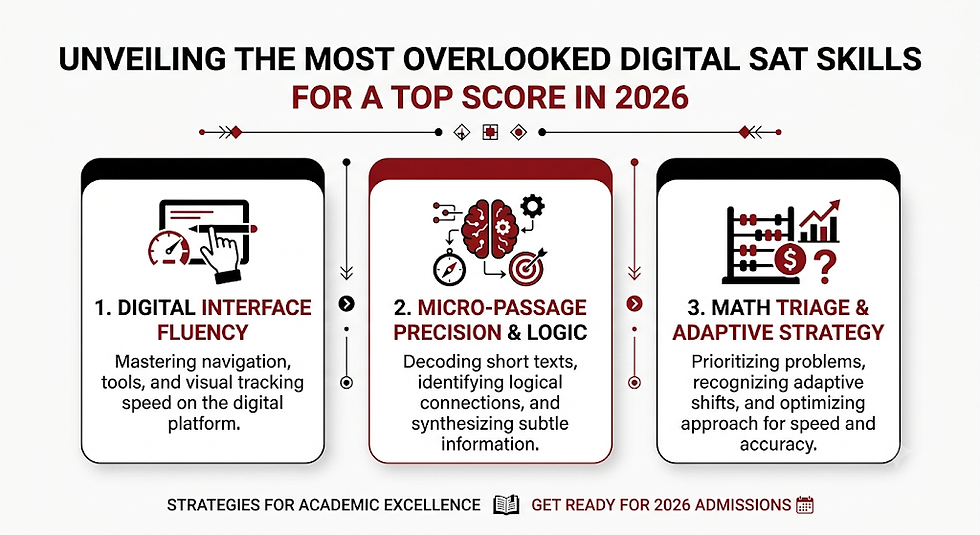
The landscape of college admissions has fundamentally shifted. With major research institutions and Ivy League universities reinstating mandatory standardized testing requirements, the pressure on high school students to achieve elite scores on the Digital SAT (DSAT) has never been higher. However, as the digital test model matures, a striking trend has emerged: traditional test-prep strategies built for the legacy paper exam are no longer enough to break into the 1400–1600 score range.
The Digital SAT is not simply a paper test displayed on a screen—it is an entirely distinct, adaptive testing ecosystem with its own unique behavioral and cognitive demands. While most test-takers focus heavily on memorizing algebraic formulas and standard grammar rules, the top 1% of scorers differentiate themselves by cultivating specific, non-obvious competencies.
In this comprehensive guide, we unpack the most overlooked Digital SAT skills that students need to master to optimize their scoring potential, streamline their pacing, and approach test day with complete confidence.
1. Multistage Adaptive Mechanics and Module Triage
The most critical structural element of the Digital SAT is its multistage computer-adaptive testing (CAT) architecture. The exam is split into two main sections—Reading & Writing and Math—and each section contains two separately timed modules.
                                [ Start Exam ]
                                      │
                     ┌────────────────┴────────────────┐
                     ▼                                 ▼
             [ Reading & Writing ]                        [ Math ]
             Module 1 (27 Qs / 32 min)                Module 1 (22 Qs / 35 min)
                     │                                 │
          ┌──────────┴──────────┐           ┌──────────┴──────────┐
          ▼                     ▼           ▼                     ▼
     Module 2: Hard       Module 2: Easy   Module 2: Hard       Module 2: Easy
     (Max score 800)      (Score capped)   (Max score 800)      (Score capped)
Your performance in Module 1 acts as a scoring gateway: it determines whether you are routed to an easier or harder version of Module 2.
The Hidden Penalty of Early Mistakes
Many students treat Module 1 casually, assuming they can make up for lost ground later. In reality, falling into the "Easier" Module 2 places an automatic mathematical ceiling on your maximum possible score—often capping that section at roughly 590 to 620 regardless of how many questions you answer correctly in the second module.
Key Takeaway: Scoring high requires treating Module 1 as a non-negotiable priority. A single careless mistake in Module 1 hurts your overall score far more than a difficult question missed in a hard Module 2.
Strategic Pacing and Time Triage
Because each question within a single module carries the same weight, sitting stuck on a single dense question for three minutes is a tactical error. Top scorers practice strategic triage:
The 60-Second Rule: If a solution path is not clear within 45 to 60 seconds, make an educated guess, flag the question using the Bluebook navigation bar, and move forward immediately.
Protecting Easy Points: Ensure you view and answer every straightforward question in the module before returning to time-consuming flagged items.
2. Advanced Desmos Mastery Beyond Simple Arithmetic
The introduction of the built-in Desmos Graphing Calculator across the entire Math section is one of the most transformative updates to the SAT. However, simply knowing how to multiply or plot basic lines is not enough. The real competitive advantage lies in utilizing Desmos as a graphical solver to bypass lengthy algebraic derivations entirely.
                     Paper SAT (Legacy)          Digital SAT (2026)
                  ┌───────────────────────┐   ┌───────────────────────┐
  Time/Question   │ ~75-90 seconds        │   │ ~30-45 seconds        │
                  │ (Manual algebra)      │   │(Desmos visual solving)│
                  └───────────────────────┘   └───────────────────────┘
Advanced Graphical Problem-Solving Techniques
High-scoring students leverage advanced Desmos features to solve complex problems in seconds:
Finding Systems of Equations Solutions: Instead of solving systems manually via elimination or substitution, graphing both functions and clicking their point of intersection yields exact x and y values instantaneously.
Evaluating Roots and Quadratic Features: Vertex coordinates, minimum/maximum points, y-intercepts, and x-intercepts (zeros) can be identified visually without applying the quadratic formula or completing the square.
Slider Functionality for Constants: When dealing with equations containing unknown constants (e.g., ax2+bx+c=0 with a specific number of real solutions), creating a slider for the parameter allows you to visually determine the precise threshold values that satisfy the condition.
Regression Analysis for Table Data: By typing given data points into a Desmos matrix table and running linear or quadratic regression equations (such as y1∼mx1+b), students can extract exact model formulas without performing algebraic calculations.
Recognizing when not to do algebra manually is one of the most effective overlooked Digital SAT skills for maximizing speed and accuracy under tight time constraints.
3. Essential Overlooked Digital SAT Skills for Reading & Writing
The Digital SAT Reading and Writing section replaced long, multi-question passages with short, single-question micro-passages (25 to 150 words). While this reduces reading fatigue, it drastically increases the demand for micro-text precision.
   [ Traditional SAT Passage ]               [ Digital SAT Micro-Passage ]
   ┌─────────────────────────────┐       ┌─────────────────────────────┐
   │ 700+ Words                  │       │ 25-150 Words                │
   │ 10-11 Questions             │   VS  │ 1 Single Question           │
   │ High stamina, macro-mapping │       │ High precision, micro-focus │
  └─────────────────────────────┘        └─────────────────────────────┘
Micro-Passage Pivot Word Tracking
In a 50-word paragraph, every word carries substantial weight. A single transition or pivot word can completely invert the logical direction of an argument. High scorers train their eyes to instantly spot structural turnarounds, such as:
Concessive/Adversative: "granted," "notwithstanding," "nevertheless," "despite this".
Causal/Explanatory: "fittingly," "consequently," "insofar as," "thereby."
Missing a subtle pivot word like "granted" or "fittingly" is the primary reason capable students fall for attractive distractor choices.
Rhetorical Synthesis and Bullet-Point Filtering
Rhetorical Synthesis questions present a series of factual bullet points and ask you to select the sentence that best achieves a specific goal (e.g., "The student wants to emphasize a difference between the two species").
Unprepared students spend valuable time reading and analyzing all the bullet points in detail. Top test-takers use a streamlined approach:
Read the Prompt Goal First: Ignore the bullet points initially and focus strictly on the prompt's explicit requirement.
Evaluate the Options Directly: Test each answer choice against that specific goal. The correct choice is the one that fulfills the task directly without adding unrequested details.
Verify Facts Only if Needed: Use the bullet points merely to double-check factual details, saving up to 30 seconds per question.
4. Digital Interface Fluency and Screen Stamina
Navigating a standardized test on a laptop or tablet requires a different set of visual and cognitive habits compared to paper testing.
┌────────────────────────────────────────────────────────────────────────┐
│ Bluebook™ Interface Strategy                                           │
├───────────────────────────────┬────────────────────────────────────────┤
│ Built-in Highlighting Tool   │ Use sparingly for core claims/pivots    │
├───────────────────────────────┼────────────────────────────────────────┤
│ Option Elimination (Crossout)│ Instantly eliminate 2 wrong options     │
├───────────────────────────────┼────────────────────────────────────────┤
│ Question Flagging            │ Tag immediately if stuck > 45 seconds   │
├───────────────────────────────┼────────────────────────────────────────┤
│ Scratch Paper Sync           │ Label paper by Question # systematically│
└───────────────────────────────┴────────────────────────────────────────┘
Avoiding Screen Fatigue and Visual Tracking Errors
Reading dense academic text on a backlit monitor can lead to visual fatigue, causing students to misread numbers or skip key words in choices.
Screen Practice: Ensure at least 80% of your practice tests and drills are completed digitally on the exact device type you plan to use on test day.
Digital Annotations: Master the built-in highlighting and strikethrough tools in the Bluebook app to maintain active focus while reading.
Structured Scratch Paper Management
Even though the exam is digital, physical scratch paper remains essential. Disorganized scratch work leads to careless arithmetic slips and sign errors. Establish a clean grid system on your scratch paper by dividing each sheet into numbered quadrants for every question. If you flag a question to revisit later, your previous steps will be clear, organized, and ready for review.
5. High-Precision Error Triage for a 98-Question Exam
In the legacy paper SAT, students answered 154 questions. The Digital SAT features only 98 total operational questions across both sections.
                     Question Count Comparison
    ┌────────────────────────────────────────────────────────┐
    │ Paper SAT: 154 Questions                               │
    ├────────────────────────────────────────────────────────┤
    │ Digital SAT: 98 Questions (Each question carries ~1.5x weight) │
    └────────────────────────────────────────────────────────┘
Because the question pool is smaller, each mistake carries significantly more weight in the final scaled score calculation. Achieving a high score requires minimizing avoidable, careless errors.
Building a Digital Error Log
To eliminate recurring mistakes, maintain a detailed digital error tracking log throughout your preparation. Group every incorrect response into one of three core categories:
Error Category | Root Cause | Corrective Action |
Conceptual Gap | Unfamiliarity with the underlying mathematical concept or grammar rule. | Study the foundational rule and complete focused topic drills. |
Procedural Misstep | Correct concept, but algebraic or computational error made along the way. | Slow down execution and verify steps using graphical tools like Desmos. |
Misread Prompt | Solved for x instead of 2x+5, or missed a negative qualifier. | Highlight the final question prompt target before calculating. |
6. Comprehensive 2026 Digital SAT Structure and Data
To put these strategies into context, review the breakdown of the exam's timing, module distribution, and question weight:
Section | Modules | Questions per Module | Total Questions | Time Allocation | Score Range |
Reading & Writing | 2 Modules | 27 Questions | 54 Questions | 64 Minutes (32 min/module) | 200–800 |
Break | — | — | — | 10 Minutes | — |
Math | 2 Modules | 22 Questions | 44 Questions | 70 Minutes (35 min/module) | 200–800 |
Total | 4 Modules | — | 98 Questions | 134 Minutes (2h 14m) | 400–1600 |
7. Frequently Asked Questions (FAQ)
What are the most overlooked Digital SAT skills that students miss during preparation?
The most overlooked Digital SAT skills include advanced Desmos graphing techniques for fast problem-solving, micro-passage pivot word tracking in Reading & Writing, and Module 1 time triage. Additionally, managing screen fatigue and organizing physical scratch paper are crucial skills that impact overall performance on test day.
Is the Digital SAT easier or harder than the paper SAT?
The Digital SAT feels shorter and less tiring because it is completed in 2 hours and 14 minutes rather than over 3 hours. However, it is not necessarily easier. Because there are fewer total questions (98 operational questions), each individual error has a larger impact on your final scaled score.
How does the adaptive scoring system work on the Digital SAT?
The exam uses a multistage adaptive model. Performance in Module 1 determines the difficulty level of Module 2. Scoring well in Module 1 routes you to a harder Module 2, unlocking access to the top score range (up to 800). An easier Module 2 caps your score potential, making Module 1 accuracy essential for high scores.
Can I use the Desmos calculator for every question on the Math section?
Yes, the built-in Desmos graphing calculator is available throughout the entire Math section on both modules. Learning how to plot lines, find intersections, evaluate vertex points, and run regressions can help you solve complex math problems quickly without lengthy algebraic work.
How can I practice to improve my digital testing stamina?
To build screen stamina, take full-length adaptive practice tests inside the official College Board Bluebook App under simulated test conditions. Practice active reading using the app's highlighting and answer-elimination tools to maintain focus throughout the exam.
Master the Digital SAT with Confidence
Scoring in the top percentile on the Digital SAT requires more than just standard subject knowledge—it demands mastering the specific digital tools, pacing strategies, and micro-skills unique to this exam format. By focusing on Module 1 accuracy, leveraging Desmos efficiently, and building structured screen habits, you can maximize your scoring potential on test day.
Take the Next Step in Your Prep
Ready to refine your strategy and build test-day readiness? Explore these official resources to start practicing today:
Download the official College Board Bluebook Practice Application to take authentic adaptive practice exams.
Access free, personalized practice pathways and skill-building modules at Khan Academy Digital SAT Prep.
Review comprehensive test dates, registration details, and testing policies on the College Board Official SAT Portal.


Comments