
The Connected German Home: Why Smart Home Technology Is Booming in Germany
- Akshada Naik
- Jul 7
- 6 min read

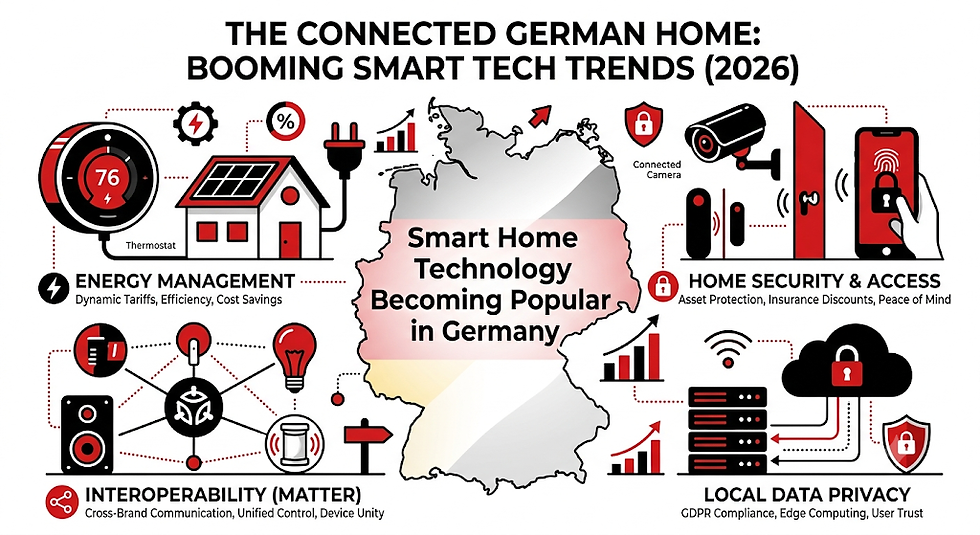
The traditional German concept of Gemütlichkeit—a sense of comfort, warmth, and coziness within the household—is getting a massive digital upgrade. Across Berlin, Munich, Frankfurt, and beyond, a quiet revolution is taking place behind residential brick-and-forth facades.
As we progress through 2026, the adoption of residential IoT has shifted from a niche hobby for tech enthusiasts into a mainstream societal shift. Driven by economic volatility, an urgent need for energy conservation, and rapid advancements in cross-brand device interoperability, German consumers are rewiring their properties at an unprecedented rate.
But what exactly is causing this acceleration, and which specific technologies are capturing the market? In this extensive 2026 analysis, we explore how smart home technology is becoming popular in Germany, looking into market data, legislative triggers, consumer behavior, and structural roadblocks.
The Scale of the Shift: Germany’s Smart Home Market in 2026
Germany has firmly established itself as one of the most mature and revenue-generating smart home markets in Europe. According to data from Mordor Intelligence and NextMSC, the German smart home industry is valued at an astonishing $8.54 billion in 2026. Experts project that this figure will march toward $12.91 billion by 2031, maintaining an impressive Compound Annual Growth Rate (CAGR) of 8.62%.
What makes Germany's growth trajectory unique is the composition of consumer spending. While global markets often see growth driven by entertainment gadgets like smart displays or robotic kitchen toys, the German market focuses on practical utility, long-term engineering value, and structural sustainability.
3 Core Drivers: Why Smart Home Technology Is Becoming Popular in Germany
The surge in connected hardware across German properties is not an accidental trend. It is the direct consequence of three powerful macroeconomic and social forces converging simultaneously.
1. The Dynamic Energy Market and the New Utility Mandates
Following the localized disruptions in the energy sector triggered by geopolitical volatility, energy pricing in Germany remains highly sensitive. To combat this, the German government instituted a nationwide dynamic utility pricing mandate.
This policy requires domestic energy providers to offer flexible, time-of-use tariffs to households equipped with smart meters. Consequently, electricity costs fluctuate throughout the day based on wholesale grid availability and renewable output.
German homeowners are turning to Home Energy Management Systems (HEMS) to balance these costs. These smart hubs automatically communicate with power grids, scheduling heavy electrical tasks—such as charging electric vehicles or cycling heat pumps—during low-demand hours when prices plunge, saving families hundreds of Euros annually.
2. Regulatory Alignment with Net-Zero 2045 Goals
Germany's strict Climate Law targets complete greenhouse gas neutrality by 2045. To meet these milestones, national building codes like the Building Energy Act (Gebäudeenergiegesetz - GEG) require substantial increases in the energy efficiency of residential infrastructure.
Whether executing complex structural retrofits on historic buildings or constructing new KfW-Effizienzhaus properties, the inclusion of intelligent environmental hardware is increasingly viewed by property owners as a matter of legal compliance rather than luxury.
3. The "Matter" Protocol Revolutionizes Interoperability
Historically, German consumers shied away from smart devices due to fragmentation fears. No one wanted to invest in an expensive ecosystem only to discover a smart thermostat could not communicate with a smart window sensor from a rival manufacturer.
The rapid maturation of the universal open-source connectivity standard Matter (utilizing Thread and Wi-Fi channels) has completely resolved this issue. By ensuring seamless, local, and secure communication among devices built by Bosch, Siemens, Apple, Google, and Amazon alike, Matter has removed major friction points from the consumer purchasing journey.
Market Segment Breakdown: Where the Investments Are Going
To fully understand how smart home technology is becoming popular in Germany, it helps to review exactly where households are allocating their capital.
Smart Home Segment | 2025/2026 Market Share / Growth Metric | Primary Consumer Value Proposition | Key Hardware Examples |
Smart Energy Management | Fastest Growing Segment (13.78% CAGR) | Financial mitigation of volatile grid utility tariffs; automated load-shifting. | Smart Thermostats, Heat-Pump Controllers, PV Inverters, HEMS |
Security & Access Control | Largest Total Revenue Share (26.65%) | Asset protection, integrated burglary prevention, home insurance discounts. | Connected Cameras, Window/Door Sensors, Smart Biometric Locks |
Smart Large Appliances | Steady Infrastructure Anchor | Operational longevity, remote maintenance tracking, automation of chores. | Smart Washing Machines, Connected Refrigerators, Dishwashers |
Connectivity & Infrastructure | Foundation Layer (Wi-Fi at 43.35% Share) | Low-latency local edge computing, device interoperability, data transmission. | Smart Routers, Power Line Communication (PLC) Modules, Matter Hubs |
Energy Management Takes the Lead
As highlighted in the data table, energy-management hardware is expanding at a rapid clip. Modern German installations go beyond standalone smart radiator valves. Homeowners are deploying fully integrated systems where rooftop solar photovoltaic (PV) arrays, local battery storage packs, and modern air-source heat pumps function as a synchronized ecosystem.
Security Dominates Revenue
Home security remains an anchor for the retail market, accounting for over a quarter of total revenue. Interestingly, this growth is supported by the German insurance sector. Several major domestic insurers now award measurable premium discounts to policyholders who verify the deployment of accredited, professionally installed water leak detectors, smoke alarms, and tamper-proof smart locks.
Cultural Nuances: The German Approach to Smart Tech
International tech giants quickly realize that marketing smart devices in Germany requires a different playbook compared to North America or Asian tech hubs. The typical German buyer evaluates connected hardware through a distinct cultural lens:
Data Privacy First (Datenschutz): Germany possesses some of the strictest individual privacy standards in the world, heavily influenced by GDPR frameworks. Devices that rely completely on continuous cloud processing or demand unnecessary personal data are met with skepticism. This has created a massive local market preference for smart hubs that process and store information locally on the edge, keeping personal data within the home.
Systems Over Standalone Gadgets: Instead of scattered, novelty plug-and-play accessories, German buyers favor robust, professional system-level integration. This preference aligns with Germany's engineering history, prioritizing reliability, technical certification, and flawless system communication.
The DIY Shift Due to Labor Shortages: Germany faces a deficit of over 96,000 positions in electrical and construction trades. Because booking a professional electrician can take months, manufacturers who build high-quality, installer-free, DIY-friendly smart hardware with video guides are winning market share.
Overcoming Obstacles: What's Restricting Faster Adoption?
Despite strong market gains, the widespread rollout of home automation faces a few structural hurdles:
The Renters' Dilemma (Mieterland)
Germany is fundamentally a nation of renters. Over 50% of the population lives in rented flats or apartments, rising above 80% in major metropolitan centers like Berlin. Because tenants cannot legally alter fundamental building wiring, plumbing, or heating plants without landlord authorization, a massive portion of the population is restricted to temporary, non-permanent retrofits like smart light bulbs, plug-in adapters, and screw-on radiator heads.
The Historic Housing Stock
A large percentage of German residential buildings were constructed prior to 1980. These structures feature dense masonry walls that degrade high-frequency wireless signals. To counter this, local networks rely heavily on a combination of robust Wi-Fi networks and Broadband Power Line Communication (PLC) systems that transmit network data directly through an apartment's existing copper power cables.
FAQ: Understanding Home Automation Trends
Q1.Why is smart home technology becoming popular in Germany so rapidly in 2026?
The rapid rise of smart home tech across Germany is primarily driven by economic incentives and utility regulations. With the nationwide implementation of dynamic electricity tariffs, households use automated systems to save money by running appliances when rates are low. This financial benefit, combined with strict federal carbon reduction laws and the introduction of the user-friendly Matter standard, has accelerated mainstream consumer adoption.
Q2.Do smart homes provide protection against burglaries in Germany?
Yes. Smart security setups featuring door-window contact sensors, motion detectors, and local video cameras act as excellent crime deterrents. Furthermore, multiple German home insurance companies offer premium reductions to properties fitted with certified connected security equipment.
Q3.Can tenants living in rented apartments utilize smart home systems?
Absolutely. While German tenants cannot modify in-wall electrical infrastructure, they heavily adopt modular, tenant-friendly smart options. Devices like plug-in smart sockets, wireless light switches, and non-permanent smart radiator valves can be easily uninstalled and moved to a new apartment at the end of a lease.
Q4.How does the Matter standard affect device privacy?
The Matter protocol supports localized edge computing. This means your smart devices can communicate directly with one another over your home network without needing an active internet connection or sending data to external cloud servers, aligning perfectly with privacy-conscious consumer requirements.
The Verdict: A Sustainable Digital Horizon
As Germany navigates the energy realities of 2026, the smart home has evolved from a luxury statement into a key tool for financial stability and ecological responsibility. By combining strict data privacy standards with a clear focus on energy optimization, German consumers are showing how modern technology can make homes more sustainable and efficient.
Optimize and Protect Your Household Today
Are you ready to integrate smart technology into your property or want to stay ahead of Europe’s evolving clean energy standards? Check out these trusted resources to begin your home automation journey:
Explore German Energy Rebates: Review federal financial support programs for energy-efficient retrofits at the KfW Banking Group Portal.
Discover Certified Matter Hardware: Browse the official list of verified cross-brand interoperable devices via the Connectivity Standards Alliance.
Track Local Market Innovations: Stay informed on Germany's engineering, automation, and manufacturing trends through Bosch Smart Home Solutions.



Comments