
Smart Manufacturing Programs Canada: 2026 Industry Analysis & Funding Guide
- shraddhagolecs
- Jul 22
- 6 min read

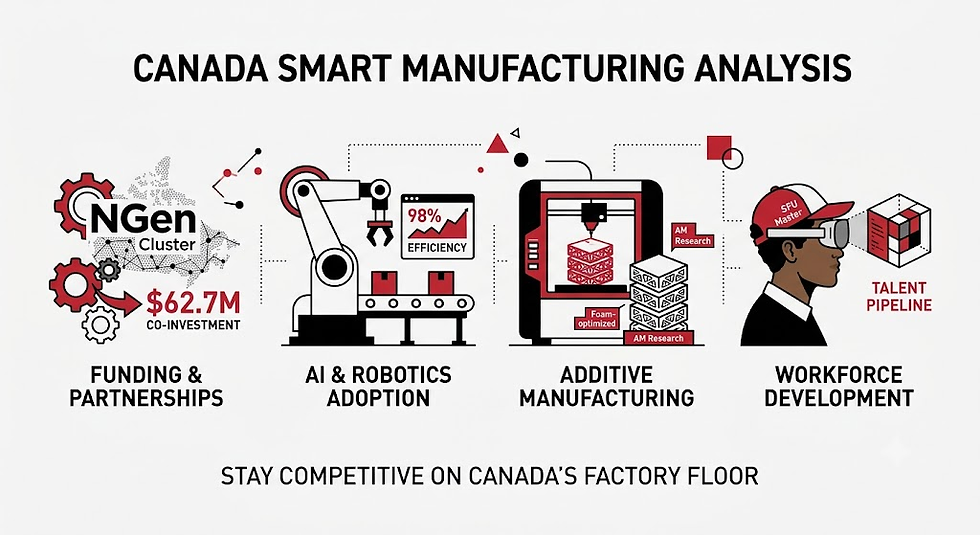
Canada’s manufacturing sector is undergoing a profound industrial transformation. Driven by rapid advancements in artificial intelligence (AI), industrial robotics, additive manufacturing, Internet of Things (IoT) sensors, and sustainable green technology, Canadian manufacturers are pivoting away from legacy assembly lines toward high-tech, data-driven smart factories. To maintain global competitiveness, boost productivity, and secure domestic supply chains, federal and provincial government bodies have created a robust ecosystem of funding streams, research clusters, and strategic growth frameworks.
Leading this technological shift are public-private partnerships, non-profit innovation clusters like Next Generation Manufacturing Canada (NGen), and research institutions such as the National Research Council (NRC). Together with regional development agencies, these entities are helping businesses de-risk capital investments, commercialize novel intellectual property, and upskill the modern workforce.
This comprehensive analysis examines how federal initiatives, regional grants, research infrastructure, and academic pipelines intersect to modernize production floors across Ontario, Quebec, Western Canada, and the Atlantic provinces.
1. NGen and the Federal Innovation Strategy
At the heart of Canada’s Industry 4.0 and Industry 5.0 acceleration is Next Generation Manufacturing Canada (NGen), the industry-led, non-profit organization managing Canada’s Global Innovation Cluster for Advanced Manufacturing. Funded through Innovation, Science and Economic Development Canada (ISED), NGen bridges the critical gap between early-stage academic R&D and commercial deployment on factory floors.
The $62.7 Million Co-Investment Surge
Demonstrating Canada’s commitment to industrial modernization, NGen announced a major $62.7 million investment package supporting 14 advanced manufacturing technology projects. Unveiled during Canada's prominent industry presence at Hannover Messe, the funding model combines $25 million in federal funding through NGen with $38 million in direct private sector contributions.
These collaborative projects focus on scaling high-impact technologies in strategic sectors:
Battery Materials & Clean Energy: Projects such as Saltworks Technologies’ Lithium Brine2Battery Chemicals initiative advance domestic chemical processing for zero-emission energy storage. Meanwhile, MakeSens Battery Technologies converts methane gas into advanced battery storage materials.
Additive & Rare Material Manufacturing: Innovations like Foam-Optimized Additive Manufacturing and NeoCtech Corp’s nano-alumina processing enhance high-precision manufacturing for aerospace, automotive, and defense tooling.
AI & Robotics Integration: Implementing predictive machine learning algorithms, autonomous mobile robots (AMRs), and digital twin frameworks to optimize real-time machine performance and eliminate material scrap.
The core requirement of NGen’s flagship Advanced Manufacturing Technology Program (AMTP) is meaningful cross-industry collaboration. Projects require a minimum of two Canadian industry partners, with at least one small-to-medium enterprise (SME) involved, ensuring that smaller suppliers are integrated into advanced technology supply chains.
2. Key Smart Manufacturing Programs Canada Offers in 2026
To understand the broader landscape, manufacturers must evaluate both federal innovation cluster funding and direct technology development support provided by government research labs and regional agencies.
National Research Council (NRC) Advanced Manufacturing Program
The National Research Council of Canada operates dedicated collaborative R&D facilities to assist ground transportation and aerospace equipment manufacturers. The NRC’s Advanced Manufacturing program focuses on increasing digital maturity and transforming traditional factories into Industry 4.0-ready facilities through three primary technological pillars:
Digital Manufacturing Systems: Developing embedded vision systems, IoT sensor networks, decision-support tools, and artificial intelligence models that process factory floor data in real time.
Advanced Metallic & Composite Processing: Refining robotic assembly, automated joining techniques, and additive manufacturing for lightweight structural components.
Sustainable & Circular Production: Lowering the environmental footprint of production by utilizing bio-based materials, industrial biomass, and energy-efficient processing technologies.
Through multidisciplinary R&D groups, over 245 NRC technical experts work directly with private companies and academic researchers to share research costs and reduce technical development risks.
Executive Insight on Industrial Co-Investment: By pairing public research funds with private sector capital, Canadian programs reduce the financial risk of adopting unproven technologies—allowing SMEs to deploy artificial intelligence, digital twins, and autonomous robotics faster than standalone market investment would allow.
Regional Development Agencies (RDAs)
To ensure regional equity across provinces, federal economic agencies deliver capital contributions for equipment purchasing, plant expansion, and digital software adoption:
FedDev Ontario: Directly supports Southern Ontario's automotive, life sciences, and precision engineering corridors by co-funding automated assembly equipment and ERP software upgrades.
PrairiesCan & PacifiCan: Targets clean technology adoption, agricultural machinery automation, natural resource processing equipment, and digital supply chain tools across Western Canada.
ACOA (Atlantic Canada Opportunities Agency): Provides funding for marine technology automation, digital inventory management, and automated processing lines in East Coast facilities.
3. Comprehensive Overview of Leading Canadian Initiatives
To help plant managers, business owners, and technology developers compare available funding pathways, the table below outlines the primary smart manufacturing programs active across Canada:
Program / Initiative Name | Lead Administering Entity | Primary Focus & Eligible Technologies | Funding Model & Target Scope |
Advanced Manufacturing Technology Program (AMTP) | Next Generation Manufacturing Canada (NGen) | AI, robotics, additive manufacturing, battery chemicals, digital twins | Co-funds up to 40% of eligible project costs ($1.5M–$8M total project size) |
NRC Advanced Manufacturing Program | National Research Council Canada (NRC) | Sensor integration, process modeling, composite materials, sustainable lightweighting | Collaborative multi-party R&D funding & direct access to NRC lab facilities |
Regional Economic Growth Innovation (REGI) | Regional Dev Agencies (FedDev, PacifiCan, etc.) | Commercial scaling, advanced hardware procurement, digital facility expansion | Repayable & non-repayable capital contributions for regional SMEs |
SMART Eureka International Calls | NGen / Eureka Global Network | Cross-border industrial R&D, smart factory software, export market expansion | Joint project co-funding across 45+ international member economies |
Sustainable Development Tech Canada (SDTC) | Environment and Climate Change Canada | Clean industrial processes, carbon reduction, energy-efficient manufacturing | Non-repayable project grants for clean technology demonstration |
4. Academic Talent Pipelines and Industry 4.0 Workforce Training
The rapid deployment of automated machinery, cloud computing, and machine learning software requires a highly educated workforce. Canadian academic institutions have introduced specialized engineering programs and upskilling initiatives to build an Industry 4.0-ready talent pipeline.
Specialized Degree Programs and Upskilling
Simon Fraser University (SFU): Offers advanced engineering programs—such as the Master of Engineering in Smart Manufacturing and Systems—combining coursework in mechatronics, cloud computing, machine vision, and industrial IoT with mandatory hands-on co-op work terms.
McMaster University & Conestoga College: Home to state-of-the-art learning factories, micro-credential courses, and applied automation labs where current manufacturing personnel learn PLC programming, predictive maintenance, and collaborative robot (cobot) operation.
Inclusive Workforce Development: NGen and federal partners actively fund STEM outreach programs targeting youth, women, and underrepresented groups to build a more diverse talent pipeline for high-tech manufacturing careers.
By pairing academic degrees with real-world industry experience, Canadian graduates enter the workforce equipped to design, program, and maintain complex cyber-physical production systems.
5. Global Collaboration: International Expansion Pathways
Canadian smart manufacturing extends far beyond domestic facilities. Through international networks, government agencies help Canadian firms export technologies and integrate into global value chains.
For instance, NGen coordinates Team Canada delegations to major international expos like Hannover Messe and leads participation in the SMART Eureka Network. These partnerships connect domestic tech providers with industrial hubs across Europe, Asia, and North America.
Key benefits of these international pathways include:
Global R&D Collaboration: Partnering with international original equipment manufacturers (OEMs) to co-develop automated systems.
Shared Financial Risk: Accessing international co-funding pools that share the expense of multi-national technology pilots.
Export Expansion: Helping Canadian SMEs sell proprietary hardware, sensors, and enterprise software directly to global aerospace and automotive supply chains.
6. Strategic SWOT Analysis
Strengths
Robust federal funding mechanisms (NGen, NRC, ISED) that reduce financial risks for early technology adopters.
Strong research infrastructure anchored by top-tier universities and college applied research centers.
Strategic access to critical raw materials (lithium, nickel, cobalt) and a clean hydroelectric grid for low-carbon manufacturing.
Weaknesses
Varying rates of digital adoption among small-and-medium enterprises (SMEs) due to initial capital expenditures.
Technical challenges in upgrading legacy factory equipment to communicate with cloud-based IoT software.
Opportunities
Accelerating nearshoring efforts across North America to secure critical automotive, electronics, and battery supply chains.
Implementing AI-driven energy monitoring systems to reduce factory carbon emissions and lower energy costs.
Threats
Intense global competition for capital and talent from foreign subvention frameworks (e.g., U.S. Inflation Reduction Act).
Increased exposure to industrial cybersecurity threats as operational technology (OT) networks connect to external cloud servers.
7. Frequently Asked Questions (FAQ)
What are the main smart manufacturing programs Canada has established for business owners?
The primary smart manufacturing programs Canada features include NGen’s Advanced Manufacturing Technology Program (AMTP), the National Research Council's Advanced Manufacturing Program, Regional Economic Growth initiatives through agencies like FedDev Ontario, and sustainable technology grants via SDTC.
How do NGen co-investment grants work for Canadian businesses?
NGen co-invests in collaborative, business-led technology projects that involve at least two Canadian partners (including at least one SME). Approved projects receive up to 40% reimbursement on eligible costs for developing, testing, and scaling Industry 4.0 solutions.
Are small and medium-sized enterprises (SMEs) eligible for advanced manufacturing funding?
Yes. SMEs are central to Canada's funding strategy. Programs like NGen require SME participation, while Regional Development Agencies offer specialized non-repayable and repayable loans tailored to smaller businesses adopting automated technology.
What skills are necessary for careers in modern Canadian manufacturing facilities?
Modern smart manufacturing roles require expertise in robotics programming, data analytics, artificial intelligence, digital twin modeling, industrial cybersecurity, IoT sensor network installation, and sustainable materials processing.
8. Official Resources and Funding Portals
To explore open funding calls, submit project proposals, or learn more about federal manufacturing initiatives, visit the official government and cluster portals below:
Learn about collaborative project streams, membership directories, and cluster updates on the official Next Generation Manufacturing Canada (NGen) Portal.
Explore technical R&D services, lab facilities, and research group contacts at the National Research Council Canada (NRC).
Access federal economic policies, cluster program overviews, and trade updates on Innovation, Science and Economic Development Canada (ISED).
Review cross-border project opportunities, international match-making events, and joint funding calls on the SMART Eureka Network Portal.


Comments