
SAT vs ACT vs TOEFL vs IELTS 2026: Which Tests Do International Students Actually Need?
- veddixitcs
- 4 days ago
- 8 min read


SAT vs ACT vs TOEFL vs IELTS 2026: Which Tests Do International Students Actually Need?
Four different tests, four different scoring scales, and a genuinely confusing amount of overlap — it's no wonder standardized testing is one of the most stressful parts of planning a US application. Understanding SAT vs ACT vs TOEFL vs IELTS starts with recognizing that these tests aren't actually competing with each other in most cases. They measure completely different things, and most applicants end up needing one test from each category, not choosing a single winner across all four. Here's a clear breakdown of what each test measures, current 2026 formats, and how to decide what you actually need.
Two Different Categories, Not One Big Comparison
The most important thing to understand before comparing any of these tests: SAT and ACT measure general academic readiness (math, reading, writing), while TOEFL and IELTS measure English language proficiency specifically. These aren't interchangeable options competing for the same slot on your application — a non-native English speaker applying to a competitive US university will frequently need to submit scores from both categories: one general aptitude test (SAT or ACT) and one English proficiency test (TOEFL, IELTS, or an accepted alternative like Duolingo).
SAT vs ACT: Choosing Your General Aptitude Test
The SAT, administered by the College Board, has been fully digital since March 2023 for international test-takers, delivered through the College Board's Bluebook app on a laptop or tablet. The test runs around 2 hours 14 minutes plus a short break — considerably shorter than the previous paper format. It's split into Math (two modules, 70 minutes total, with a calculator allowed throughout via an embedded Desmos tool) and Reading and Writing, with section scores combining into a composite score out of 1600.
The ACT covers English, Math, Reading, and Science Reasoning, with each section scored out of 36 and a composite score (also out of 36) averaged from the core sections. From February 2026, the ACT introduced fewer questions and shorter passages overall. The shortened core test runs around 2 hours 5 minutes; adding the Science section brings it to roughly 2 hours 45 minutes; adding both Science and the optional Writing section extends it to around 3 hours 25 minutes. Notably, the ACT places a stronger relative emphasis on time management and pacing compared to the SAT.
Which one should you take? Most students perform similarly on both once properly prepared, and the choice often comes down to personal comfort with each format — some students prefer the SAT's more flexible pacing and embedded calculator, while others prefer the ACT's more predictable, straightforward question style, or specifically want the Science Reasoning section as an opportunity to show strength in that area. Taking an official practice test for each is the most reliable way to determine which format suits you better, since the "right" test genuinely varies by individual.
Are the SAT and ACT Even Required Anymore?
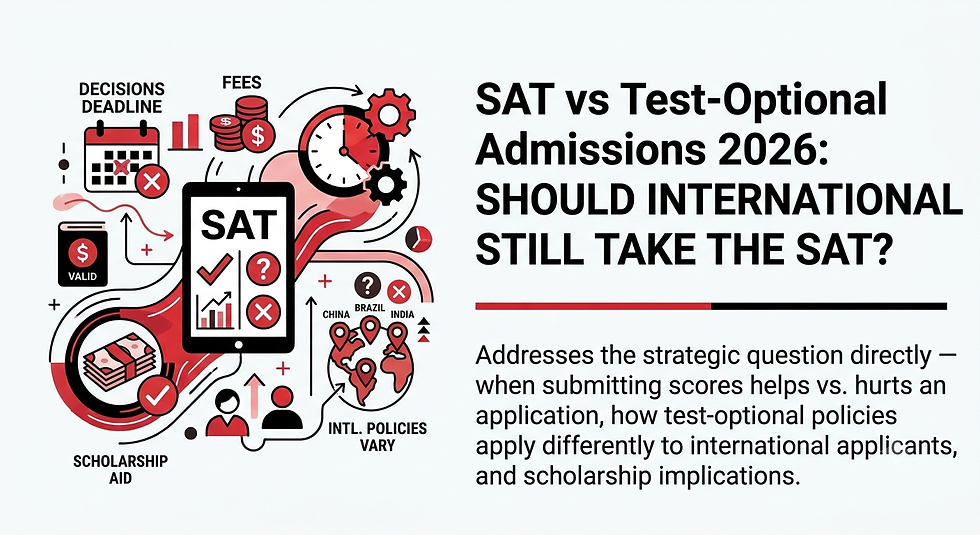
This is where things have gotten more complicated in recent years. Many selective US universities have moved to test-optional or test-flexible policies, and these policies generally apply to international applicants as well as domestic ones. However, submitting strong scores typically still helps — particularly for applicants from countries with grading systems that US admissions readers may find unfamiliar or difficult to calibrate, including systems with significant grade inflation or those that compress scores heavily at the top end (Singapore's A-Levels or China's Gaokao, for example). Third-party standardized scores give admissions committees a consistent, comparable data point across wildly different educational systems — which is precisely why many counselors still recommend submitting strong scores even at test-optional schools, particularly for international applicants.
A financial consideration worth knowing: SAT scores currently unlock considerably more scholarship opportunities than most English proficiency tests, with many merit scholarship programs setting specific SAT score thresholds. If scholarship funding is a priority, a strong SAT score meaningfully broadens your options compared to relying on English proficiency scores alone.
TOEFL vs IELTS: The Two Dominant English Proficiency Tests
TOEFL iBT remains the single most widely accepted English proficiency test among American universities specifically, with virtually all US universities recognizing it and more than 12,500 institutions worldwide accepting it. It emphasizes integrated tasks that combine reading, listening, and speaking or writing together, rather than testing each skill in complete isolation.
A significant format change is worth flagging directly: from January 2026, TOEFL moved from its familiar 0–120 point scale to a new 1–6 scale, where roughly 4.5 and above is considered the new equivalent of a strong, competitive score. If you're comparing your own score (or a target score listed by a university) against older TOEFL benchmarks, confirm which scale is actually being referenced, since scores under the two systems aren't directly interchangeable without conversion. Applicants who tested under the old 0–120 scale before the 2026 transition can generally continue using those scores within the standard two-year validity window.
IELTS Academic, jointly managed by the British Council, IDP, and Cambridge English, is the most widely recognized English test globally, accepted by more than 11,000 institutions worldwide. Unlike TOEFL's integrated approach, IELTS evaluates each skill (listening, reading, writing, speaking) separately with section-specific timing, and includes a face-to-face speaking component with a live examiner — a meaningful difference for students who feel more comfortable in an in-person conversational format compared to TOEFL's fully computer-based speaking section. IELTS is scored on a 1–9 band scale in 0.5 increments.
Which one is right for you? If you're specifically targeting US universities, TOEFL remains the safer default choice, given its stronger and more universal acceptance among American institutions specifically. If you're keeping options open across multiple countries — the UK, Australia, Canada — or simply prefer a live speaking component over a computer-based one, IELTS offers broader global flexibility. Both tests remain valid for two years from your test date, which is generally sufficient time to cover your application cycle and subsequent F-1 visa processing.
The Duolingo English Test: A Fast-Growing Third Option
The Duolingo English Test (DET) has moved from a niche alternative to genuinely mainstream acceptance, with more than 2,200 US universities now accepting it, including several Ivy League schools and Stanford. Its core appeals are speed, cost, and convenience: it's taken entirely online from home in about an hour, delivers results within 48 hours (with an optional faster turnaround for an added fee), and costs considerably less than TOEFL or IELTS — commonly around $59–$70, compared to $190–$300 for TOEFL or $185–$250 for IELTS. DET is scored on a 10–160 scale, with roughly 120 corresponding to an IELTS 7.0 and 130 corresponding to an IELTS 8.0.
The one genuine trap with Duolingo: acceptance isn't universal, and specific score thresholds vary meaningfully by school — some selective programs set considerably higher DET cutoffs than the general norm. Always verify direct acceptance and the specific required score with each target university before
committing your preparation time to this option rather than TOEFL or IELTS.
When Can You Skip English Proficiency Tests Entirely?
Universities generally waive TOEFL, IELTS, or Duolingo requirements for several categories of applicants:
Students whose native language is English, including applicants from the UK, Ireland, Canada (outside Quebec), Australia, and New Zealand
Students who completed a substantial portion of secondary education — typically four or more years — at English-medium schools, even in non-English-speaking countries (this covers many international and American curriculum schools in places like India, Singapore, and Hong Kong)
Students with sufficiently strong SAT or ACT scores demonstrating clear English fluency, though the specific qualifying threshold varies meaningfully by university — one common benchmark cited by several schools is an SAT Evidence-Based Reading and Writing score of 660 or higher
Waivers are rarely automatic, even when you technically qualify — most universities require you to actively request the waiver and provide supporting documentation, so don't assume you're exempt simply because you meet the general criteria without confirming directly with each specific school's admissions office.
A Practical Score Comparison Reference
Since these four tests use entirely different scales, a rough comparison is genuinely useful when interpreting a university's stated requirements:
TOEFL iBT (old scale) | IELTS | Duolingo | General Level |
100–110 | 7.0–7.5 | 120–130 | Competitive for selective universities |
80–99 | 6.5–7.0 | 105–120 | Solid for many mainstream programs |
102–109 | 7.5 | ~125–130 | Roughly equivalent tier |
These conversions are approximate rather than official, and individual section-level minimums (commonly around 25 out of 30 on a specific TOEFL section, for example) can matter SAT vs ACT vs TOEFL vs IELTS 2026 as much as the overall composite score — always check a target university's specific published requirements rather than relying solely on general conversion tables.
Building Your Testing Timeline
A reasonable general plan for most international applicants: begin researching required tests during 11th grade, allow three to six months of structured preparation for whichever tests you need, and aim to complete initial testing early enough in 12th grade to allow for at least one retake if your first attempt falls short of your target. Testing early also matters for a more practical reason — if you're applying under Early Decision or Early Action deadlines (commonly November 1–15), your scores need to be finalized and sent well before that window closes.
FAQs About SAT vs ACT vs TOEFL vs IELTS
Q1. Do I need to take all four tests — SAT vs ACT vs TOEFL vs IELTS — for a single US application? A: No. You choose one from the aptitude category (SAT or ACT, if required or beneficial at your target schools) and one from the English proficiency category (TOEFL, IELTS, or an accepted alternative like Duolingo, unless you qualify for a waiver) — not all four.
Q2. Should I take the SAT or ACT if my target universities are test-optional? A: It's often still worth it, particularly for international applicants from grading systems unfamiliar to US admissions readers. Strong scores can meaningfully strengthen an application even at test-optional schools, and SAT scores specifically tend to unlock more scholarship opportunities than relying on English proficiency scores alone.
Q3. Is TOEFL or IELTS better for applying to US universities specifically? A: TOEFL generally has the edge for US-specific applications, given its stronger and more universal acceptance among American universities. IELTS offers broader global flexibility if you're also considering universities in the UK, Australia, or Canada, and its live speaking component suits students who prefer face-to-face interaction over a computer-based format.
Q4. Is the Duolingo English Test a reliable substitute for TOEFL or IELTS? A: Increasingly, yes — it's now accepted by more than 2,200 US universities, including several Ivies. However, acceptance and required score thresholds vary meaningfully by institution, so always confirm directly with your target schools before relying on it instead of TOEFL or IELTS.
Q5. Can I skip English proficiency tests entirely if I attended an English-medium school? A: Possibly, but not automatically. Many universities waive the requirement for students who completed several years of secondary education at an English-medium school, but you typically need to actively request the waiver and provide documentation — confirm the specific policy and process directly with each target university.
Ready to Plan Your Testing Strategy?
Confirming exactly what your target universities require — and by which scale — before you start preparing saves real time and money. Here's where to check official, current requirements:
Register for or research the SAT: College Board – SAT
Register for or research the ACT: ACT – Official Site
Check current TOEFL iBT format and scoring: ETS – TOEFL iBT
Check current IELTS format and scoring: IELTS – Official Site
Have a specific test or university requirement you're trying to confirm? Share it in the comments, and in our final post of this batch, we'll cover how to build a professional network and LinkedIn presence in the US as an international student.



Comments