
SAT Goal Setting: How to Choose SAT Target Score Based on Your Dream University List
- Diksha Bhapkar
- Jul 30
- 7 min read

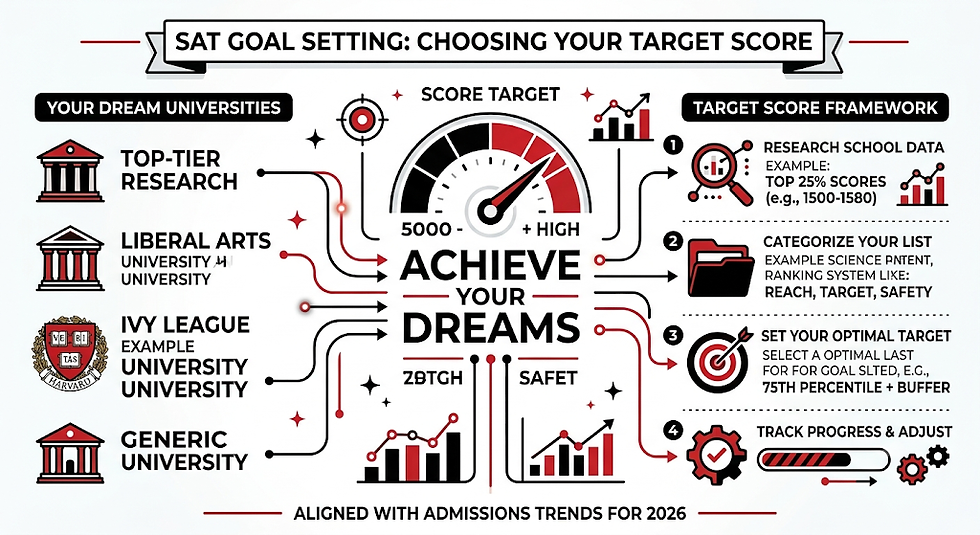
The college admissions landscape has reached a defining pivotal moment. After years of post-pandemic uncertainty, test-optional policies are rapidly shifting. Premier institutions—including Harvard, Yale, Dartmouth, Brown, MIT, Caltech, Stanford, Cornell, and UPenn—have fully reinstated standardized testing requirements for the 2025–2026 and 2026–2027 admissions cycles.
With the widespread rollout of the adaptive Digital SAT, taking the exam is no longer just a recommendation; for top-tier applicants, it is an essential component of a competitive application.
However, aiming aimlessly for a "perfect 1600" is rarely the most efficient strategy. Success in standardized testing begins with clear, data-driven goal setting. By analyzing the admissions statistics of your target schools, you can establish an achievable score goal that maximizes your admissions chances without causing unnecessary burn-out.
Here is a guide on how to choose your SAT target score based on your dream university list.
Why SAT Goal Setting Matters in the 2026 Admissions Environment
Setting a target SAT score is not merely about picking a high number; it is about strategic allocation of your time, energy, and financial resources. High school juniors and seniors balance demanding AP/IB courses, varsity sports, leadership roles, and personal essays. Knowing your precise target score prevents over-studying when your score is already competitive, allowing you to reallocate time toward other critical parts of your application portfolio.
       [ Research Target Colleges ]
                   │
                   ▼
       [ Find Middle 50% Ranges ]
                   │
                   ▼
 [ Identify Highest 75th Percentile Score ]
                   │
                   ▼
 [ Add 10–20 Points (Your Target Score) ]
1. The Reinstatement of Standardized Testing
For the 2026–2027 application cycle, six of the eight Ivy League institutions require SAT or ACT scores. Internal research at Dartmouth, Brown, and MIT revealed that standardized test scores remain the single most reliable predictor of undergraduate academic success, particularly when contextualizing high school grade inflation.
2. The "Self-Selection" Distortion
During the peak of test-optional policies, average published SAT scores at selective universities artificially inflated. Because only students scoring in the top percentiles submitted their results, middle 50% score ranges jumped substantially. Understanding how to read this data accurately is key to setting realistic goals today.
3. Contextual Admissions
Admissions officers evaluate your SAT score within the broader framework of your application—including your High School GPA, course rigor, letters of recommendation, and personal background. Your target score serves as the baseline that opens the door for human evaluation of your unique story.
Understanding the "Middle 50%" SAT Score Range
Before establishing your score goals, you must master the fundamental metric used by admissions offices: the Middle 50% SAT Range.
The Middle 50% represents the score span between the 25th percentile and the 75th percentile of enrolled freshmen at a given institution.
25th Percentile: 25% of enrolled students scored at or below this number (75% scored above).
75th Percentile: 75% of enrolled students scored at or below this number (25% scored higher).
Key Rule of Thumb: If a university's middle 50% score range is 1480–1560, a score of 1480 puts you at the bottom 25th percentile of admitted students, while a 1560 puts you in the top 25%.
How to Find Verified Score Data
To find reliable, unvarnished score statistics, search for the Common Data Set (CDS) of each university on your list. Section C9 of any university’s CDS details the exact 25th, 50th, and 75th percentile scores for Reading/Writing and Math from the most recently enrolled class.
How to Choose SAT Target Score Based on Your College List: A 4-Step Framework
To build an actionable test preparation strategy, you must systematically evaluate your entire college list. Here is the step-by-step framework to help you choose your SAT target score effectively.
Step 1: Categorize Your College List
Divide your list of colleges into three distinct tiers based on your academic profile and institutional acceptance rates:
Reach Schools: Top-tier or highly selective colleges where admission rates are under 15% or your academic credentials fall below the average.
Match (Target) Schools: Universities where your academic profile aligns with the middle 50% of admitted applicants and acceptance rates are moderate (15%–40%).
Safety Schools: Institutions where your academic credentials sit comfortably above the 75th percentile and acceptance rates exceed 40–50%.
Step 2: Extract the 75th Percentile for Every School
Gather the middle 50% ranges for all colleges on your list and record the 75th percentile score for each.
University Name | School Tier | Middle 50% Range | 75th Percentile SAT |
Harvard University | Reach | 1510–1580 | 1580 |
New York University (NYU) | Match/Reach | 1480–1550 | 1550 |
Boston University | Match | 1430–1510 | 1510 |
State Flagship University | Safety | 1200–1380 | 1380 |
Step 3: Establish Your Master Target Score
Your overall target score should equal or slightly exceed the 75th percentile score of the most competitive "Match" school on your list—or the 50th percentile of your top "Reach" school.
For example, if your top reach school has a 75th percentile of 1550, achieving a 1540–1560 ensures that your test score will be an asset across your entire college portfolio, rather than a hurdle.
Step 4: Account for Specific Major Requirements
Academic majors often maintain different benchmark expectations:
STEM & Engineering Majors: Focus heavily on the Math section. A student applying to Engineering at Carnegie Mellon or Purdue should aim for a 780–800 Math section score, even if their composite score matches the overall university average.
Humanities & Business Majors: Require high Reading & Writing marks alongside quantitative competence.
2026 Target SAT Score Ranges by University Tier
To help you baseline your goals, here are the general score targets across different institutional tiers based on current 2026 admissions statistics:
Score Spectrum & Admissions Tiers
│
├── 1520 - 1600 ── Tier 1: Ivy League / Top 20 (MIT, Harvard, Stanford)
│
├── 1420 - 1510 ── Tier 2: Highly Selective (NYU, BU, UMich, UVA)
│
├── 1250 - 1410 ── Tier 3: Selective Public & Private Universities
│
└── 1050 - 1240 ── Tier 4: Regional Universities & Safety Institutions
Tier 1: Ivy League, MIT, Stanford, & Top 15 Universities
Middle 50% SAT Range: 1500–1580
Target SAT Score Goal: 1550+
Context: With testing required at MIT, Yale, Harvard, Brown, Dartmouth, Stanford, Cornell, and UPenn, a score above 1540 places you safely within competitive consideration.
Tier 2: Top 16–50 Selective Universities & Public Flagships
Middle 50% SAT Range: 1380–1520
Target SAT Score Goal: 1480–1520
Context: Schools like NYU, Boston University, University of Michigan, and UNC Chapel Hill seek strong academic foundations.
Tier 3: Selective State Universities & Regional Liberal Arts Colleges
Middle 50% SAT Range: 1150–1380
Target SAT Score Goal: 1320–1380
Context: Reaching the 75th percentile in this bracket often qualifies students for substantial merit-based scholarships.
Leveraging the Digital SAT & Superscoring in Your Goal Setting
Understanding exam mechanics allows you to set smarter targets and hit them faster.
The Adaptive Digital SAT Mechanics
The Digital SAT uses a multistage adaptive structure:
Module 1 (Reading/Writing & Math): Contains a mixture of easy, medium, and hard questions.
Module 2: The difficulty level adapts based on your Module 1 performance.
To achieve a score above 1400, you must perform well enough in Module 1 to trigger the upper-tier Module 2. Missing easy questions in Module 1 limits your score ceiling regardless of how well you answer subsequent questions.
                    [ Module 1 ]
             (Mix of Easy/Medium/Hard)
                        │
         ┌──────────────┴──────────────┐
         ▼                             ▼
   High Accuracy                 Low Accuracy
         │                             │
         ▼                             ▼
  [ Upper Module 2 ]            [ Lower Module 2 ]
(Max Score: 800 Points)       (Max Score Cap: ~600 Points)
Maximizing Your Score with Superscoring
Most universities implement Superscoring—combining your highest individual Reading & Writing score with your highest Math score across all test dates to calculate a composite score.
When planning your target score strategy:
Test 1 Target: Focus on mastering one specific section (e.g., getting a 780+ on Math).
Test 2 Target: Maintain your Math score while dedicating extra effort to Reading & Writing.
Combining two distinct test dates allows many students to increase their overall composite score by 40 to 80 points.
Frequently Asked Questions (FAQs)
1. How do I choose SAT target score if my dream colleges are test-optional?
To choose SAT target score for test-optional universities, research the school's published 50th and 75th percentile scores from their most recent Common Data Set. If your score falls at or above the 50th percentile (and ideally near the 75th percentile), submitting your score will strengthen your application. If your score falls below the 25th percentile, applying test-optional may be advantageous unless testing is required for your specific major or merit scholarship consideration.
2. Is a 1400 a good SAT score for top universities in 2026?
A score of 1400 ranks in the top 10% of all test-takers nationwide, making it a strong score for most colleges and universities. However, for Top 20 institutions or Ivy League schools—where the middle 50% range often sits between 1500 and 1580—a 1400 falls below the average competitive threshold. For Tier 2 and Tier 3 universities, a 1400 is highly competitive.
3. How many times should I take the Digital SAT to reach my target score?
Most students reach their peak score after taking the test 2 to 3 times. Taking the exam more than three or four times rarely leads to significant score jumps and can result in test fatigue. Prepare deliberately between attempts using diagnostic analytics to address specific weak areas.
4. What is the average SAT score in 2026?
The national average SAT composite score hovers around 1030 to 1050 out of 1600. Scoring above 1200 places you in the top 25% of test-takers, while scoring above 1350 places you in the top 10% nationally.
5. How far in advance should I start preparing for the SAT?
Ideally, you should begin preparing 3 to 6 months prior to your target test date. This timeline allows for 40 to 80 hours of structured practice, multiple full-length practice exams, and sufficient time to review concepts without compromising your high school course grades.
Conclusion: Turn Your Target Score into an Action Plan
Setting a target SAT score bridges the gap between your college ambitions and practical preparation. By analyzing the 75th percentile statistics of your target institutions, tailoring goals to your intended major, and taking advantage of digital test dynamics, you create a clear roadmap to admissions success.
Remember: your SAT score is a valuable tool designed to showcase your academic readiness alongside your overall profile. Set your target, establish a structured prep schedule, and execute your plan with confidence.
Take the Next Step in Your SAT Preparation
Ready to hit your target score? Start by diagnosing your current skill level with official, adaptive practice resources:
Take official adaptive practice tests on the College Board Digital SAT Suite.
Access free, personalized practice modules on Khan Academy's Official SAT Prep.
Look up verified admissions statistics for your target schools via the College Board BigFuture College Search.


Comments