
SAT Exam Pattern 2027: Complete Section-Wise Guide for Beginners
- Diksha Bhapkar
- 5 days ago
- 6 min read

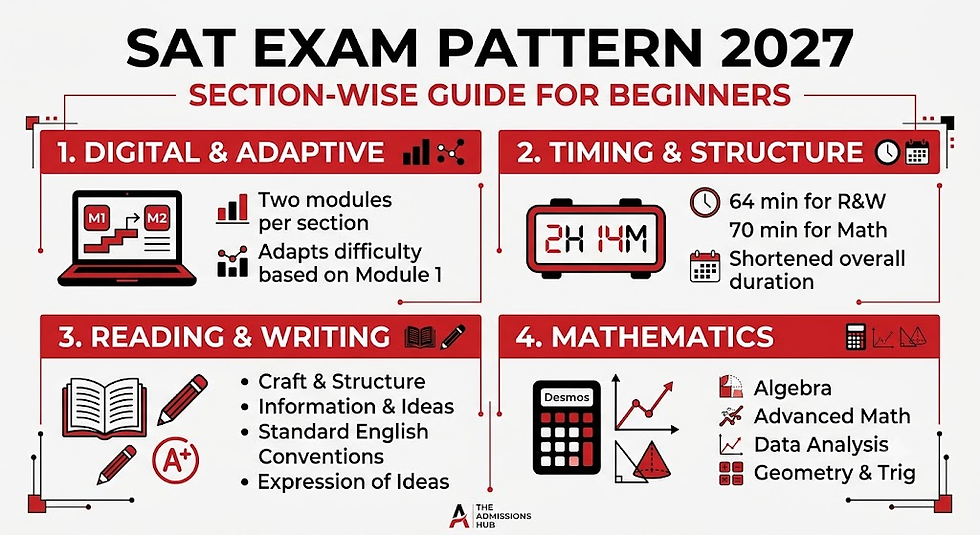
Navigating college admissions can feel overwhelming, but mastering the standardized testing portion does not have to be. If you are aiming for admissions in 2027 or 2028, you will be taking the fully streamlined, digital version of the Scholastic Assessment Test (SAT). The modern SAT is vastly different from the grueling, three-hour paper marathon your older siblings or parents took.
Understanding the SAT exam pattern 2027 is your first major step toward college readiness. This comprehensive guide breaks down everything from structural timing and adaptive grading parameters to granular section-by-section strategies.
1. The Big Picture: What is the SAT Exam Pattern 2027?
The SAT is a computer-based standardized test administered by the College Board. Designed to evaluate a student's high school academic foundation and predict college success, the modern exam structure prioritizes real-world analysis over pure rote memorization.
Since transitioning entirely to a digital format globally, the test has cut unnecessary fluff. The overall testing blueprint remains locked into a highly efficient, multi-stage adaptive structure. Here are the foundational fast facts:
Total Test Duration: 2 hours and 14 minutes (134 minutes of pure active testing time).
Total Questions: 98 questions.
Maximum Score: 1600 points (200–800 score range per section).
Format: Digital-only, administered via the College Board's official Bluebook app. You must take this exam on an approved laptop, tablet, or school-issued device at an authorized test center.
Negative Marking: Absolutely none. You are only scored on correct answers, making educated guessing an essential strategy.
The Core Blueprint at a Glance
Section | Active Testing Time | Total Questions | Scoring Window |
Reading & Writing (R&W) | 64 Minutes (Two 32-min modules) | 54 Questions (27 per module) | 200 – 800 Points |
Scheduled Optional Break | 10 Minutes | — | — |
Mathematics | 70 Minutes (Two 35-min modules) | 44 Questions (22 per module) | 200 – 800 Points |
Grand Total | 2 Hours 14 Minutes | 98 Questions | 400 – 1600 Points |
2. Deciphering Multi-Stage Adaptive Testing
The most critical strategic change in the SAT exam pattern 2027 is its multistage adaptive framework. The exam does not adjust the difficulty after every single question. Instead, it adapts at the module level.
Both the Reading & Writing section and the Math section are split cleanly into two distinct modules.
[Section Started] ──> [Module 1: Mix of Easy/Med/Hard]
                             │
                             ▼ (Performance Analyzed)
       ┌─────────────────────┴─────────────────────┐
       ▼                                           ▼
[Module 2: Lower Difficulty]              [Module 2: Higher Difficulty]
  (Caps maximum potential score)            (Unlocks top 800 section score)
Module 1 (The Baseline): Every single test taker receives a standardized, highly balanced mix of easy, medium, and difficult questions.
The Pivot: The Bluebook testing algorithm scores your Module 1 performance instantly behind the scenes.
Module 2 (The Adaptive Path): If you perform exceptionally well in Module 1, you automatically route to a high-difficulty Module 2. If you struggle with Module 1, you route to a lower-difficulty Module 2.
Critical Strategy Note: To secure a high score (such as cracking a 1400+ overall), you must unlock the higher-difficulty Module 2. Routing to the lower-difficulty Module 2 mathematically caps your maximum achievable section score, even if you answer every single question in that second module perfectly.
3. Deep Dive: Reading & Writing (R&W) Section
The combined Reading & Writing section eliminates the historical 800-word essays and boring reading passages. Instead, you face discrete, ultra-short passages ranging between 25 and 150 words. Every single passage corresponds to exactly one question.
You must tackle 54 questions total across 64 minutes. This gives you an average pacing buffer of roughly 1.2 minutes per question.
The 4 Crucial English Domains
The College Board organizes your verbal evaluation into four core categories, explicitly weighted to test clear academic mechanics.
Craft and Structure (~28% / 13–15 Questions): Focuses heavily on advanced high-school vocabulary used in context, evaluating text structures, determining rhetorical purposes, and drawing cross-textual connections between two brief opposing arguments.
Information and Ideas (~26% / 12–14 Questions): Tests reading comprehension at its core. You will need to extract central ideas, decode specific text details, accurately make logical inferences, and parse informational graphics like bar charts or line graphs tied directly to scientific texts.
Standard English Conventions (~26% / 11–15 Questions): Pure structural mechanics. You must identify sentence boundaries, resolve complex subject-verb or pronoun-antecedent agreements, and perfectly apply advanced punctuation (such as proper colon and semicolon usage).
Expression of Ideas (~20% / 8–12 Questions): Focuses on structural editing and synthesis. A common question type presents a bulleted list of raw research notes and asks you to choose the answer option that best achieves a specific rhetorical goal.
4. Deep Dive: Mathematics Section
The Math section evaluates your analytical, problem-solving, and computational agility. Under the SAT exam pattern 2027, there is no longer a "No-Calculator" section. You are legally permitted to use an approved calculator for 100% of the math questions.
You will face 44 questions spread over 70 minutes, giving you a slightly more relaxed pacing average of 1.6 minutes per question.
The Question Types: MCQs vs. SPRs
The math section splits its evaluation formats into two styles:
Multiple-Choice Questions (75%): Traditional four-option choices.
Student-Produced Responses (25%): Also known as "grid-ins." There are no multiple-choice safety nets here. You must solve the problem manually and input your precise numerical answer directly into the Bluebook interface.
The 4 Targeted Math Domains
The College Board tests concepts ranging from fundamental arithmetic up to introductory trigonometry.
  ┌─────────────────────────────────────────────────────────┐
  │                   SAT MATH DOMAINS                      │
  ├─────────────────────────────────────────────────────────┤
  │  Algebra (~35%)                                         │
  │  Linear equations, inequalities, coordinate systems     │
  ├─────────────────────────────────────────────────────────┤
  │  Advanced Math (~35%)                                   │
  │  Quadratics, exponentials, polynomials, parabolas       │
  ├─────────────────────────────────────────────────────────┤
  │  Problem-Solving & Data Analysis (~15%)                 │
  │  Ratios, percentages, statistics, unit conversions     │
  ├─────────────────────────────────────────────────────────┤
  │  Geometry & Trigonometry (~15%)                         │
  │  Circles, volume, right triangles, basic trig           │
  └─────────────────────────────────────────────────────────┘
Algebra (~35%): Focuses heavily on linear equations in one or two variables, graphing systems of linear equations, interpreting linear functions, and solving linear inequalities.
Advanced Math (~35%): Tests nonlinear equations, working with complex polynomials, quadratic functions, exponential growth/decay models, and graphing parabolas.
Problem-Solving and Data Analysis (~15%): Focuses on real-world numeric application. You will calculate ratios, proportions, probabilities, percentages, and margins of error while evaluating statistical claims from scientific studies.
Geometry and Trigonometry (~15%): Tests lines, angles, triangles, right-triangle trigonometry, circle theorems, and area/volume formulas.
5. Built-In Bluebook Interface Tools to Leverage
Because you are taking a digital assessment, mastering the app interface itself is a core component of your preparation strategy. The College Board's official Bluebook software includes several integrated utilities designed to lower structural friction:
Built-In Desmos Calculator: You do not even need to buy an expensive graphing calculator. A fully integrated version of the powerful Desmos graphing calculator is available on-screen for the entire duration of the Math section.
The Flagging Utility: If a question is chewing up too much time, you can flag it with a single click. The bottom navigation bar tracks your flagged items, letting you skip ahead and instantly return to skipped items before the module closes.
Cross-Out Tool: Allows you to visually eliminate answer choices that you know are wrong, lightening your mental processing load on tough multiple-choice problems.
Math Formula Reference Sheet: A built-in icon gives you immediate access to standard geometric formulas (like the volume of a sphere or the Pythagorean theorem), meaning you don't have to waste mental space memorizing basic area and volume configurations.
6. Frequently Asked Questions (FAQs)
What are the main changes to expect in the SAT exam pattern 2027 compared to older versions?
The modern SAT exam pattern is completely digital, adaptive, and significantly shorter than its paper-pencil predecessor. The historical three-hour exam with massive reading passages has been condensed into a 2-hour, 14-minute exam using ultra-short paragraphs. Additionally, the standalone "No-Calculator" math block has been permanently discontinued, granting students continuous calculator access via an integrated Desmos tool across all math modules.
Are there experimental or unscored questions on the SAT?
Yes. Every single section of the exam includes hidden "pretest questions" (typically 2 pretest items per module, totaling 8 across the entire test). These are ungraded experimental items mixed seamlessly into the test to help the College Board calibrate difficulty for future exam pools. Because they look identical to regular questions, you must treat every question as if it counts toward your final score.
Is there any negative marking for incorrect answers on the digital SAT?
No, there is no penalty for wrong answers. The digital SAT uses a right-only scoring method, meaning an incorrect answer or a blank space results in zero points deducted. Because leaving a question blank hurts your chances of advancing to the higher-difficulty adaptive modules, you should always submit an educated guess for every single question before a module timer runs out.
Can I practice with the exact adaptive algorithm before test day?
Yes. The College Board provides official, full-length adaptive diagnostic practice tests directly inside the downloadable Bluebook application. These practice materials precisely mirror the adaptive structure, pacing constraints, and user interface tools you will encounter on your official test day.
7. Next Steps: Accelerate Your 2027 SAT Preparation
Now that you understand the formal framework of the SAT exam pattern 2027, it's time to build a structured study plan around your target score.
The most effective next steps for high school beginners include:
Downloading the official Bluebook app and executing a timed, full-length diagnostic test to discover your structural baseline.
Linking your College Board profile to Khan Academy SAT Prep for completely free, hyper-targeted conceptual drills.
Registering for your official target test date well in advance via the Official College Board SAT Portal to secure an optimal testing seat in your local area.




Comments