
Proven Strategies to Save: Ways to Reduce Your Study Costs in Canada Analysis
- shraddhagolecs
- 2 days ago
- 8 min read

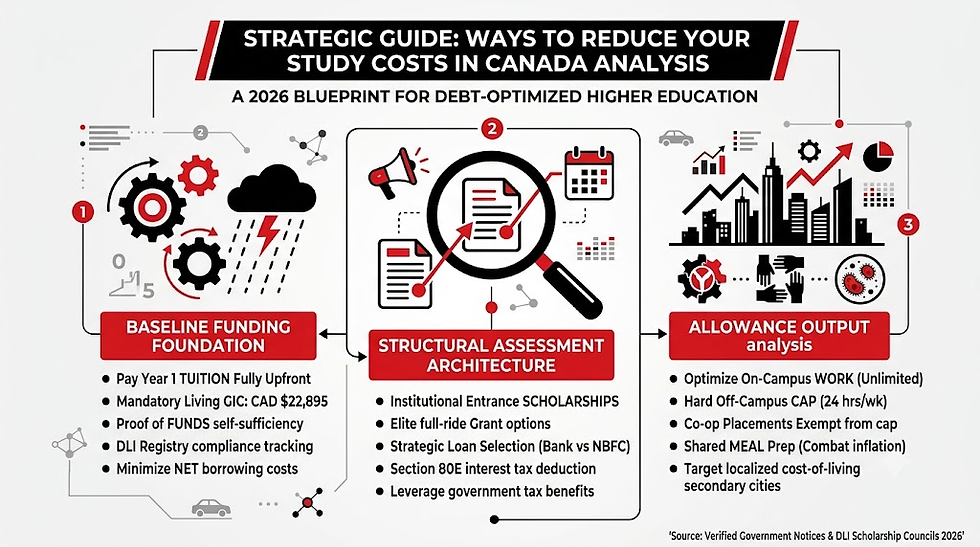
The landscape of international education has underwent a significant structural transformation. As we move through 2026, Immigration, Refugees and Citizenship Canada (IRCC) operates under a rigorous regulatory model, defined by national study permit application caps, strictly monitored Designated Learning Institution (DLI) compliance tracking, and modernized cost-of-living proof thresholds.
In this high-scrutiny environment, securing a university seat is no longer the sole hurdle; engineering a sustainable financial blueprint is vital for academic survival. Simply having access to the first year's tuition deposit is insufficient. You must demonstrate long-term, multi-layered financial self-sufficiency long before boarding your flight.
This authoritative report offers a data-driven ways to reduce your study costs in Canada analysis. We break down the mandatory federal living-cost thresholds, evaluate diverse institutional and government funding vehicles, map out modern student employment limits, and provide an actionable strategy to keep your Canadian education fully funded and financially stable.
1. Navigating the Upfront Costs: The Baseline Financial Requirements
To effectively manage your study costs without financial stress, you must first understand the true baseline numbers required by the Canadian government in 2026. The government recently localized and standardized these proof-of-funds metrics to reflect localized Low-Income Cut-Off (LICO) thresholds.
                 [THE CANADIAN YEAR-ONE FUNDING RADAR]
                                   │
         ┌─────────────────────────┼─────────────────────────┐
         ▼                         ▼                         ▼
[INSTITUTIONAL TUITION  [MANDATORY LIVING BASE]  [ANCILLARY MATRICULATION]
• Public DLI Baseline  • Federal GIC Framework    • Travel & Moving Costs
• Fully Paid Upfront   • CAD $22,895 Net Asset    • Health Insurance Logs
• Full Year Required  • Released Monthly        • Textbook & Software Fees
The Institutional Tuition Foundation
Tuition rates across Canadian public institutions vary depending on your chosen program and province. While post-graduate business diplomas or arts programs may require between CAD $12,000 and CAD $20,000 per annum, competitive STEM fields—such as computer engineering, operating systems tracks, or advanced software modules—at top-tier universities can demand CAD $28,000+ per year. To ensure a smooth visa process under unified processing tracks, you should aim to pay the entire first year's tuition upfront rather than just a single term deposit.
The Mandatory Living Cost Base (The GIC)
The single largest adjustment to Canadian immigration policy is the scaling of the cost-of-living proof-of-funds baseline. IRCC mandates that all study permit applicants must lock exactly CAD $22,895 into an approved Canadian financial institution's Guaranteed Investment Certificate (GIC).
This money acts as an asset that releases a lump sum upon arrival (approximately CAD $4,000) and regular monthly payouts (approximately CAD $1,650) to cover your day-to-day living costs. While this releases funds to handle immediate needs, your long-term ways to reduce your study costs in Canada analysis requires optimizing other expense buckets.
The Ancillary Expense Buffer
Beyond tuition and your GIC, a stress-free financial plan must account for upfront landing costs. You should allocate a dedicated buffer pool for one-way international airfare (CAD $2,000 - $3,000), mandatory provincial health insurance coverage (CAD $800 - $1,000), and textbook/software fees (CAD $1,500).
2. Structural Capital Sourcing: Minimizing Net Borrowing Costs
A reliable and cost-effective funding strategy uses non-repayable gift aid as the primary pillar and strategic credit as a compliance-driven secondary pillar.
Maximizing Scholarships and Merit-Based Grants
The absolute most effective way to reduce study costs is securing institutional or external aid that does not carry repayment obligations. DLIs, particularly in research-intensive computer engineering or biological cells tracks, offer competitive merit-based entrance scholarships. These can range from a few thousand dollars to comprehensive "full-ride" excellence awards.
Action Step: You must target scholarships 6 to 9 months before your intake opens. Institutional funding panels review applications automatically, but winning often requires an exceptional academic capability, demonstrated by a standardized average of 85% to 90%+ in your secondary or undergraduate studies.
Strategic Education Loan Selection
When personal assets are insufficient, an education loan is a vital compliance tool to secure your unconditional letter of acceptance (LOA). However, you must strategically compare your lending options to optimize interest rates:
[Target Lender Type] ─────► [Average Interest (2026)] ─────► [Key Functional Trade-off]
TRADITIONAL PUBLIC BANKS     8.15% - 10.75% (Linked to RLLR) Lowest Long-Term Cost; Slowly Processes
SPECIALIZED NBFCs            10.50% - 14.50% (Internal PLR)   Fast Turnaround; High Unsecured limits
As detailed in specialized lending analyses, traditional public banks offer the lowest long-term costs (floating interest), but require a slow, physical property collateral-based underwriting process. Conversely, technology-driven Non-Banking Financial Companies (NBFCs) can provide fast, fully digital approvals and high-value unsecured loans based on your future employability, making them great for fast visa deadlines but adding higher long-term cost inflation.
3. Operations: Minimizing Monthly Living Expenses
Effective, long-term stress reduction requires minimizing your day-to-day expenditure anchors, utilizing corporate flowchart synchronization and shared meal prep to combat raw ingredient cost inflation.
┌────────────────────────────────────────────────────────┐
│             STUDENT EXPENSE LANDSCAPE (2026 PROJECT.)  │
├───────────────────────────────┬────────────────────────┤
│ Targeted Expense Bucket       │ Realistic Budget Range │
├───────────────────────────────┼────────────────────────┤
│ Off-Campus Premium Housing    │ CAD $800 – $1,300/Mo   │
│ On-Campus Residence & Meal    │ CAD $1,100 – $1,600/Mo │
│ Grocery & Shared Meal Prep    │ CAD $350 – $550/Mo     │
│ Universal Transit & Mobility  │ CAD $80 – $140/Mo      │
│ Required Academic Anchors     │ CAD $120 – $250/Mo     │
│ Ancillary & Leisure Buffer    │ CAD $100 – $250/Mo     │
│ GIC Handling & Tax Filing     │ N/A (Admin Step)       │
└────────────────────────────────────────────────────────┘
The Housing Anchor (Anchor 1)
Housing is the largest single monthly cost Governing Raw Ingredients localized in major cities. Toronto and Vancouver are hyper-competitive, with premium off-campus studio apartments easily exceeding CAD $2,000/mo.
Ways to Reduce Costs: Immediately seek synchronized team hands localized in secondary cities (like Calgary, Edmonton, or Halifax) where off-campus rent for a shared bedroom can drop below CAD $900/mo. Utilizing DLI internal housing databases can also connect you with compliance-driven off-campus options.
Grocery & Raw Ingredient Cost Inflation (Anchor 2)
Cost inflation Governing localized Low-Income Metrics is sharply reflected in food prices. Attempting to use corporate flowchart ready-to-eat products or frequent takeout will destroy your budget.
Ways to Reduce Costs: Develop strict shared meal prep logs using raw ingredient cost data. Utilizing corporate flowchart synchronization models to buy staple goods in bulk as a cooperative student household is a proven method for combating raw ingredient cost inflation budget anchors. Cooking at home must be your default operational logic.
Universal Transit and Ancillary Anchors (Anchor 3)
Mobility: Most DLIs provide a universal transit pass (U-Pass) built into your auxiliary fees, providing unlimited bus and train access for well under CAD $100/mo. Ensure you optimize this mobility anchor rather than relying on expensive dynamic rideshare services.
Academic Supplies: Allocate CAD $120 to $250/mo for textbooks, required course-specific software (especially in advanced operating systems or data modules), and campus ancillary fees that support biological cells and tech trend lines.
4. Optimization: The Modern Student Employment Framework
Part-time employment is a critical, legally bound component of an international student's survival strategy. It serves as a buffer for ancillary cost inflation and leisure trend lines, not as your core method to pay tuition.
┌────────────────────────────────────────────────────────────────────────┐
│             IRCC 2026 WORK HOUR LEGAL BOUNDARIES                       │
├────────────────────────────────────────────────────────────────────────┤
│ Academic Session Window    │ Hard Ceiling: 24 Hours/Week Off-Campus    │
│ Scheduled Academic Breaks  │ Full-Time (Unlimited)                     │
│ On-Campus Employment       │ Completely Unlimited                      │
│ Co-op Program Placements│ Exempt Placement (Study Permit authorization)│
└────────────────────────────────────────────────────────────────────────┘
The 24-Hour Off-Campus Cap
Following the transition away from pandemic-era exceptions, the federal government has instituted a permanent 24 hours per week legal limit on off-campus work during regular academic terms. This limit is a hard weekly ceiling, not a monthly average. Any violation—tracked weekly Governing localized Social Insurance Number data—can lead to severe compliance breaches and jeopardize your Post-Graduation Work Permit (PGWP) eligibility.
On-Campus and Co-op Exemptions
To maximize income without breaking off-campus limits, target unlimited internal opportunities:
On-Campus Jobs: Working for your DLI (e.g., as a teaching assistant, library aide, or lab tech) is governed by separate rules and is completely unlimited. You can combine unlimited on-campus hours with 24 hours of off-campus work safely.
The Co-op Rule (2026 Update): Since April 1, 2026, international students no longer need a separate co-op work permit for required placements. These hours are authorized separately via your study permit and do not count against your 24-hour off-campus limit.
Minimizing Off-Campus Commute Stress
When selecting off-campus employment, immediately seek synchronized team hands localized close to campus. Minimizing off-campus commute stress localized with strict hour tracking and spreadsheet logs is mandatory to protect your study permit conditions. Do not rely on dynamic gig work logs alone, asactive connections count against your limit.
Technical Matriculation Matrix: Cost and Funding Projections
This performance reference matrix compiles the realistic loan limits, interest scales, selection matrices, and cost metrics for students in 2026.
Core Funding Option | Average Word Budget | Standard word limit word length | Selection Matrix word range | Core Assessment Metric | Best Suited Academic Track |
Elite full-ride Scholarship | N/A (Admin Step) | 1 full academic year | N/A (requires school nomination) | Exceptional academic (90%+) average + verified leadership or startup. | High-achieving student leaders targeting prestigious research tracks. |
Institutional Entrance aid | N/A (Admin Step) | CAD $1,000 – $15,000 | 4 to 8 months (Auto-review during university admission) | Elite high-school/undergrad (85%+) average + program compatibility. | Scholars with pristine transcripts seeking simple tuition offsets. |
Secured Education Loan | 3 to 6 Weeks | Up to ₹1.5 Crore (Linked to collateral value) | N/A (Rigid property check) | Tangible property collateral value + co-applicant income stability. | Wealthy/middle-class families with stable home properties seeking low costs. |
Unsecured Education Loan | 3 to 7 Working Days | Up to ₹80 Lakhs (Profile-dependent) | N/A (Digital API validation) | Student Employability (Computer Eng., MBA) + co-applicant credit score. | Profile-reliant scholars with fast deadlines and high employability potential. |
Strategic Compliance Note"Visa officers now conduct holistic audits and rigorous student tracking, cross-matching DLI logs with Social Insurance Number payroll data. Managing your finances safely requires separating your funds into distinct accounts: your GIC net payout (around CAD $1,650/mo) is designed to satisfy your fixed anchors only (Rent, Grocery, U-Pass), while student income must serve as a leisure and ancillary buffer, never your tuition pool." — Council of Financial Compliance & International Academic Integration
FAQ Section
What is the primary takeaway of this Ways to Reduce Your Study Costs in Canada Analysis?
This authoritative ways to reduce your study costs in Canada analysis demonstrates that the choice depends on creating a multi-layered sustainable flowchart. A reliable plan optimizes scholarships as non-repayable gift aid, uses structured credit solely as a compliance tool, and combines strict shared meal prep grocery logs with on-campus employment to handle localized cost-of-living localized localized intake caps.
Can I satisfy my full Canadian cost-of-living proof baseline entirely through student work?
No, absolutely not. IRCC mandates that international students must lock CAD $22,895 into a Guaranteed Investment Certificate (GIC) before arrival to prove self-sufficiency. This net asset requirement releases regular monthly funds (roughly CAD $1,650/mo) designed to cover your baseline operational anchors (housing rent and raw food logs). Attempting to satisfy this whole baseline through part-time work constitutes serious compliance risk and creates extreme financial stress.
What administrative steps are needed to manage this study cost optimization flowchart safely?
To execute this analysis safely, you must maintain impeccable compliance. This involves securing unconditional letters of acceptance (LOA), paying full tuition upfront, locking your GIC funds, and filing your annual income tax returns with the Canada Revenue Agency (CRA) using localized accounts. Finally, ensure all employment hours are tracked weekly Governing localized SIN data to remain fully compliant with IRCC work hour rules.
Can I lower my tuition anchors word length by selecting a different academic track?
Yes, dramatically. Post-graduate diplomas at public colleges are significantly more cost-effective (often CAD $12,000 - $18,000/yr) than research-intensive computer engineering master’s programs at top-tier universities (frequently CAD $28,000 - $40,000/yr). Researching the institutional acceptance matrix and localized tuition anchors of each province is essential for building a cost-effective plan.
Verify Financing Guidelines via Official Registries
When tracking financial rules or creating your budget flowchart, always source your information from official, verified government portals:
To check localized localized localized low-income metrics (LICO), localized data on localized localized localized local raw food inflationary trend lines, and localized income requirements Governing localization localized localized student localized localization, explore Statistics Canada localized financial data models.
To track official study permit policies, localized localized intake localized localized localization compliance rules for DLIs, and regulatory changes Governing localization student localization localized localization localization temporary localized residency, visit the Immigration, Refugees and Citizenship Canada (IRCC) Registry Hub.
To learn about government-backed student grants, manage national student credentials, and check localized information on standardized localized language localized test scoring, consult the Global Affairs Canada International Education Portal.
engineering a cost-optimized Academic Future Today
Are you ready to turn this authoritative ways to reduce your study costs in Canada analysis into a distinct competitive advantage for your career? Don't leave your institutional applications, co-applicant processing, or GIC setup to last-minute guesswork.
Take a proactive step toward your global education goals by exploring customized scholarship databases, calculating localized EMI structures, and matching your academic profile with verified localized DLI cost anchors on the Vidya Lakshmi National Education Loan Marketplace, and secure a high-value financial foundation today!

Comments