
Navigating the 2026 UK Visa Rule Changes: A Complete Guide for International Applicants
- Akshada Naik
- Jul 13
- 7 min read

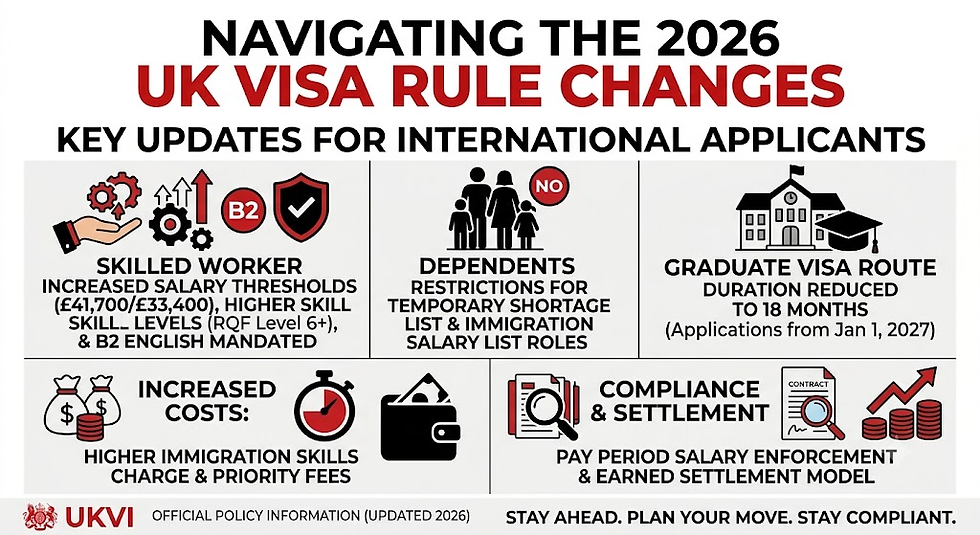
The landscape of immigration in the United Kingdom is undergoing one of its most transformative overhauls in modern history. Following the milestone policy frameworks introduced in recent years, the year 2026 brings sweeping adjustments that impact students, skilled professionals, families, and employers alike.
For international applicants, staying ahead of these structural updates is no longer optional—it is the difference between a successful relocation and a costly visa refusal. This comprehensive guide breaks down the essential legal transformations, updated financial thresholds, and procedural mandates that define the UK immigration framework this year.
The Shifting Philosophy of UK Immigration
The primary catalyst for these sweeping updates is the complete implementation of the policy principles laid out in the government’s comprehensive roadmap, Restoring Control Over the Immigration System. The core strategy focuses heavily on lowering net migration, prioritizing high-skilled international talent, and pushing domestic businesses to invest in the local workforce.
As a result, the routes that once served as accessible entry points for mid-skilled workers or transitional avenues for graduates have been heavily tightened. Navigating this ecosystem requires clear, granular knowledge of the active requirements.
Understanding the Key UK Visa Rule Changes in 2026
The structural alterations to the immigration rules cross multiple visa categories. Below, we dissect the major updates that every international applicant must factor into their immigration strategy.
1. Elevated Salary Floor and RQF Level Requirements for Skilled Workers
The Skilled Worker visa route has experienced profound changes that fundamentally redefine who qualifies for corporate sponsorship. The baseline requirements have shifted across two critical vectors:
The General Salary Threshold: The standard minimum salary floor for incoming Skilled Worker applicants stands firmly at £41,700 per year, or the specific "going rate" for the occupation code, whichever is higher. This marks a sharp escalation from historical baselines, pricing out many entry-level or junior corporate roles from international recruitment.
The New Entrant Discount: For those under 26, recent UK university graduates, or individuals in professional training, a transitional "new entrant" discount applies. However, this discounted general floor has been lifted to £33,400 per year.
The RQF Skill Level Cap: The minimum skill level required for standard corporate sponsorship has returned to Regulated Qualifications Framework (RQF) Level 6 (equivalent to a bachelor's degree). Approximately 180 medium-skilled roles (historically classified at RQF Levels 3 to 5) have been removed from the general eligible occupations list, narrowing the range of sponsorable positions.
+---------------------------------------+--------------------------+
| Visa Sub-Category                     | Minimum Salary Baseline  |
+---------------------------------------+--------------------------+
| General Skilled Worker (Standard)     | £41,700 per year         |
| New Entrant / Recent Graduate Rate    | £33,400 per year         |
| PhD Holder (STEM Discount)            | £33,400 per year         |
| PhD Holder (Non-STEM Discount)        | £37,500 per year         |
| Global Business Mobility (Senior)     | £52,500 per year         |
+---------------------------------------+--------------------------+
2. Tightened Rules on Dependents and the Shortage Transition
Family relocation rules have faced severe contraction. The previous Shortage Occupation List has been entirely restructured into the highly restricted Temporary Shortage List.
The defining change for 2026 centers on family unity: New applicants applying under roles listed on the Temporary Shortage List or the remaining Immigration Salary List allocations are explicitly restricted from bringing dependents (spouses and children) to the UK.
Furthermore, the Temporary Shortage List operates under strict industrial expiration dates. Aside from adult social care occupations, the current list of medium-skilled exceptions is legally scheduled to sunset on December 31, 2026. Industries utilizing these codes must actively demonstrate domestic workforce development plans to retain sponsorship privileges.
3. The B2 English Language Standard Acceleration
A major operational adjustment implemented at the start of the year involves language proficiency. For all new applicants entering via the Skilled Worker, Scale-up, or High Potential Individual (HPI) routes, the mandated English language benchmark has been elevated from the historical B1 level to the more advanced B2 CEFR standard (Common European Framework of Reference for Languages).
Applicants must demonstrate a stronger command of fluent professional English during their initial application process. This higher B2 standard is also scheduled to become the definitive baseline for permanent settlement applications by late March 2027.
4. Spiking Financial Costs for Sponsors and Applicants
Relocating to or hiring in the UK is demonstrably more expensive. The government implemented a steep 32% increase to the Immigration Skills Charge (ISC).
Large or Medium Sponsors: Must pay £1,320 per sponsored worker for the first 12 months, plus £660 for each additional 6 months. For a standard 5-year visa, large corporate employers face an upfront commitment of £6,600 in skills charges alone.
Small or Charitable Sponsors: Face an updated rate of £480 for the initial 12 months.
Additionally, standard priority processing fees for both sponsor licenses and individual visa applications have scaled upward, driving the total transactional cost of a single corporate visa application package well into the £5,000 to £9,000 range when accounting for the Immigration Health Surcharge (IHS).
Impact on Students and the Graduate Route Strategy
International students must adapt their post-graduation timelines immediately. While the structural integrity of the Graduate Visa (Post-Study Work route) remains intact for the current calendar year, a clear regulatory deadline has been codified.
Crucial Transition Date: For any international student applying for the Graduate Visa on or after January 1, 2027, the standard visa duration will be permanently reduced from 2 years down to 18 months. Only doctoral/PhD holders will retain their specialized 3-year post-study terms.
Furthermore, universities are under heightened oversight via strict student visa compliance protocols implemented in mid-2026. Educational providers face immediate bans on international recruitment if their student completion, baseline attendance, or visa-switching metrics deviate from rigid Home Office performance criteria.
Additionally, the upcoming International Student Levy—a proposed flat annual fee of £925 per international student payable by higher education institutions—is undergoing its final consultation phases, forecasting an indirect rise in global tuition rates.
Corporate Compliance: The "Pay Period" Enforcement Mandate
For international workers already inside the UK or companies managing global mobility programs, payroll compliance has shifted from an annual review process to a real-time audit reality.
Under the updated operational rules, corporate sponsors are legally required to guarantee and evidence that a sponsored Skilled Worker receives their full, pro-rated required salary threshold within every single individual pay period.
Historically, companies could balance out variations in hours, project-based bonuses, or temporary unpaid leaves over an annual average. Now, any dip below the pro-rated threshold within a specific month or week triggers immediate system flags within the UK Visas and Immigration (UKVI) monitoring software. Failing to comply can result in the immediate suspension or revocation of an employer’s sponsor license, rendering all actively sponsored visas invalid.
Settlement and Indefinite Leave to Remain (ILR) Overhaul
The path to permanent settlement in the UK is moving toward an "Earned Settlement" model. The government’s structural shift aims to replace the traditional, automated 5-year residency route with a variable qualifying timeline tethered directly to economic contribution and specific professions.
The Baseline Extension: The default residency period required to claim Indefinite Leave to Remain (ILR) is transitioning toward a 10-year baseline for standard, lower-to-medium earning tiers.
Accelerated Tracks for High Earners: Individuals earning over £125,140 per annum can qualify for a fast-track reduction, allowing full settlement eligibility in as little as 3 years.
Strategic Professional Tracks: High-skilled professionals earning above £50,270, alongside public sector workers in recognized healthcare and teaching tracks, retain an optimized 5-year pathway to permanent residency.
Dedicated FAQ Section
What are the primary UK visa rule changes impacting international applicants this year?
The defining UK visa rule changes in 2026 include raising the general Skilled Worker salary floor to £41,700, elevating the minimum skill requirement to RQF Level 6, increasing corporate sponsorship fees by 32%, and raising the initial English language requirement to the B2 level. Additionally, applicants under the Temporary Shortage List are no longer permitted to bring family dependents.
Can I still switch from a Student Visa to a Skilled Worker Visa inside the UK?
Yes, switching is legally permitted, but you must secure a job offer that satisfies the newly escalated minimum salary thresholds (£41,700 for standard roles or £33,400 under the new entrant graduate exemption) and fits within the updated RQF Level 6 skill classifications.
What is the current minimum salary required for a UK Skilled Worker Visa?
The standard baseline is £41,700 per year. If the specific occupation code's "going rate" designated by the Home Office is higher than £41,700, the employer must pay the higher amount.
How do the 2026 rules affect family members of international workers?
If you are sponsored under the standard, higher-skilled tracks (RQF Level 6) meeting the full salary threshold, you can generally still bring dependents. However, if your role relies on the Temporary Shortage List or specific lower-tier health and care frameworks, bringing family dependents is strictly prohibited.
Strategic Action Plan for Applicants
To successfully navigate this highly restrictive immigration environment, international applicants should follow a precise, structured sequence:
Verify Occupation Codes (RQF Level): Prior to entering formal interviews, check the official UKVI occupational registers to ensure your target job code is classified at RQF Level 6 or holds an explicit, verified exemption.
Audit the Salary Offer Against Local Going Rates: Ensure the gross base salary exceeds both the general £41,700 floor and the absolute 50th percentile going rate for that specific role.
Secure B2 Language Certification Early: Do not rely on older B1 certifications. Schedule an approved Secure English Language Test (SELT) that explicitly verifies B2 competency across reading, writing, speaking, and listening.
Confirm Sponsor License Health: Confirm that your prospective employer maintains an active, A-rated sponsor license and possesses an available allocation of Certificates of Sponsorship (CoS).
Navigating Next Steps
Securing a visa in the United Kingdom requires precision, absolute compliance, and reliable resource tracking. Ensure your application aligns perfectly with active legislation by utilizing official government portals and verification networks.
Assess Personal Visa Eligibility: Use the interactive Official UK Visa Assessment Tool to verify your specific pathway requirements.
Verify Employer Licensing Status: Cross-reference prospective companies against the updated Register of Licensed UK Sponsors to guarantee they hold legal sponsorship clearance.
Review Detailed Worker Criteria: Read the comprehensive frameworks directly on the GOV.UK Skilled Worker Visa Portal to audit active occupation codes and going-rate salary adjustments.


Comments