
MBA in USA 2026: Top Programs, GMAT Requirements, Costs & ROI for International Students
- veddixitcs
- Jul 10
- 6 min read

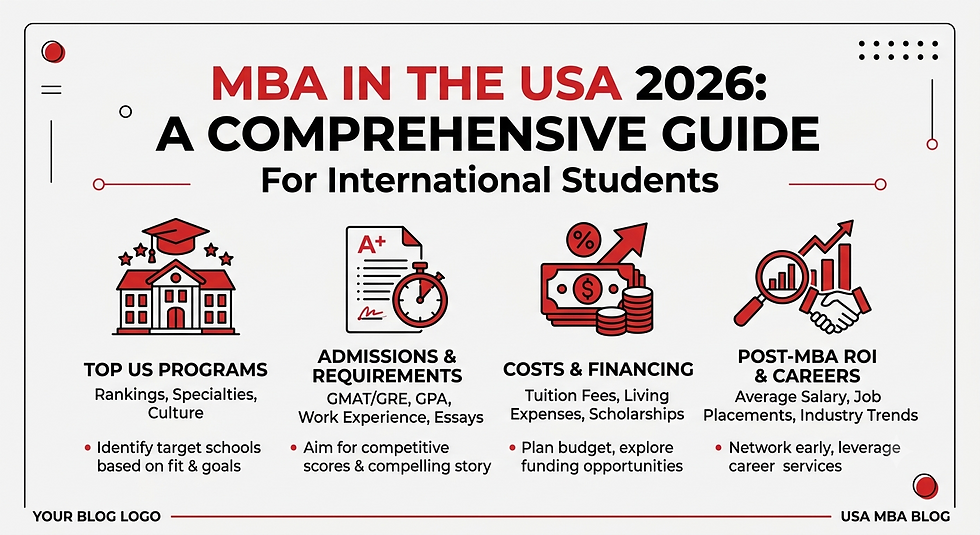
MBA in USA 2026: Top Programs, GMAT Requirements, Costs & ROI for International Students
An MBA remains one of the most consequential investments an international professional can make — and also one of the most expensive. Between GMAT waivers, six-figure tuition, and salary jumps that can exceed 130%, deciding whether an MBA in USA programs are worth it in 2026 requires real numbers, not marketing brochures. Here's a complete, data-backed breakdown of what admission, cost, and return on investment actually look like this year.
Why the US Still Dominates Global MBA Rankings
The United States remains home to more than half of the world's top-ranked business schools, including the widely referenced "M7" group — Harvard, Stanford, Wharton, Kellogg, Booth, MIT Sloan, and Columbia. For the 2026 cycle, Wharton is ranked the top business school globally, followed closely by Harvard Business School and MIT Sloan. These programs dominate hiring pipelines into consulting (McKinsey, BCG, Bain), technology (Google, Amazon, Microsoft), and finance (JPMorgan Chase, Goldman Sachs), which is a major reason international candidates continue to target US programs despite the cost.
GMAT and GRE Requirements in 2026
Standardized testing requirements have loosened considerably in recent years, and this trend has continued into 2026. Roughly 65% of US MBA programs now either waive testing requirements or don't require them at all for qualified candidates. Schools including MIT Sloan, NYU Stern, Michigan Ross, Michigan Ross, Cornell Johnson, Duke Fuqua, and even several M7 schools now offer GMAT waivers for applicants with a strong undergraduate GPA (typically 3.4–3.5+), extensive work experience (often 8–12+ years), or relevant professional certifications like the CFA or CPA.
That said, competitive scores still matter for students without a waiver-qualifying profile. Top 10 MBA programs report average GMAT scores between 720 and 740 on the GMAT Focus Edition scale, while the broader pool of accredited MBA programs shows significantly more variation, with average scores closer to the mid-500s to high-600s depending on program tier. Importantly, GMAT and GRE scores are treated as one signal among several — candidates with lower scores but exceptional leadership experience or a distinctive career narrative are routinely admitted over higher scorers with a generic profile.
Cost of an MBA in USA Programs: 2026 Numbers
Tuition at top-tier (M7 and T25) US business schools now ranges from $75,000 to $92,800 annually, with several elite programs pushing even higher — Columbia Business School tops the list at roughly $88,300 per year, MIT Sloan charges close to $86,550, and Yale SOM sits around $84,900. Across 27 leading US MBA programs, average tuition now exceeds $80,000 annually, with a dozen schools now charging more than $80,000 — up sharply from just seven the year before.
Once you factor in the full cost of attendance, the numbers grow considerably:
Tuition (2 years, top-tier program): $150,000–$185,000
Living expenses: $25,000+ per year in high-cost cities like New York, Boston, or San Francisco
Books, technology fees, and case materials: $2,000–$4,000 per year
Health insurance, networking events, and recruiting travel: an additional $5,000–$8,000 per year
Altogether, total two-year program costs at elite US schools now commonly land between $230,000 and $275,000, once tuition, housing, insurance, and other fees are combined.
More Affordable Paths Without Sacrificing ROI
Not every strong MBA requires a six-figure private-school price tag. Public university programs, part-time formats, and mid-ranked schools with excellent regional reputations can meaningfully reduce costs — sometimes by half — without proportionally reducing career outcomes.
A standout example: the University of Georgia's Terry College of Business was recently named the best-value MBA program in the world, even though it ranks only 60th overall globally. International student tuition at Terry runs about $38,526 per year, for a total program cost of roughly $70,000–$77,000 — a fraction of MIT Sloan's roughly $178,000 in tuition alone. Yet Terry MBA graduates report an average weighted salary of more than $150,000 three years after graduation, with an average salary increase of 134%, meaning graduates can often earn more than double their tuition cost within three years of finishing the program.
Public schools like UC Berkeley's Haas School and Georgia Tech's Scheller College of Business are similarly known for delivering strong returns at meaningfully lower cost than the most elite private programs.
Return on Investment: What the Data Actually Shows
ROI is where an MBA truly earns its price tag — or doesn't. In 2026, top MBA graduates from the most selective programs typically report base salaries in the $175,000–$206,000 range, with M7 schools specifically reporting median base salaries between $175,000 and $185,000. Industry matters as much as school rank: consulting, investment banking, and private equity consistently pay more than other sectors, regardless of whether a program ranks third or tenth overall.
Payback periods vary meaningfully by school tier. Elite M7 programs often see graduates recoup their investment within roughly one year of a $200,000+ starting salary, while mid-tier and value-focused programs typically see a 2.5 to 4-year break-even period. Across the broader MBA landscape, average return on investment sits around 224%, though this figure varies enormously depending on specialization, industry, and school reputation.
The STEM MBA Advantage for International Students
For international students specifically, one factor matters more than almost anything else: whether the MBA program carries a STEM designation. A standard MBA grants F-1 graduates 12 months of Optional Practical Training (OPT) after graduation. A STEM-designated MBA extends that to 36 months total — a 24-month extension on top of the standard period — giving graduates significantly more time to find sponsored employment and multiple additional chances at the H-1B visa lottery.
Given how competitive the H-1B lottery has become, this extended runway has turned STEM MBA designation into one of the single most important filters international applicants use when building their shortlist, often outweighing small differences in overall program ranking.
Scholarships and Financial Aid for International MBA Candidates
The full tuition sticker price is rarely what admitted students actually pay. More than half of MBA students globally receive some form of scholarship, ranging from partial tuition coverage to full-ride awards based on merit or financial need. While need-based aid remains more limited for international candidates than for US citizens, merit-based scholarships and institutional fellowships — including well-known programs at schools like Wharton and Chicago Booth — are genuinely accessible to strong international applicants, and external options like Fulbright scholarships are worth exploring as well.
Application Timing and Rounds
Most top MBA programs run multiple application rounds — commonly Round 1 in September, Round 2 in January, and a smaller Round 3 in March or April. For international candidates specifically, Round 1 tends to offer a modest advantage for both scholarship funding and visa timing, since it gives more runway to complete the F-1 visa process before the program begins. Regardless of round, application quality — essays, recommendation letters, and a clear post-MBA career narrative — should never be sacrificed purely to hit an earlier deadline.
FAQs About Pursuing an MBA in USA Programs
Q1. Do I need a GMAT score to apply for an MBA in USA programs in 2026? A: Not necessarily. Roughly 65% of US MBA programs now offer GMAT or GRE waivers for candidates with a strong GPA (typically 3.4+), significant work experience, or relevant professional certifications. Competitive applicants without a waiver should still target GMAT scores in the 700+ range for top programs.
Q2. How much does an MBA in USA programs typically cost for international students? A: Tuition at top-tier schools ranges from $75,000 to $92,800 per year, with total two-year program costs (including living expenses and fees) commonly landing between $230,000 and $275,000. More affordable public and value-ranked programs can bring total costs down to $70,000–$150,000.
Q3. What is the average ROI for an MBA in the US? A: It varies significantly by school and industry, but average ROI across MBA programs sits around 224%, with top-tier program graduates often earning base salaries of $175,000–$206,000 and recouping their investment within one to four years depending on the school.
Q4. Why does STEM designation matter for international MBA students? A: A STEM-designated MBA extends Optional Practical Training (OPT) from 12 months to 36 months total, giving international graduates significantly more time to secure sponsored employment and additional chances at the H-1B visa lottery.
Q5. Are there good MBA options in the US that don't cost $200,000+? A: Yes. Public university programs and value-focused schools like the University of Georgia's Terry College of Business offer significantly lower tuition — often under $80,000 total for international students — while still delivering strong post-graduation salary outcomes relative to cost.
Ready to Start Your MBA Application?
Choosing the right program means balancing cost, ranking, STEM designation, and career goals against your specific budget. Here's where to research further:
Verify GMAT registration, scoring, and test prep resources directly: GMAC – Official GMAT Website
Check which MBA programs carry STEM designation for extended OPT eligibility: ICE – STEM Designated Degree Program List
Compare official program costs, outcomes, and rankings: U.S. Department of Education – College Scorecard
Which factor matters most to you when choosing a program — ranking, cost, or ROI? Share it in the comments, and in our next post, we'll walk through how to apply for a master's degree in the US, including SOPs, research fit, and funding through assistantships.

Comments