
How to Get Internships in USA as International Student: CPT Rules & Top Companies
- veddixitcs
- 7 days ago
- 7 min read

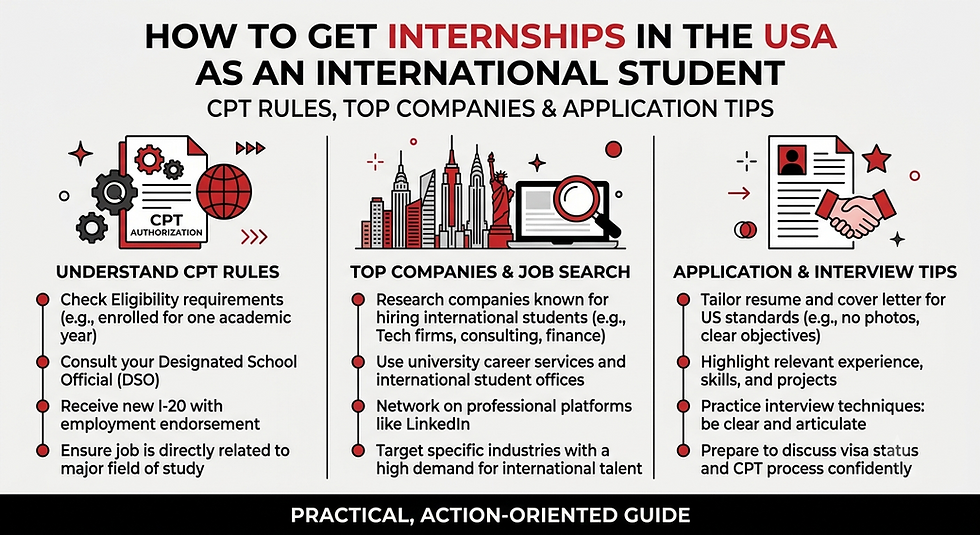
How to Get Internships in USA as International Student: CPT Rules & Top Companies (2026)
Landing your first US internship is often the moment a study-abroad journey starts paying off — it builds resume-worthy experience, opens doors to full-time offers, and gives you a genuine head start toward OPT and eventual H-1B sponsorship. But for F-1 visa holders, the process runs through a specific legal framework most students don't fully understand until they're already searching. Here's exactly how to get internships in USA as an international student in 2026, including CPT rules, where to actually find opportunities, and which companies consistently hire international talent.
Understanding CPT: The Legal Foundation for Your Internship
Curricular Practical Training (CPT) is the primary work authorization that allows F-1 students to take a paid or unpaid internship during their studies. Unlike OPT, which requires a separate USCIS application, CPT is authorized directly by your school's Designated School Official (DSO) — no application to USCIS or separate Employment Authorization Document is required, which makes it considerably faster to arrange once you've secured an offer.
To qualify for CPT, you generally need to:
Have been lawfully enrolled full-time for at least one full academic year (with an important exception below)
Not be studying English as a second language
Have already secured a specific training position — you need the internship offer in hand before applying for CPT, not the other way around
Have the internship be an integral part of your curriculum, meaning it must relate directly to your major and, in most cases, connect to a specific internship course or credit requirement at your school
The graduate student exception: Students in certain master's or doctoral programs whose curriculum requires internship experience from the very start don't need to complete the standard one-year waiting period — some programs authorize CPT from a student's first semester if the internship is a stated degree requirement. Since this list varies by university and by program, check directly with your school's international student office rather than assuming a fixed rule applies everywhere.
Part-Time vs. Full-Time CPT: A Critical Distinction
This is one of the most consequential details in the entire CPT system, and getting it wrong can affect your eligibility for OPT later:
Part-time CPT (20 hours per week or fewer) does not affect your OPT eligibility at all, regardless of how long you use it.
Full-time CPT (21+ hours per week) is fine in moderate amounts, but accumulating 12 months or more of full-time CPT makes you permanently ineligible for OPT at that same educational level.
In practice, this means a single semester-long, full-time co-op is generally safe, but stacking multiple full-time internships across your program can quietly erase your OPT eligibility before you even graduate. Always track your cumulative full-time CPT hours, and consult your DSO before accepting any additional full-time placement if you're unsure how close you are to the 12-month threshold.
The Application Process Step by Step
Secure the internship offer first. Employers don't need to take any special action to hire a CPT-eligible student — applying for CPT is solely the student's responsibility, though the employer typically needs to provide an official offer or employment letter confirming the role.
Register for the relevant internship course, if your program requires one, since successful completion of that course is often necessary for both your current and any future CPT authorizations.
Submit your CPT request to your DSO, generally through your school's international student portal, including your offer letter and any required course registration confirmation.
Receive your updated Form I-20 with the DSO's CPT endorsement, showing your approved employer, dates, and full-time or part-time status — you cannot legally begin working before the start date listed on this document.
Complete your employer's I-9 verification on your first day, using your CPT-endorsed I-20 as proof of work authorization.
Which Companies Actively Hire International Students on CPT
Some of the largest and most consistent CPT employers include Amazon, Google, Microsoft, IBM, Intel, Meta, Adobe, Tesla, and a range of major financial and consulting firms including JPMorgan Chase, Goldman Sachs, Citi, Barclays, Deloitte, and Moody's. This isn't a coincidence: Computer Science is currently the most popular field of study among F-1 students, with 118,137 CS majors in a recent count, which is a major reason technology companies dominate CPT hiring — Amazon, Tesla, and Google in particular maintain robust internship pipelines specifically structured around CPT and OPT timelines.
Beyond the household names, opportunities cluster by field:
Software development internships — regularly offered by Google, Microsoft, and IBM, primarily for STEM-track students
Data science and analytics internships — strong opportunities at Amazon, Meta, and similar large tech employers
Engineering co-op programs — common with aerospace and automotive manufacturers, often structured as longer, full-time placements
Finance and accounting internships — accessible at major banks and consulting firms for students in relevant majors
Marketing and business development internships — spread across technology, healthcare, and consumer products companies
Beyond the large, well-known employers, a substantial number of small and mid-sized firms and startups also offer CPT-eligible roles each year — worth exploring if you're targeting a specific city or niche industry rather than only the biggest brand names.
Where to Actually Search
Finding the right opportunity takes more than browsing a single job board. A layered search strategy consistently works best:
University career platforms — Handshake, Symplicity, or your school's specific career portal. Many listings here are pre-screened for CPT/OPT eligibility or come from employers with a track record of sponsoring international students, making this one of the highest-quality starting points.
Alumni and faculty referrals — Ask professors or academic advisors whether past students from your program have interned at companies in your field; warm introductions from alumni networks are consistently one of the most effective paths into a first internship.
Career fairs — Attend both general university career fairs and any field-specific events, since many employers attending these have already indicated openness to hiring international candidates.
Visa-aware companies — Prioritize firms with a documented history of hiring F-1 students or sponsoring H-1B visas; these employers are typically far more familiar with CPT paperwork and timelines, which reduces friction during the hiring process.
Niche platforms built for international students — Tools like Interstride and GoinGlobal filter specifically for visa-friendly employers, saving significant time compared to searching general job boards where visa policy is often unclear or unstated.
Why an Internship Matters Beyond the Immediate Paycheck
CPT experience delivers value well beyond your first paycheck. It gives you real, résumé-strengthening practical exposure before you graduate, and it builds genuine professional relationships with US-based employers — relationships that can directly lead to future H-1B sponsorship. It's also a meaningful opportunity for career path exploration, letting you test different roles or industries before committing to a full-time job search, and for many students, a strong CPT internship becomes the deciding factor an employer weighs when choosing whom to offer OPT-based full-time employment down the line.
Salary Expectations for CPT Internships
Pay for CPT internships varies considerably by field, employer, and location, but competitive compensation is common in high-demand areas like tech, engineering, and finance — often meaningfully higher than standard on-campus student jobs, since these roles are tied directly to professional-level work rather than general campus employment. As a general pattern, CPT interns in software engineering and data-focused roles at major tech employers tend to see the highest pay among internship categories, while marketing, general business, and smaller-firm roles typically pay less but can still offer strong long-term career value.
Connecting Your Internship to OPT and H-1B Later
A well-chosen CPT internship isn't just a standalone experience — it's often the first link in a longer chain. Many students transition from CPT during their studies, into OPT (and the 24-month STEM extension if eligible) immediately after graduation, and eventually into H-1B sponsorship with the same employer or one they networked with during their internship. Since OPT carries a strict 90-day post-graduation window to secure qualifying employment, having already built a relationship with a visa-aware employer through a strong CPT internship gives you a real head start on that tighter post-graduation timeline.
Practical Tips for a Stronger Application
Apply early and broadly. Internship recruiting for major tech and finance employers often starts 6–9 months before the actual start date, particularly for summer roles.
Tailor your resume to US formatting norms — one page, quantified achievements, no photo, and no personal details like age or marital status, which is standard practice in many other countries but unusual on a US resume.
Practice behavioral interview questions specifically, since US interviews — especially at larger companies — frequently emphasize structured behavioral questions (often following the STAR method: Situation, Task, Action, Result) alongside technical or role-specific questions.
Confirm CPT eligibility with your DSO before accepting an offer, not after, to avoid any timing conflicts with your enrollment status or course registration deadlines.
Track your cumulative full-time CPT hours carefully across your entire program to protect your future OPT eligibility.
FAQs About Getting Internships in USA as an International Student
Q1. What work authorization do I need for internships in USA as an international student? A: Most F-1 students use Curricular Practical Training (CPT) for internships during their studies, which is authorized directly by your school's DSO rather than requiring a separate USCIS application. Internships after graduation typically use Optional Practical Training (OPT) instead.
Q2. Can I do an internship in my first year as an international student? A: Generally no — CPT usually requires completing one full academic year first, though certain graduate programs that require immediate internship participation as part of the curriculum are exempt from this waiting period.
Q3. Will doing a full-time internship affect my ability to use OPT later? A: It can. Part-time CPT (20 hours/week or fewer) never affects OPT eligibility, but accumulating 12 months or more of full-time CPT (21+ hours/week) makes you ineligible for OPT at that same degree level — track your cumulative full-time hours carefully.
Q4. Which companies are known for hiring international students on CPT? A: Amazon, Google, Microsoft, IBM, Intel, Meta, Adobe, Tesla, and major finance and consulting firms like JPMorgan Chase, Goldman Sachs, and Deloitte are among the most consistent CPT employers, particularly in technology, finance, and consulting fields.
Q5. Do I need my internship offer before applying for CPT authorization? A: Yes. You must secure a specific internship offer first, since applying for CPT is the student's responsibility and requires an employer offer or letter as part of the DSO authorization process — CPT authorization comes after you have the offer, not before.
Ready to Start Your Internship Search?
A strong internship can meaningfully shape your entire post-graduation career path — start the search early and understand your visa rules before you apply. Here's where to go next:
Review official CPT and OPT regulations directly from the source: USCIS Policy Manual – Practical Training
Learn about F-1 CPT authorization requirements: Study in the States – Curricular Practical Training
Search internships through your university's career platform (Handshake or Symplicity, depending on your school) as your first and most reliable step.
Have a specific field or company you're targeting? Share it in the comments, and in our final post of this series, we'll cover renting an apartment in the US as an international student, including credit challenges, guarantors, and lease red flags to avoid.

Comments