
How to Apply for a Master's Degree in USA: SOP, GRE, LORs & Research Fit Explained
- veddixitcs
- Jul 10
- 7 min read

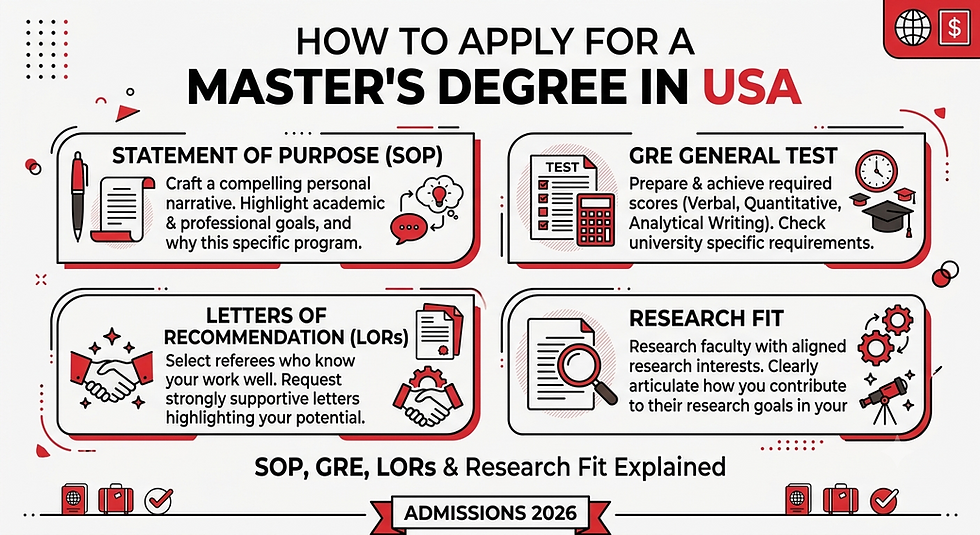
How to Apply for a Master's Degree in USA: SOP, GRE, LORs & Research Fit Explained (2026)
A master's application in the US runs on a fundamentally different logic than undergraduate admissions. It's less about a single "profile score" and much more about narrative fit — how your research interests, prior experience, and target program line up with what a specific department and specific faculty member are actually looking for. Here's a complete, step-by-step breakdown of how to apply for a master's degree in the US in 2026, including current GRE benchmarks, SOP expectations, and how funding through assistantships really works.
Why the US Remains the Top Destination for Master's Study
The scale is genuinely significant: the US currently hosts more than 1.1 million international students, and nearly 45–48% of them are enrolled in STEM-related master's programs, including computer science, data science, engineering, artificial intelligence, and business analytics. According to the QS World University Rankings 2026, the US remains home to roughly half of the world's top 50 universities, and the country invests more than $679 billion annually in research and development — giving STEM master's students access to lab resources and industry partnerships that are difficult to match elsewhere.
Step 1: Understand the Basic Eligibility Requirements
Before shortlisting programs, confirm you meet the baseline academic criteria most US universities apply:
Bachelor's degree: A 4-year undergraduate degree is standard, though a growing number of universities — including CMU and NYU — accept strong 3-year degrees, sometimes requiring a course-by-course credential evaluation from an agency like World Education Services (WES).
Minimum GPA: Generally 3.0 out of 4.0, though competitive programs often admit students well above this baseline.
English proficiency: IELTS scores of roughly 6.5–7.5 or TOEFL iBT scores of 80–100, depending on program competitiveness. Some universities waive this requirement if your prior degree was taught in English.
Standardized test scores: GRE or GMAT, depending on the program (see below for current 2026 requirements).
Step 2: Decide Whether You Need the GRE — Because It's Changed Significantly
This is one of the biggest shifts in US graduate admissions over the past few years. Roughly 65–70% of US universities have now made the GRE optional for master's programs, and several well-known schools — including Northeastern (most Engineering programs), UIUC (MS in Computer Science), and UC San Diego (MS and PhD in Computer Science and Engineering) — have waived it entirely for select programs heading into Fall 2026.
That said, top-ranked and highly competitive programs, particularly in Computer Science, AI, and Engineering, still recommend or require it. If you do take the exam, here's how to benchmark your score:
300–310: Considered average, generally sufficient for Tier 2 and Tier 3 universities
310–319: Considered good, competitive for most mid-ranked programs
320–327: Considered excellent, meaningfully strengthens scholarship and assistantship chances
328+: Frequently required or strongly preferred for fully funded master's and PhD programs with a tuition waiver plus stipend
It's worth noting these are approximate benchmarks based on admitted-student averages, not official hard cutoffs — universities evaluate your GRE score as one part of a holistic profile alongside GPA, research experience, and your SOP. A 310 with strong research experience and an excellent SOP frequently outperforms a 330 attached to a generic, unfocused application.
Step 3: Identify Your Research Fit Before You Apply
This is the step applicants from undergraduate-style application systems most often underestimate. Unlike a general undergraduate application, a strong master's application — especially for thesis-based or research-heavy programs — should demonstrate a clear connection between your interests and the specific faculty and research happening at that department.
Practical ways to build this fit before submitting your application:
Read recent publications from professors in your target department and identify two or three whose work genuinely aligns with your interests.
Reach out to potential advisors directly before applying to discuss your research interests — this can meaningfully strengthen your application and give you a much clearer, more specific direction for your Statement of Purpose.
Reference specific labs, courses, or ongoing research projects in your SOP rather than generic statements about the university's "reputation" or "resources."
Programs in fields like anthropology, engineering, and the sciences often explicitly ask applicants to name the faculty member they'd like to work with and their specific geographical or topical area of research — treat this as a serious signal of what admissions committees are evaluating, even when it isn't explicitly required.
Step 4: Write a Statement of Purpose That Actually Stands Out
The Statement of Purpose (SOP) is typically a 1–2 page document, and it carries more weight than most applicants assume. A strong SOP should cover:
Your educational and professional background, and what specifically led you toward this field
Your research interests, described with enough specificity to show genuine familiarity with the subject area
Why this particular program and, where relevant, which specific faculty member you'd like to work with
Your long-term career goals and how this graduate degree connects directly to them
If your undergraduate degree isn't directly related to your intended master's field, a clear explanation of why you're making that transition
Admissions committees assess SOPs for academic background, analytical and communication skills, and demonstrated research experience — generic, templated statements that could apply to any university are one of the most common reasons otherwise qualified applicants get rejected.
Step 5: Secure Strong Letters of Recommendation
Most programs require two to three letters of recommendation (LORs), ideally from professors or supervisors who can speak specifically to your academic capabilities and likelihood of success in graduate study — not just general character references. Approach recommenders early, ideally three to four months before your deadline, and provide them with your CV, draft SOP, and a short summary of the specific points you'd like them to address, since specific, detailed letters carry significantly more weight than generic ones.
Step 6: Build the Rest of Your Application Package
A complete master's application typically includes:
Official transcripts from all institutions attended (with GPA conversion to the US 4.0 scale where needed)
GRE/GMAT scorecard (if required or submitted voluntarily)
TOEFL/IELTS scores (for non-native English speakers, unless waived)
Statement of Purpose
Two to three Letters of Recommendation
Updated resume or CV
Proof of funds (required later, once admitted, for your I-20 and F-1 visa)
Most applicants apply to a mix of six to ten universities spanning ambitious, moderate, and safety tiers — a strategy that meaningfully increases the odds of securing at least one strong offer while still reaching for top-choice programs.
Step 7: Understand How Assistantship Funding Actually Works
This is a critical reality check many applicants don't get until it's too late in their planning. While roughly 502,000 international graduate students enrolled in US universities in the most recent academic year — an all-time high — funded opportunities remain scarce specifically for master's students. Nationally, there are approximately 220,000–240,000 total assistantships available, with international master's students facing roughly 10-to-1 odds for any given position, since most universities allocate 70–90% of assistantships to doctoral students. In practice, this means only about 10% of international MS students secure Teaching Assistant, Research Assistant, or Graduate Assistant funding.
Your odds improve meaningfully if you apply to thesis-based programs rather than coursework-only master's tracks, since faculty with active research grants genuinely need research assistants to complete funded project work — creating natural RA openings that simply don't exist in coursework-only programs. It's also worth knowing that several major universities have reduced graduate funding recently due to budget constraints, so don't assume assistantship funding will be available even at well-resourced institutions — plan your finances as though you'll be self-funded, and treat any assistantship offer as a bonus rather than an expectation.
Cost Planning: What to Budget Alongside Tuition
Total annual cost for a master's degree in the US, including tuition and living expenses, typically ranges from $35,000 to $80,000 depending on the university and location. One-time costs on top of this include the $350 SEVIS fee and $185 visa application fee once you're admitted and applying for your F-1 visa. Most master's programs require 30–36 credits, structured around credit completion rather than a fixed calendar timeline, so program length can vary somewhat based on course load.
FAQs About How to Apply for a Master's Degree in USA
Q1. Do I need the GRE to apply for a master's degree in USA programs in 2026? A: Not necessarily. Roughly 65–70% of US universities have made the GRE optional for master's programs, though top-ranked and highly competitive programs in fields like Computer Science and Engineering still recommend or require it.
Q2. What GRE score do I need for a fully funded master's degree in the US? A: For programs offering a tuition waiver plus stipend, aim for a GRE score of 328 or higher, with strong Verbal and Quantitative sub-scores. Scores of 320+ significantly improve chances for merit scholarships and assistantships more broadly.
Q3. How important is research fit when applying to a US master's program? A: Very important, particularly for thesis-based programs. Reaching out to potential faculty advisors before applying and referencing specific research areas or labs in your SOP meaningfully strengthens your application compared to generic statements about program reputation.
Q4. Are teaching or research assistantships common for international master's students? A: They're more competitive than most applicants expect — only about 10% of international MS students secure TA/RA/GA funding nationally, since most assistantships go to doctoral students. Thesis-based programs generally offer better odds than coursework-only tracks.
Q5. How far in advance should I start my master's application process? A: Ideally 12–18 months before your intended intake. This gives you time to prepare for the GRE (if required), draft a strong SOP, secure quality recommendation letters, and research faculty fit at your target programs.
Ready to Start Your Master's Application?
A strong master's application comes down to specificity — in your research interests, your SOP, and your university shortlist. Here's where to go next:
Register for or research the GRE exam: ETS – Official GRE Website
Search official program requirements and deadlines by university: EducationUSA – U.S. Department of State
Get your foreign credentials evaluated for US graduate admissions: World Education Services (WES)
Which part of the process feels most uncertain right now — the SOP, funding, or finding the right research fit? Share it in the comments, and in our next post, we'll cover education loan options for international students studying in the US, including interest rates and repayment timelines.

Comments