
How Internships During Your Master's Can Improve Your Career in Europe

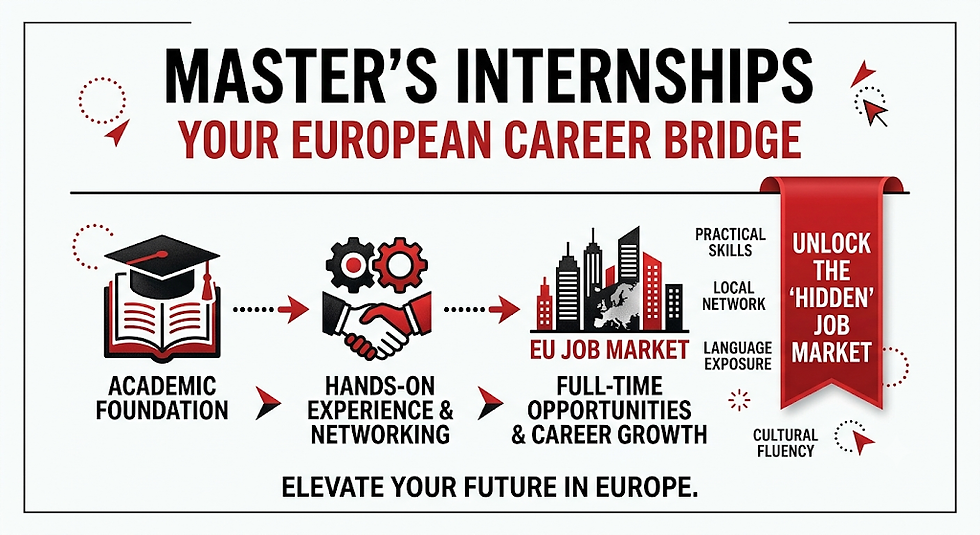
Navigating the European job market can feel like trying to decode a complex, multi-lingual puzzle. If you are pursuing a postgraduate degree, you have likely realized that academic excellence alone no longer guarantees a golden ticket to employment. In today's competitive corporate climate, real-world regional experience is the ultimate differentiator.
Integrating hands-on work experience into your academic timeline is one of the most strategic moves you can make. The data backs this up: according to recent Eurostat labor reports, the employment rate for recent tertiary graduates in the European Union reached a stellar 87%. However, landing those coveted roles in top-tier economic hubs like Germany, the Netherlands, or France heavily depends on practical familiarity with local corporate culture.
Let's explore exactly how internships during your master's can improve your career in Europe, transforming you from an academic applicant into an indispensable asset.
1. Bridging the Gap: Academic Theory Meets European Corporate Culture
European universities are globally renowned for their rigorous theoretical frameworks. Whether you are studying data science in Munich, luxury brand management in Paris, or sustainable development in Stockholm, you will absorb deep foundational knowledge. Yet, knowing the theory behind an algorithm or supply chain model differs drastically from applying it within an active corporate setting.
An internship serves as a dynamic laboratory where you can stress-test your classroom knowledge. More importantly, it acts as a cultural translator. European business environments are far from monolithic:
Northern and Western Europe: Highly value flat hierarchies, direct communication, and an emphasis on collaborative consensus.
Southern Europe: Navigates corporate spaces through nuanced relationship-building and distinct professional protocols.
Understanding these operational subtitles—ranging from managing hybrid work dynamics to utilizing localized workplace tools—cannot be learned from a syllabus. Gaining this exposure prior to graduation prevents the culture shock that often hits new hires, allowing you to hit the ground running on day one.
2. Unlocking the Hidden European Job Market Through Networking
In Europe, a vast percentage of mid-to-high-level vacancies are never published on public job boards. Instead, they are filled internally or via professional recommendations. This dynamic is commonly referred to as the hidden job market.
+-------------------------------------------------------------+
|               THE EUROPEAN GRADUATE JOB FUNNEL              |
+-------------------------------------------------------------+
|  [ Public Job Boards ]  --> High Volume, Low Conversion     |
|          |                                                  |
|          v                                                  |
|  [ The Hidden Market ]  --> Filled via Internal Referrals   |
|          ^                                                  |
|          |-- ENTER HERE: Master's Internships & Placements  |
+-------------------------------------------------------------+
When you step into an office as an intern, you gain immediate, legitimate entry into this hidden ecosystem. You are no longer just an anonymous resume filtering through an automated Applicant Tracking System (ATS); you are a familiar face working right down the hall.
By collaborating with cross-functional teams, attending company-wide standups, and participating in informal coffee chats, you actively build organic professional relationships. The colleagues and mentors you interact with during a six-month placement often become the direct references who vouch for you when internal roles open up.
3. Maximizing the Direct Conversion Pipeline to Full-Time Roles
For major multinational corporations across Europe—including tech giants, financial institutions, and engineering firms—internship programs function as extended, low-risk tryouts. Rather than relying on a couple of brief interview rounds to evaluate a candidate, employers get to observe your work ethic, problem-solving skills, and cultural fit over several months.
Industry Insight: Data from the 2025–2026 European Graduate Employment Surveys indicates that up to 60% of structured corporate internships lead directly to full-time job offers upon graduation.
For companies, converting a proven intern into a full-time employee drastically reduces recruitment costs and minimizes onboarding time. For you, it eliminates the stressful, months-long post-graduation job hunt. You can return to your university to finish your master's thesis with a signed contract already in hand.
4. Gaining Critical Local Language and Regulatory Exposure
For international students arriving from outside the EU, the professional landscape presents two major hurdles: language barriers and complex immigration compliance. Undertaking a professional placement elegantly addresses both obstacles.
Overcoming the Language Barrier
While English serves as the primary corporate language within global tech hubs, finance sectors, and digital agencies, local language proficiency remains a massive competitive advantage. Working day-to-day in an office in Frankfurt, Amsterdam, or Barcelona exposes you to local corporate terminology, industry jargon, and client communication styles that regular language classes simply miss.
Navigational Legalities and Visas
In many European countries, student visas come with built-in permissions to work a specific number of hours per year or include mandatory internships directly within the curriculum.
Completing an internship gives you a practical look at how local labor regulations operate, including tax declarations, social security registrations, and working hour limits. This foundational knowledge proves incredibly useful when transitioning to post-study work visas, making you look much more informed and prepared to future employers.
5. Cultivating In-Demand Digital and Adaptability Skills
The European corporate landscape in 2026 is moving faster than ever, driven by rapid digital transformation and green energy transitions. Employers are no longer looking for static skill sets; they want agile professionals who can pivot alongside emerging technologies.
Recent hiring trends show that nearly 70% of master’s-level interns actively use generative AI tools for advanced data analysis, predictive modeling, coding, and strategic reporting right in their daily workflows.
Top Skills Demanded by European Employers (2026)
--------------------------------------------------
1. Applied AI & Data Literacy  [████████████████] 88%
2. Cross-Cultural Collaboration [██████████████] 76%
3. Agile Project Management    [█████████████] 72%
4. Sustainability Metrics      [███████████] 60%
Securing an internship allows you to work directly with these modern enterprise systems. Graduating with a resume that highlights real-world experience managing automated workflows, analyzing cloud-based data, or coordinating international projects makes you stand out in any pile of applications.
A Step-by-Step Strategy to Landing a European Master's Internship
Knowing the benefits is one thing, but securing the actual position requires a clear, proactive approach. Use this structured strategy to kickstart your application journey:
Verify University and Visa Guidelines: Month 1
Check with your university's international office to confirm the exact credit requirements for internships. Verify the maximum working hours allowed under your specific student visa to ensure total compliance with local labor laws.
Localize Your Application Materials: Month 2
Adapt your CV to match regional preferences (such as using the standard Europass layout or country-specific formats like the German 'Lebenslauf'). Ensure your LinkedIn profile is fully optimized with relevant industry keywords.
Target Regional Job Portals: Months 3-4.
Look beyond generic platforms. Explore highly targeted resources like EURES for cross-border opportunities, or utilize EURAXESS if your master's focus leans heavily toward research and development.
Prepare for Regional Interview Formats: Month 5.
Practice handling situational interview questions and technical assessments. Be ready to explain exactly how your academic research directly addresses the real-world operational challenges the target company faces.
Frequently Asked Questions (FAQ)
Are internships during your master's can improve your career in Europe if they are unpaid?
While paid roles are always ideal, even unpaid or stipended placements can significantly improve your career prospects if they offer top-tier mentorship and high-impact project experience. That said, many European nations have strict labor laws requiring mandatory internships that are part of a university curriculum to be compensated, ensuring fair treatment for student professional development.
Which European countries offer the highest graduate employment rates?
According to latest Eurostat data, Malta (91.0%), Germany (90.6%), and the Netherlands (90.1%) lead the region with the highest overall employment rates for recent graduates. Securing an internship within these highly active economies during your studies is a brilliant way to position yourself for long-term career success.
Can an international non-EU student complete an internship in Europe?
Yes, absolutely. Most European student visas are specifically designed to accommodate internships, particularly if the placement is a mandatory requirement for completing your degree. Always coordinate closely with your university’s international student office to ensure your paperwork and working hours align perfectly with local immigration regulations.
How long do typical master's internships last in Europe?
The majority of master's-level internships run between 3 to 6 months. This timeframe is ideal because it gives you enough room to take ownership of substantial, long-term corporate projects, integrate seamlessly into the team dynamic, and make a lasting impression on hiring managers.
Step Into the European Professional Arena
Pursuing a master's degree in Europe provides a fantastic academic foundation, but pairing that education with a targeted internship turns your hard work into a launching pad for your career. By stepping out of the lecture hall and into the professional world, you unlock the hidden job market, build a robust network of professional connections, and gain the practical skills needed to thrive in a global economy.
Your future career won't wait until graduation—the groundwork starts right now.
Ready to Launch Your International Career?
Don't wait until finals week to start thinking about your professional future. Explore cross-border European vacancies today by visiting the official EURES Job Portal, or discover high-impact innovation placements through EURAXESS. Your journey toward a successful global career is just one application away!


Comments