
Germany's New Security Measures: Complete Public Safety Updates

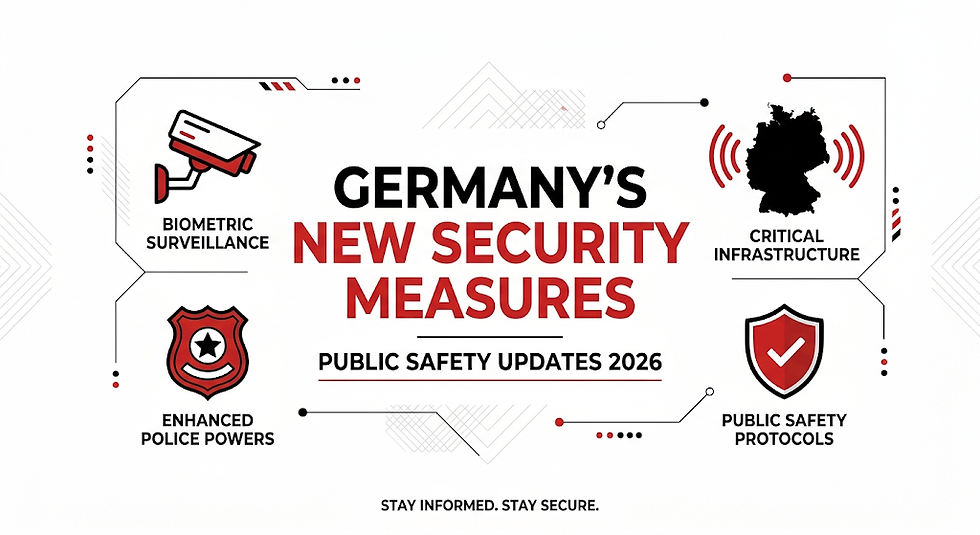
The landscape of domestic security and public order in Germany is undergoing a profound and highly visible structural shift. Driven by evolving domestic challenges, hybrid geopolitical threats, and a modernizing framework for surveillance, the German federal government has enacted sweeping legislative updates.
At the center of this domestic evolution stands the Security Package 2.0, alongside a massive €35 billion Space Safety and Security Strategy and the newly codified KRITIS Umbrella Law. For citizens, residents, and international professionals operating within Europe’s largest economy, staying abreast of these updates is paramount.
1. Elevated Alert: Moving to a "High Threat Level"
Domestic safety parameters underwent an immediate structural upgrade. In an official announcement, the Federal Ministry of the Interior formally shifted Germany's security posture from an "abstract threat level" to a "high threat level."
Official Stance: Under this designation, the risk of localized infrastructure or public space attacks must be actively factored into emergency and operational planning at all times. Authorities have cited clear, discernible intelligence pointing to sophisticated risks targeting both physical infrastructure and prominent public institutions.
This baseline threat landscape forms the primary catalyst for the major police and data tracking expansions deployed under recent legislation.
2. Security Package 2.0: Deep Dive into Enhanced Policing Powers
Passed by the federal cabinet, Security Package 2.0 bundles together interrelated draft laws specifically designed to optimize digital investigative powers across the Federal Criminal Police Office (BKA) and the Federal Police. These provisions fundamentally rewrite the rules regarding automated surveillance and public space policing.
Automated Data Networking and Analysis
Through the introduction of Section 98e of the Code of Criminal Procedure (StPO), investigative agencies are now authorized to network previously disparate police databases. Artificial intelligence systems can search these data nodes simultaneously, mapping out behavioral connections and tracking moving targets within seconds.
Biometric Real-Time Facial Recognition
The deployment of public computer-vision platforms marks a major shift in urban safety management:
Active Urban Pilots: Cities like Frankfurt am Main have formally rolled out real-time biometric facial recognition pilots at high-capacity transport hubs.
Intelligent Video Analysis: Cities including Mannheim, Heidelberg, and Hamburg are actively training and operating predictive AI video networks to analyze crowd behaviors and scan for wanted individuals.
Internet Scraping Powers: Authorities are legally permitted to cross-reference biometric data extracted from criminal files directly against publicly available images, web pages, and social media platforms.
No-Cause Stop and Search Zones
Public presence policies have dramatically tightened. The Federal Police are empowered to conduct stop-and-search procedures on any individual without specific cause when operating inside designated weapons and knife prohibition zones—primarily localized around busy railway networks and city centers. This physical enforcement is backed up by widespread drone reconnaissance and vehicle license plate scanners actively deployed across Germany's borders.
3. Redefining Infrastructure and Space Security
Domestic defense is no longer limited to terrestrial police patrols. The German government has implemented comprehensive, multi-layered defensive frameworks spanning critical utilities up to satellite communication networks.
The KRITIS Umbrella Law
To comply directly with the European Union’s Critical Entities Resilience (CER) Directive, Germany passed the KRITIS Umbrella Law. This legislation establishes strict, uniform physical security baselines across 11 key sectors, including energy, health, finance, transport, space, and digital telecommunications.
Systematic Auditing: Critical infrastructure operators must conduct rigorous, multi-layered risk analyses at minimum once every four years.
Enforced Penalties: The Federal Office for Civil Protection and Disaster Relief (BBK) oversees compliance and possesses the legal teeth to levy hefty fines ranging from €100,000 to €1 million for systemic security violations.
Drone Defense Infrastructure: Due to rising localized sabotage and drone incursions, Germany launched the Joint Drone Defence Centre to unify defensive interception strategies across state police forces and the Bundeswehr.
Germany's Space Safety and Security Strategy
For the first time in modern cabinet history, Germany adopted a dedicated Space Safety and Security Strategy, committing a massive €35 billion budget up to 2030. The strategy prioritizes building autonomous satellite constellations, fortifying electromagnetic defense systems, and enhancing cyber capabilities to protect crucial national and European space assets against foreign state aggression.
4. Understanding Germany's New Security Measures
To see how these broad changes impact standard daily interactions, travelers, and corporate security obligations, evaluate the structural breakdown below:
Security Domain | Previous Standard | 2026 Operational Framework |
Public Video Monitoring | Localized closed-circuit loops | Real-time biometric AI scanning and automated internet image cross-referencing. |
Police Stop & Search | Mandated probable cause/suspicion | No-cause searches permitted within weapon/knife exclusion zones. |
Infrastructure Compliance | Sector-specific, siloed IT guidelines | Cross-sector KRITIS Umbrella Law with mandatory auditing and heavy fines. |
Digital Communications | Target-specific court warrants | Preventive telecommunications surveillance (Quellen-TKÜ) and mandatory IP retention. |
5. Migration Enforcement, Asylum Revisions, and Naturalization
Public safety initiatives remain structurally bound to stricter, highly controlled border policies. Federal Minister of the Interior Alexander Dobrindt has overseen the deep implementation of the Common European Asylum System (CEAS) into national German law, drastically reshaping border control.
Permanent Border Checks: Temporary border controls and active entry refusal mechanisms remain strictly enforced across Germany's internal Schengen borders to reduce irregular migration paths.
Accelerated Deportation Pipelines: Under the updated Federal Police Act, authorities can bypass local municipal immigration offices, applying for pre-trial deportation detention orders directly via competent courts to accelerate removals.
Tightened Naturalization Criteria: The window for fast-track citizenship has formally closed. The minimum lawful residence requirement for naturalization is fixed at 5 years (up from the historical 3-year fast-track allowance), reaffirming that citizenship represents the final step of successful cultural and economic integration.
Frequently Asked Questions
What are the main changes introduced under Germany's new security measures?
The updates focus heavily on expanding digital investigative powers via Security Package 2.0, allowing real-time biometric facial recognition in public transport spaces, enabling cross-database AI analysis, enforcing strict physical protection standards under the KRITIS Umbrella Law, and applying rigorous controls along national borders.
How do no-cause stop and search zones affect daily transit passengers?
Under the expanded Federal Police Act, police personnel do not require predefined suspicion or probable cause to stop and search individuals who are physically moving through designated weapons and knife prohibition zones, which frequently encompass major central train stations and municipal airports.
Are private companies affected by the KRITIS Umbrella Law?
Yes. Private or public corporations operating within essential sectors (such as energy, transport, communications, IT, and food supply) that meet the critical size criteria must perform documented risk analyses every four years and face fines of up to €1 million for structural non-compliance.
Does the elevated "high threat level" alter travel rules for international visitors?
While the visa-free 90-day travel list remains active for eligible third-country nationals, visitors should expect significantly higher police presence, routine identity verifications, vehicle scanners at borders, and stricter security queues across major transit hubs due to active threat monitoring.
Stay Compliant and Secure in a Shifting Germany
Navigating a highly monitored, secure European landscape requires precise corporate and personal operational planning. Ensure your organizational risk management strategies, travel protocols, and compliance mechanisms align directly with the latest statutory announcements.
To review formal legal updates and structural shifts in domestic security, check out the official Federal Ministry of the Interior (BMI) Security Hub.
For detailed regulatory information regarding critical entity infrastructure requirements, reference the Federal Office for Civil Protection and Disaster Relief (BBK).
To evaluate operational parameters, legal changes, and digital tracking updates, track the Federal Criminal Police Office (BKA) Statutory Frameworks.
Disclaimer: Domestic security policies and legislative mandates can adjust rapidly based on real-time threat landscapes. Always cross-reference operational plans with official government gazettes or seek specialized legal counsel within the Federal Republic of Germany.
For a visual breakdown of the broader EU-wide context shaping these national changes, watch this analysis on the updated European Border and Entry Strategies for 2026 which covers upcoming electronic entry systems and travel frameworks impacting Germany.


Comments