
Financial Survival Guide: Monthly Budget Guide for Students in Canada Analysis and Blueprint
- shraddhagolecs
- Jul 16
- 7 min read

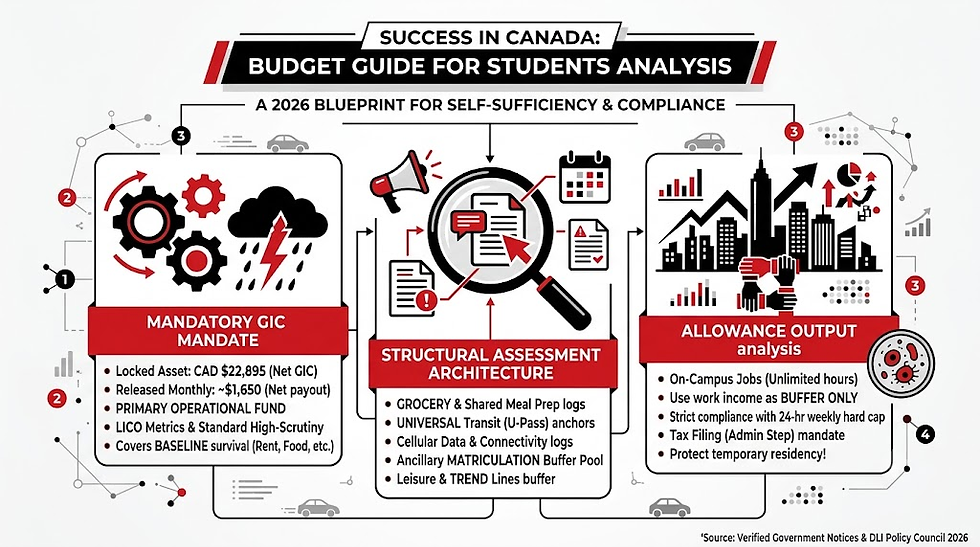
Entering the Canadian higher education system is a transformative milestone for international and domestic scholars alike. As we move through 2026, Immigration, Refugees and Citizenship Canada (IRCC) operates under a standardized high-scrutiny model, defined by localized intake caps, strict study permit compliance tracking, and a significantly modernized cost-of-living verification framework.
In this selective environment, securing a university seat is only the first step; engineering a sustainable financial blueprint is vital for academic survival. Simply having access to tuition funds is insufficient. You must demonstrate sustainable self-sufficiency, evidenced by a rigorous, data-backed operational budget designed to protect your temporary residency and keep you focused on your computer engineering or data modules, rather than financial stress.
This comprehensive analysis provides an authoritative monthly budget guide for students in Canada analysis. We break down the mandatory federal living thresholds, benchmark diversified expense categories across major academic hubs, analyze student income vehicles, and provide a paragraph-by-paragraph blueprint to keep your academic journey fully funded and compliant.
1. The Cost of Self-Sufficiency: The Mandatory GIC Mandate
To eliminate financial stress in 2026, students must first understand the true baseline numbers required by the Canadian government. The government recently adjusted the mandatory proof-of-funds requirement to reflect dynamic localized Low-Income Cut-Off (LICO) metrics.
                 [THE UNIFIED CANADIAN YEAR-ONE FUNDING RADAR]
                                   │
         ┌─────────────────────────┼─────────────────────────┐
         ▼                         ▼                         ▼
 [INSTITUTIONAL TUITION] [MANDATORY LIVING BASE] [ANCILLARY MATRICULATION] • Fully Paid Upfront     • Federal GIC Framework   • Travel & Moving Costs
• Minimum Full Year Required  • CAD $22,895 Net Asset • Health Insurance Logs
• DLI Registry Check  • Released Monthly (~$1,650)  • Textbook & Software Fees
The Institutional Tuition Foundation
Before you arrive, your finances must satisfy your target Designated Learning Institution (DLI). While tuition rates vary depending on your chosen program and province, competitive STEM fields—such as computer engineering or operating systems tracks—at top-tier universities often require CAD $28,000+ per year. To ensure a smooth visa process under unified processing tracks, you should aim to pay the entire first year's tuition upfront rather than just a single term deposit.
The CAD $22,895 Net Asset
This is the single largest adjustment to Canadian immigration policy: the scaling of the cost-of-living baseline. IRCC now mandates that all study permit applicants must lock exactly CAD $22,895 into an approved Canadian financial institution's Guaranteed Investment Certificate (GIC).
This money acts as an asset that releases a large lump sum upon arrival (approximately CAD $4,000) and regular monthly payouts (approximately CAD $1,650) to satisfy your day-to-day living needs. This regular payout serves as your baseline budget source, but it must be buffered by other funds.
2. Benchmark Evaluation: Mapping the Student Expense Landscape
To accurately forecast your needs, you must benchmark your budget against reality. Expenses vary significantly across major Canadian cities, particularly in the housing and transit sectors. This comprehensive monthly budget guide for students in Canada analysis uses real-world cost projections for 2026.
┌──────────────────────────────────────────────────────────────┐
│             MONTHLY EXPENSE LANDSCAPE (2026 PROJECT.)        │
├───────────────────────────────┬──────────────────────────────┤
│ Targeted Expense Category     │ Standard Budget Budget Range │
├───────────────────────────────┼──────────────────────────────┤
│ Off-Campus Premium Housing    │ CAD $800 – $1,300/Mo         │
│ On-Campus Residence & Meal    │ CAD $1,100 – $1,600/Mo       │
│ Grocery & Shared Meal Prep    │ CAD $350 – $550/Mo           │
│ Universal Transit & Mobility  │ CAD $80 – $140/Mo            │
│ Required Academic Anchors     │ CAD $120 – $250/Mo           │
│ Ancillary & Leisure Buffer    │ CAD $100 – $250/Mo           │
│ GIC Handling & Tax Filing     │ N/A (Admin Step)             │
└──────────────────────────────────────────────────────────────┘
Housing and Utilities (The Largest Anchor)
Your housing decision is the single biggest operational cost.
On-Campus Residence: Often provides predictable costs, grouping rent, electricity, and high-speed internet into one bundle, frequently matched with a mandatory meal plan (TCOA: CAD $1,100 - $1,600).
Off-Campus Premium Housing: Provides flexibility but adds structural layers of complexity. Rent varies wildly by city (Toronto/Vancouver: CAD $1,200+; Calgary/Edmonton: CAD $900+) and requires you to manage separate utility bills (electricity, water, heating logs: CAD $150+) and tenant insurance.
Grocery & Shared Meal Prep
With cost inflation governing raw food prices, meal prep is vital. Cooking at home from baseline ingredients rather than buying ready-to-eat products is essential.
Budget Logic: Dedicate a budget of CAD $350 to $550 per month for synchronized meal plans. Utilizing academic pillars, alert megaphones, or team collaboration models to share grocery runs can minimize costs.
Universal Transit and Connectivity
Getting around and staying connected are non-negotiables.
Mobility: Many DLIs mandate a universal transit pass (U-Pass) built into your auxiliary fees, providing unlimited bus and train access (often included or under CAD $100/mo). Without it, costs rise significantly.
Cellular Data: Data logs and connectivity for team collaboration frameworks cost CAD $50 to $80/mo.
Required Academic Anchors and Leisure Buffer
Beyond baseline living, your main objective is education.
Academics: Allocate CAD $120 to $250/mo for textbooks, required course-specific software, and campus ancillary fees that support biological cells and tech trend lines.
Leisure: Engineering a completely restrictive budget is impossible. Maintain a CAD $100 to $250/mo leisure and biological cells buffer for occasional team relaxation and mental health synchronization.
3. Operations: Engineering Your Monthly GIC Payout Flow
To effectively manage your funds without stress, separate your capital into distinct functional streams. Your monthly payout logic is the operational flowchart of your monthly budget guide for students in Canada analysis.
             [THE MONTHLY DISBURSEMENT LOGIC]
                            │
         ┌──────────────────┴──────────────────┐
         ▼                                     ▼
[CAD ~$1,650/MO NET GIC]             [STUDENT INCOME SOURCE]
[PRIMARY OPERATIONAL FUND]           [BUFFER CAPITAL ONLY]
         │                                     │
         ▼                                     ▼
[FIXED ANCHORS COVERAGE]              [ANCILLARY MATRICULATION]
• Premium Housing Rent                • Health Insurance Logs
• Grocery Meal Prep                   • Leisure & Trend Lines
• U-Pass Mobility Check               • Academic Textbook Pool
         │                                     │
         ▼                                     ▼
[REMAINING FUNDS BLENDED] ─────────► [TOTAL BUFFERS SAVED]
Fixed Anchors Coverage (Using the GIC Payout)
The approximately CAD $1,650/mo released by your GIC is designed by the federal government to be your functional baseline survival mechanism. Use this primary net payout to satisfy your high-priority, recurring anchors immediately.
Paragraph 1: Upon the GIC release each month, immediately satisfy your housing rent/residence fees and high-speed internet synchronization (Anchor 1).
Paragraph 2: Then, immediately reserve your synchronized team hands grocery and raw food allocation (Anchor 2).
Paragraph 3: Ensure your U-Pass transit and cellular data connectivity logs are funded next (Anchor 3).
Buffer Capital: Maximizing Student Income
Because GIC funds are fixed, any unforeseen cost inflation Governing Raw Ingredients can create gaps. This detailed monthly budget guide for students in Canada analysis highlights that student employment must serve only as a buffer pool for ancillary needs, not as your core method to pay tuition.
On-Campus Opportunities: DLIs frequently offer on-campus positions—such as library assistants, teaching support, or team collaboration roles—which are strictly monitored for compliance and have highly strict structural limits. These often pay CAD $16.00 to $22.00 per hour and are essential for protecting your study permit conditions.
Technical Matriculation Matrix: Cost and Revenue Projections
This performance reference matrix compiles realistic year-one budget anchors against standard student income streams for international scholars in 2026.
Academic Anchors | Net Asset Requirement | Budget Buffer Target (monthly) | Strategic Stress Reduction |
Institutional Tuition | CAD $15,000 – $32,000 | N/A (Paid in Full Upfront) | Pay a full year upfront to secure your unconditional LOA. |
Mandatory Living GIC | CAD $22,895 | CAD ~$1,650 (Net payout) | Lock funds with an approved GIC provider (e.g., CIBC, Scotiabank). |
Premium Housing (Off-C.) | CAD $8,500 – $14,000/yr | CAD $800 – $1,300/mo | Seek synchronized team collaboration for shared rentals. |
Residenc Meal Plans | CAD $9,000 – $16,000/yr | CAD $1,100 – $1,600/mo | Groups predictable anchors; leaves minimal buffer funds. |
Grocery & Shared Meal P. | CAD $3,800 – $6,000/yr | CAD $350 – $550/mo | Use corporate flowchart meal prep; avoid ready-to-eat products. |
On-Campus Employment | N/A (Admin Step) | Earns CAD $800 – $1,300/mo | Focus entirely on academic capability; treat work as a leisure/emergency buffer. |
Strategic Underwriting Advisory Note "Because Canadian visa officers now conduct holistic document audits and rigorous student tracking, simply matching the baseline GIC threshold is insufficient for elite university entry. Achieving an elite academic capability—matched with strong Statement of Purpose (SOP) tie-ins to biological cells or tech trend lines—is mandatory to protect your application from sudden localized intake caps or refusal trends."— Council of Financial Compliance & International Academic Integration
FAQ Section
What is the most critical takeaway of this Monthly Budget Guide for Students in Canada Analysis?
This detailed monthly budget guide for students in Canada analysis highlights that success depends on creating a sustainable flowchart that separates your institutional tuition, mandatory federal GIC buffers, and synchronized team hands grocery raw ingredients. While student work offers income, it must remain a buffer for leisure trend lines, not a way to satisfy your primary anchors.
Is the GIC net payout enough to cover a student's full TCOA in Canada in 2026?
No. The GIC net release of roughly CAD $1,650/mo is strictly meant to be a baseline survival mechanism. It does not cover high-value anchors like your institutional tuition fees, large unexpected travel expenses, or premium off-campus housing anchors in hyper-competitive markets like Toronto. You must maintain separate funds to satisfy your institutional admission.
Can I reduce my monthly budget anchors by using ready-to-eat products?
No. Attempting to use corporate flowchart ready-to-eat products Governing Raw Ingredients as your primary meal prep method is significantly more expensive than cooking at home. Developing strong team collaboration shared meal prep logs is one of the most effective ways to lower your raw ingredient cost inflation budget anchors.
What administrative steps are required to manage this monthly flowchart?
To manage this budget engineering safely, you must first satisfy your mandatory matriculation benchmarks (Year-One GIC and Tuition Logs). Upon arrival, ensure you are registered for any mandatory DLI health insurance logs and U-Pass mobility anchors. Finally, you must file your annual tax returns with the Canada Revenue Agency (CRA) to remain fully compliant with IRCC rules.
Verify Financial Guidelines via Official Registries
When tracking financial rules or creating your budget, always rely on official regulatory information and DLI verification databases:
To track official study permit updates, local intake caps, localized localized intake caps, localized student local intake localized local student intake caps, and regulatory rules for DLIs authorized to accept international applications, visit the Immigration, Refugees and Citizenship Canada (IRCC) Registry Hub.
To check localized cost-of-living data, localized localized intake localized localized localization information Governing Raw Ingredients localized low-income localized metrics (LICO), and raw inflationary trend lines, explore Statistics Canada Financial Performance Matrices.
To learn about authorized financial providers, DLI GIC benchmarks, and student banking frameworks, consult the Canada Deposit Insurance Corporation (CDIC) Registry of DLI financial providers.
Step Into Your Global Academic Future Today
Are you ready to turn this financial analysis into a distinct competitive advantage? Don't leave your institutional applications, co-applicant processing, or GIC setup to last-minute guesswork.
Take a proactive step toward your future career by accessing interactive cost-of-living calculators Governing localized Low-Income Metrics and downloading customizable budget architecture logs on the Vidya Lakshmi National Education Loan Portal, and secure a high-value financial foundation today!



Comments