
F-1 Student Visa Process 2026: Complete Guide to US Study Abroad Education
- veddixitcs
- Jul 17
- 4 min read

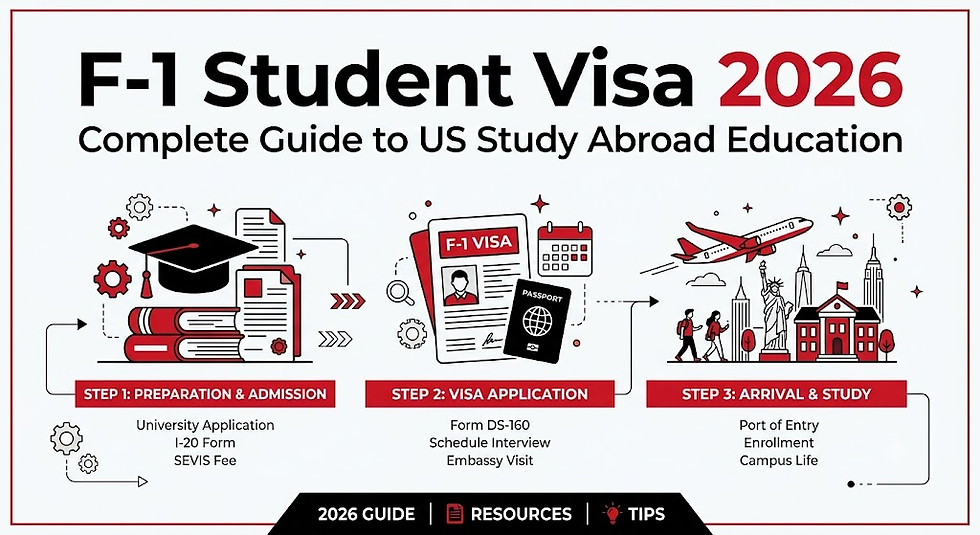
F-1 Student Visa Process : Complete Guide to US Study Abroad Education
Studying abroad in the United States remains a dream for lakhs of international students every year, and 2026 is no exception. With over 1.1 million international students currently enrolled at American universities, the US continues to be the top choice for higher education among students seeking world-class academics, research opportunities, and career growth. But before you can step onto a US campus, you need to successfully navigate the F-1 student visa process — a journey that intimidates many first-time applicants.
This complete guide breaks down every step, fee, and requirement so you can apply with confidence in 2026.
What Is the F-1 Student Visa?
The F-1 visa is the most common nonimmigrant visa category for international students attending an accredited academic institution in the United States — including universities, colleges, conservatories, and certified language training programs. To be eligible, your chosen institution must be certified by the Student and Exchange Visitor Program (SEVP). There are roughly 8,700 SEVP-certified schools across the US, ranging from major research universities to smaller specialized colleges, so students have a wide range of options depending on their academic goals and budget.
Step-by-Step F-1 Student Visa Process in 2026
Understanding the F-1 student visa process step by step can save you months of stress and last-minute scrambling. Here's how it works in 2026:
Step 1: Get Accepted and Receive Your Form I-20
Everything starts with admission. Once a SEVP-certified school accepts you and you've submitted proof of financial support (covering tuition and living expenses), your school's Designated School Official (DSO) will issue Form I-20, your Certificate of Eligibility for Nonimmigrant Student Status. This document is essential — you cannot proceed without it.
Step 2: Pay the SEVIS I-901 Fee
Before you can schedule your visa interview, you must pay the SEVIS I-901 fee, which funds the Student and Exchange Visitor Information System that tracks international students throughout their stay in the US. As of 2026, this fee is $350 for F-1 applicants. Payment is made online at the official SEVP portal, fmjfee.com, using your SEVIS ID number (found on your I-20). This fee is non-refundable, even if your visa is ultimately denied, though you won't have to pay it again if you reapply within 12 months of a denial.
Step 3: Complete the DS-160 Online Application
The DS-160, or Online Nonimmigrant Visa Application, is mandatory for all F-1 applicants. You'll complete this form through the Consular Electronic Application Center (CEAC) website, providing personal, academic, and travel details. Be meticulous here — errors on the DS-160 are one of the most common reasons for delays or additional scrutiny during interviews.
Step 4: Pay the MRV Visa Application Fee
Next comes the Machine Readable Visa (MRV) fee, which is $185 as of 2026. This fee is paid separately from the SEVIS fee, through your local US Embassy or Consulate's designated payment portal, and it's also nonrefundable regardless of the interview outcome.
Step 5: Schedule and Attend Your Visa Interview
Once your fees are paid and your DS-160 confirmation is in hand, book your visa interview at the nearest US Embassy or Consulate. Bring your passport, I-20, SEVIS payment receipt, DS-160 confirmation page, financial documents, admission letter, and passport-sized photos. Dress professionally, stay calm, and be ready to clearly explain your academic program, career plans, and ties to your home country — consular officers are primarily assessing your intent to return home after your studies.
Step 6: Enter the United States
You're permitted to enter the US no earlier than 30 days before your program start date. At the port of entry, a Customs and Border Protection (CBP) officer will stamp your passport and create your I-94 arrival/departure record, which should reflect "D/S" (Duration of Status) rather than a fixed date. You can verify your I-94 anytime at i94.cbp.dhs.gov.
How Much Does the F-1 Visa Really Cost?
Budgeting matters just as much as paperwork. Here's a realistic breakdown for 2026:
● SEVIS I-901 fee: $350
● MRV visa application fee: $185
● Total minimum government fees: $535
Beyond these mandatory charges, expect additional costs such as courier or appointment service fees, photographs, and country-specific charges. Realistically, most applicants should budget between $600 and $2,000 once school-specific fees and logistics costs are factored in. It's worth noting there is no fee waiver for the SEVIS fee, though a parent, relative, or scholarship sponsor can pay it on your behalf.
Common Mistakes Applicants Make
Even strong candidates get rejected due to avoidable errors. Some of the most frequent mistakes include:
● Skipping or delaying the SEVIS fee payment — a confirmed SEVIS record is checked in real time during your interview, and an unpaid fee results in immediate refusal with no same-day fix.
● Inconsistent information across the I-20, DS-160, and interview answers.
● Weak financial documentation that fails to convincingly show you can cover tuition and living costs.
● Poor articulation of post-study plans, which can raise doubts about immigrant intent under Section 214(b).
● Applying too late — experts recommend starting the process 3 to 6 months before your program begins, especially if you're applying from countries with historically long wait times, such as India, China, Nigeria, or Pakistan.


Comments