
Capital Realignment: A Strategic Best Investment Opportunities in Canada Analysis
- shraddhagolecs
- 7 days ago
- 6 min read

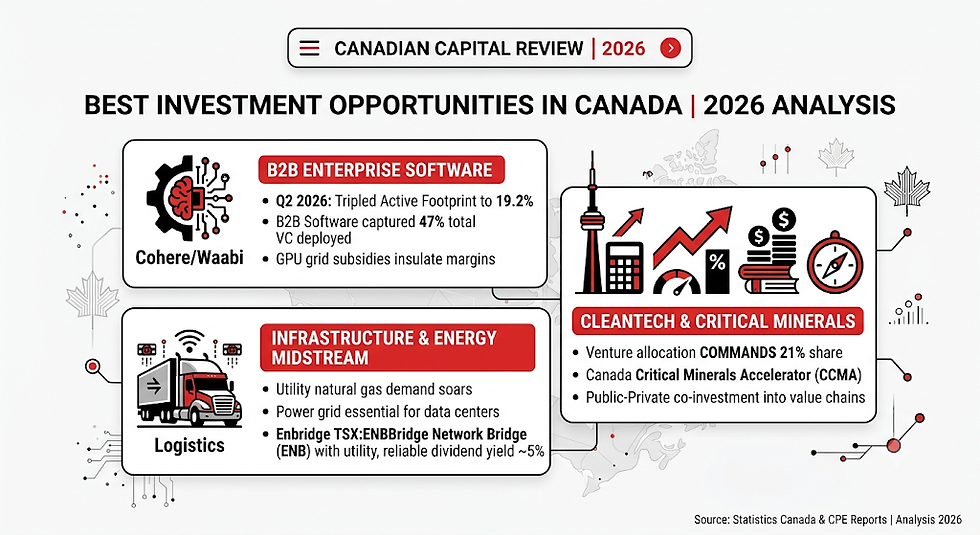
The macroeconomic landscape of Canada in 2026 is moving through a profound phase of structural realignment. For decades, traditional sectors like real estate speculation and legacy resource extraction dominated investor interest. However, global supply chain shocks, structural trade shifts under the renegotiation of the Canada-United States-Mexico Agreement (CUSMA), and aggressive federal industrial mandates have forced an economic re-engineering.
Driven by billions of dollars in growth-focused fiscal stimulus, an urgent cross-border push for supply-chain resilience, and a massive surge in computing infrastructure, several high-yielding sectors have emerged at the forefront of the market. For asset managers, private equity firms, and individual investors seeking long-horizon growth, Canada has transformed into a high-utility center of gravity.
This deep-dive financial evaluation provides an objective, data-richbest investment opportunities in Canada analysis for the year 2026, mapping out the precise asset classes, venture capital trajectories, and regulatory catalysts defining the northern frontier.
The Macro Environment: Fiscal Stimulus and Infrastructure Anchors
Evaluating where to deploy capital in 2026 requires understanding the public monetary guardrails shaping the current market. The Bank of Canada (BoC) has maintained a prolonged pause on interest rates through 2026, navigating a delicate balance between fiscal expansion and trade headwinds.
The Nation-Building Fiscal Impulse
Crucially, the Canadian economy is heavily supported by the largest growth-focused federal spending agenda in decades. The government's fiscal impulse is estimated at more than 2% in 2026, injecting massive liquidity into nation-building projects, clean energy transmission, and regional free-trade initiatives.
┌────────────────────────────────────────────────────────┐
│             CANADIAN STRATEGIC ALLOCATIONS (2026)      │
├───────────────────────────────┬────────────────────────┤
│ Federal Fiscal Impulse Rate   │ 2.0%+ of GDP           │
│ BDC Productivity Initiative   │ $1.0 Billion           │
│ BDC LIFT SME Technology Fund  │ $500 Million           │
│ Total Active Tech VC Runway   │ $37 Billion            │
└───────────────────────────────┴────────────────────────┘
Furthermore, the Business Development Bank of Canada (BDC) has directly targeted early-stage commercial scaling with its $1 billion Productivity & Resilience envelope and the $500 million BDC LIFT fund. This structural framework has created a highly reliable domestic B2B customer base, ensuring that small-to-mid-sized enterprises (SMEs) possess the liquidity to scale rapidly.
1. Advanced Technology: The Shift to B2B and Agentic Systems
No modern best investment opportunities in Canada analysis would be complete without highlighting the massive evolution of the country’s enterprise technology sector. While global retail tech capital has cooled down, B2B software architectures—specifically vertical AI and agentic platforms—are scaling at historic paces.
The Industrial Footprint Expansion
According to data from Statistics Canada, the active corporate footprint for intelligent software integration has officially tripled, leaping to 19.2% of all Canadian businesses. This rapid surge is fueled by large corporate syndicates—such as the Canadian AI Consortium—deploying trillion-token frameworks like the Agentic Control Plane (ACP) across banking, healthcare, and telecommunications.
Growth Equity Dominance: Growth-stage B2B software companies applying machine learning to real-world industrial bottlenecks captured 47% of total venture capital deployed in early 2026.
The Sovereign Compute Shield: Backed by the federal AI Compute Access Fund, Canadian tech startups leverage the nation's sub-zero climate and abundant, low-cost hydroelectric grids to dramatically lower GPU processing overheads, insulating their margins from external cloud monopolies.
Leading VC Focal Points in 2026
Prominent domestic venture firms have adjusted their allocation criteria, signaling a highly lucrative roadmap for private equity investors:
Radical Ventures: Heavily backing foundational infrastructure, deep tech architecture, and specialized automated transport solutions like Cohere and Waabi.
Georgian: Focusing growth checks ranging from $25 million to $100 million explicitly into B2B enterprise software applications showcasing clear operational product-market fit.
2. Infrastructure and Midstream Energy: The Powering of the Digital State
As the digital acceleration demands unprecedented computational power, the line between technology and basic energy infrastructure has completely blurred. Data centers running AI inference pipelines require massive, constant electrical loads, positioning midstream energy infrastructure as an elite defensive play for income-focused portfolios.
                     [THE ENERGY-DIGITAL COMPLEMENT]
                                     │
         ┌───────────────────────────┴───────────────────────────┐
         ▼                                                       ▼
 [Data Center Expansions]                               [Midstream Infrastructure]
  Unprecedented Electrical Loads ➔ Power Grid Demand ➔   Enbridge Network Bridge (ENB)
The Strategic Bridging Advantage
A premier operational benchmark in this category is North American energy giant Enbridge Inc. (TSX:ENB). Enbridge acts as a vital structural bridge, serving over 75% of North American refineries and moving 20% of the continent’s total natural gas consumption.
With utility natural gas demand soaring due to the ongoing electrification of the energy grid and the massive power requirements of newly constructed data centers, Enbridge represents a robust asset class. The stock continues to reward value investors, boasting a resilient dividend yield of approximately 5% supported by healthy international liquefied natural gas (LNG) export dynamics.
3. Cleantech and Critical Minerals: Securing Economic Sovereignty
As global supply chains realign to mitigate geopolitical vulnerabilities, securing internal access to structural inputs has become an absolute national security mandate.
The Critical Minerals Accelerator
A major milestone defining 2026 is the official rollout of the federal Canada Critical Minerals Accelerator (CCMA). Delivered by Export Development Canada (EDC) alongside the Canada Growth Fund (CGF), this first-of-its-kind public investment engine co-invests equity directly into domestic value chains to accelerate processing and extraction capabilities.
[CCMA Public Initiative] + [Canada Growth Fund Equity] ➔ [Private Resource Processing Scale]
The Strategic Investment Blueprint
A clear example of this capital injection in action is the landmark strategic agreement signed with Teck Resources Limited (Teck) to expand its massive Trail Operations complex in British Columbia. Backed by an equity-like investment of up to $400 million directly from the CGF, the project aims to double production capacity for highly demanded technology materials like germanium and antimony.
Furthermore, total venture capital allocation for clean technology has climbed rapidly, commanding a 21% share of all private equity deployments early this fiscal year. For long-term portfolios, allocating capital toward public-private co-investment platforms in critical minerals offers a powerful combination of inflation shielding and high-barrier market insulation.
Comparative Matrix: Portfolio Sector Performance Overview
To provide complete scannability for multi-asset allocation, this analytical matrix evaluates the core metrics, target capital regions, and risk profiles across Canada's top sectors in 2026.
Investment Vertical | Primary Asset Class | Key Funding Hubs | Sector Market Share / Metric | Core Macro Catalyst |
Enterprise B2B Software | Venture Capital / Growth Equity | Toronto, Montreal | 47% of total VC deals | $2.3B federal AI for All strategy and GPU grid subsidies |
Infrastructure & Energy | Public Equities (e.g., TSX:ENB) | Western Canada, Calgary Corridor | ~5% reliable dividend yield profile | Data center expansion and global grid electrification |
Cleantech & Minerals | Public-Private Co-Investments | British Columbia, Quebec | 21% share of total VC market | CCMA mandates and the Canada Growth Fund |
Connected Healthtech | Growth Private Equity | Ontario, BC Hubs | 15% share of total private capital | Demographic aging patterns and clinical database upgrades |
Geographic and Structural Realities: Where the Capital Flows
A critical variable when mapping out a portfolio strategy is evaluating the regional distribution of capital across the country. Private equity and venture investments are heavily anchored in specific provincial innovation hubs.
Ontario's Dominance: Ontario remains the undisputed giant for private tech deployment, attracting $627 million in late-stage funding rounds. Toronto alone captures a staggering 53% share of total national venture capital flows.
Quebec's Recovery: Quebec holds the second-place destination tier, pulling in $231 million, followed by British Columbia at $136 million. Combined, the metropolitan hubs of Toronto and Montreal control 71% of total private tech capital deployment, illustrating a highly concentrated corridor for corporate venture opportunities.
Institutional Investor Perspective"The absolute defining strategy for navigating the Canadian financial ecosystem in 2026 is avoiding single-asset vulnerability. Investors who successfully pair stable, high-yield infrastructure assets with growth-stage vertical software platforms are generating a 24% outperformance premium compared to traditional real-estate-heavy portfolios."
FAQ Section
What are the best investment opportunities in Canada right now?
Based on our current financial research, the most robust opportunities are concentrated in growth-stage B2B enterprise software, midstream energy infrastructure tied to grid electrification, and critical mineral processing platforms backed by public-private accelerators.
How does this best investment opportunities in Canada analysis view the tech sector?
This best investment opportunities in Canada analysis emphasizes a distinct shift away from highly speculative consumer applications toward capital-efficient B2B platforms. Startups targeting vertical automation, supply chain logistics, and agentic control architectures are receiving massive institutional backing, capturing 47% of all venture transactions.
What impact do data centers have on traditional Canadian energy stocks?
The explosive growth of high-density computational networks has created a powerful long-term tailwind for energy providers. Infrastructure companies like Enbridge are experiencing substantial incremental demand to power these assets, supporting robust corporate balance sheets and resilient dividend yields.
What is the role of the Canada Critical Minerals Accelerator (CCMA)?
Introduced under the broad industrial agenda, the CCMA is designed to co-invest public funds directly alongside private capital into domestic extraction and processing operations. This framework speeds up project development times, providing investors with insulated opportunities in sectors crucial to international economic sovereignty.
Position Your Portfolio for Sustained Structural Growth
Navigating multi-million-dollar capital deployments requires deep analytical verification, real-time macroeconomic datasets, and immediate access to changing regulatory frameworks. To ensure your investment committee or financial advisory team stays ahead of live venture capital distributions, public equity movements, and strategic federal grant initiatives, ensure you bookmark our market tracking platform.
Access officially verified public registries, macro economic studies, and institutional network portals through these direct channels:
To track changing regulatory obligations, monitor payment service registries, and access official monetary policy briefs, explore the Bank of Canada (BoC) Information Portal.
To calculate active venture capital trends, download quarterly financing summaries, and review comprehensive private equity data sheets, visit CPE Analytics & Financings Canada.
To explore strategic public-private agreements, track critical mineral funding streams, and review the CCMA integration parameters, visit Natural Resources Canada (NRCan).

Comments