
American Culture and Campus Etiquette: A Guide for International Students
- veddixitcs
- 4 days ago
- 8 min read

American Culture and Campus Etiquette: A Guide for International Students (2026)
Academic preparation gets most of the attention before you move to the US, but the everyday social rules — how close to stand during a conversation, whether to speak up in class, when a tip is actually expected — are the details that shape your daily comfort once you're actually here. Understanding American culture and campus etiquette before you arrive won't eliminate culture shock entirely, but it meaningfully shortens the adjustment period and helps you avoid the small misunderstandings that otherwise pile up in your first few months.
Classroom Participation: The Biggest Academic Culture Shift
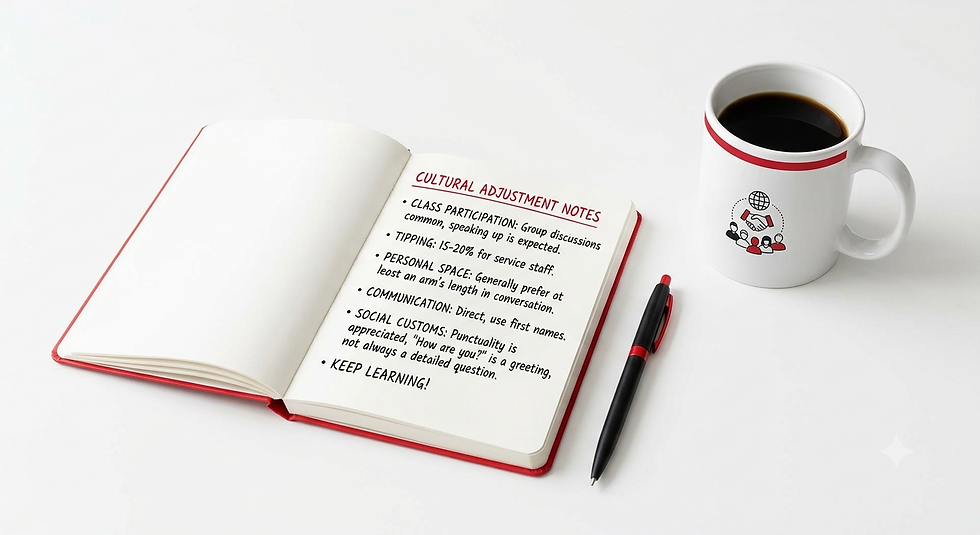
This is consistently the adjustment international students mention first, and for good reason — it's often the most fundamental difference from their prior education system. In American classrooms, active participation is not just tolerated but genuinely expected, and it frequently contributes directly to your overall grade. Students are expected to ask questions, share opinions, and engage openly in discussion, which represents a significant shift for students coming from education systems built around more passive, lecture-based learning with less emphasis on classroom questioning.
Importantly, asking questions or challenging a point a professor makes is not seen as disrespectful — it's read as a sign of genuine engagement and critical thinking. In smaller classes, discussion tends to be informal, and you generally don't need to raise your hand before speaking. In larger lecture-hall settings, professors more often prefer you raise your hand and wait to be called on before contributing. Attendance itself is also treated as a serious expectation, not merely a suggestion, and professors generally prioritize understanding over memorization when evaluating your grasp of material.
A practical tip for professor communication: Address instructors using formal titles — "Professor Jones" or "Dr. Smith" — unless they specifically invite you to use their first name. This is a straightforward way to demonstrate respect while you're still learning a given professor's specific preferences.
Punctuality: Taken More Seriously Than You Might Expect
Being on time is highly valued across American academic and social settings, and arriving late to a class, meeting, or appointment can genuinely be read as a sign of disrespect for other people's time — a stricter norm than in some other cultures where a more flexible relationship with scheduled time is common. A useful general habit: arrive 5–10 minutes early to classes and appointments, and plan your route in advance to avoid unexpected delays, particularly during your first few weeks while you're still learning campus geography and local transit timing.
Personal Space and Physical Greetings
Americans generally value more personal space during conversation than is customary in many other cultures, and standing too close during a conversation can create real, if unspoken, discomfort for the other person. As a general rule, always ask before hugging or engaging in other physical touch with someone you don't know well — a handshake, rather than a hug, remains the standard greeting in academic and professional settings specifically. A firm handshake is generally read as a signal of confidence, though the appropriate firmness and duration vary meaningfully by culture, so this is worth practicing if it isn't already a natural greeting style for you.
Direct Communication: A Recurring Source of Misunderstanding
American communication culture tends to value directness — "yes" is generally intended to mean yes, and "no" is generally intended to mean no, with relatively little of the indirect, context-dependent communication common in many other cultures. This creates a specific and recurring point of confusion: in some cultures, a polite "maybe" is understood as a soft way of declining something, but the same word in American conversational context is frequently taken at face value as genuine uncertainty or even tentative agreement. If you need to decline an invitation or a request, a direct but polite "no, thank you" is generally clearer and better received than an ambiguous, softened response intended to avoid confrontation.
Humor and light sarcasm are also common in everyday American conversation, though sarcasm specifically isn't always obvious and can be genuinely difficult to detect as a newer arrival — it's completely reasonable to ask directly for clarification if you're unsure whether something was meant literally.
Small Talk: What's Safe and What to Avoid
Americans are generally open to casual conversation with people they don't know well — with a coffee shop barista, a classmate, or a stranger in an elevator — but certain topics are typically treated as private, even among otherwise talkative acquaintances. Politics, religion, and personal financial details (including specific salary figures) are generally considered inappropriate subjects for casual or early-stage conversations. Safer, more universally comfortable small talk topics include weekend plans, sports, popular culture, or general shared experiences like classes or campus events.
Tipping: A Genuine Financial Obligation, Not Just a Courtesy
This is one of the more consequential cultural norms to understand early, since getting it wrong has real financial and social implications. Tipping in the US functions as an expected part of the service economy, not merely a bonus gesture, largely because many service workers are paid a reduced base wage specifically under the assumption that tips will supplement their income to a reasonable total. The standard is generally 15–20% of the total bill at sit-down restaurants with table service, and the same expectation typically extends to rideshare and taxi drivers, hairdressers and barbers, and food delivery personnel. Forgetting to tip, or tipping unusually low without a legitimate service issue, is generally viewed as a significant breach of etiquette rather than a minor oversight.
As a practical example: on a $50 restaurant bill, a reasonable tip would generally fall between $7.50 and $10. If you're ever uncertain whether a specific situation calls for tipping — self-service counters and fast food generally don't require it, while any service involving a dedicated staff member attending to you specifically usually does — it's completely normal to quietly ask a local friend or classmate rather than guessing.
Public Space Etiquette
American campus and public-space norms generally expect a fairly high degree of consideration for others sharing the same space. Loud conversations, phone calls, or music playing audibly in shared spaces like classrooms, libraries, or public transportation are generally discouraged, and headphones are the expected norm for any personal audio in public settings. Posted rules and signage — campus policies, parking regulations, building-specific rules — are generally expected to be followed precisely rather than treated as loose suggestions. When dealing with service workers in stores, restaurants, or campus offices, patience and politeness are the clear norm; visibly frustrated or aggressive behavior toward service staff is broadly viewed as unacceptable, regardless of the underlying issue.
RSVP Culture: Taken More Literally Than You Might Expect
If you're invited to an event, party, or gathering that requests an RSVP, this is generally treated as a genuine, expected response rather than an optional courtesy. Confirming whether you'll attend — and providing timely notice if your plans change — is considered respectful of the host's planning, particularly for anything involving food, seating, or a headcount-dependent activity.
Individualism and Daily Independence
American culture places significant cultural emphasis on individual self-sufficiency, and this shows up in everyday campus life in concrete ways: you'll generally be expected to independently manage cooking, laundry, and personal finances, even if these were handled by family members back home. For many international students, particularly those transitioning directly from a family household, this represents a genuine adjustment — worth treating as a practical skill-building opportunity rather than an unwelcome burden, since these same skills serve you well long after graduation.
Navigating Assumptions About Identity and Background
The US is a genuinely diverse country, and it's worth avoiding assumptions about someone's background, beliefs, or nationality based on appearance alone — someone who appears to be a "typical American" may have parents or grandparents who immigrated fairly recently from elsewhere, and this is particularly common in larger metropolitan areas and university towns specifically. Approaching new acquaintances with open curiosity rather than assumptions tends to open up genuine common ground more often than expected — including, not infrequently, discovering someone who has visited your home country or knows someone connected to it.
Understanding Culture Shock as a Normal Process
It's worth naming this directly: feeling disoriented, uncertain, or occasionally overwhelmed by these adjustments is an entirely normal part of the transition, not a sign that something has gone wrong. Culture shock typically unfolds in phases — an initial period of excitement and fascination, followed by a phase where accumulated small frustrations and misunderstandings can feel more pronounced, before gradually settling into genuine comfort as routines, friendships, and familiarity build. Cultural missteps along the way — misjudging personal space, misreading a direct comment as harsh, missing an unspoken social rule — are normal, expected learning moments rather than failures. Staying calm, asking polite clarifying questions in the moment, and treating misunderstandings as learning opportunities rather than embarrassments consistently serves students better than avoiding social situations out of fear of getting something wrong.
Practical Tips for a Smoother Adjustment
Practice speaking up early in smaller settings — a study group or a smaller seminar — before attempting it in a large lecture hall, to build comfort with the participation norm gradually.
Ask directly when you're uncertain about a specific social rule, whether it's a tipping situation or whether a comment was meant sarcastically — most people respond warmly to genuine curiosity rather than silent confusion.
Join a club, sports team, or student organization early — most universities offer extensive options specifically because building community is recognized as central to a successful adjustment.
Watch how your peers navigate specific situations — noticing how classmates address professors, order at a restaurant, or greet acquaintances is one of the fastest, lowest-pressure ways to absorb unwritten norms.
Give yourself real time. Genuine comfort with these norms generally builds over a full semester or two, not a few weeks — expecting instant fluency in a new culture's unwritten rules sets an unrealistic bar.
FAQs About American Culture and Campus Etiquette
Q1. Is it considered rude to ask questions or disagree with a professor in American classrooms? A: No — the opposite is generally true. Active classroom participation, including asking questions and respectfully challenging ideas, is genuinely expected in American academic culture and often factors directly into your grade, unlike more lecture-based, passive-learning systems common in some other countries.
Q2. How much should I tip at restaurants and for services in the USA? A: The standard is generally 15–20% of the total bill at sit-down restaurants, and similar tipping norms typically extend to rideshare drivers, hairdressers, and food delivery. Tipping functions as a genuine expectation tied to how many service workers are paid, not an optional bonus gesture.
Q3. Why do Americans seem to value more personal space than people from my culture? A: Personal space norms vary significantly by culture, and American social interactions generally favor more physical distance during conversation than many other cultures consider standard. A good general rule is to ask before hugging or touching someone you don't know well, and to default to a handshake in academic or professional settings.
Q4. Is it normal to feel culture shock even after researching American culture and campus etiquette in advance? A: Yes, completely normal. Preparation meaningfully shortens the adjustment period, but genuine comfort with unwritten social norms still generally takes a semester or more to build. Culture shock is a well-documented, expected process, not a sign that something has gone wrong with your transition.
Q5. What topics should I avoid in casual conversation with new American acquaintances? A: Politics, religion, and specific personal financial details (like exact salary figures) are generally considered private topics best avoided in early or casual conversations. Safer starting topics include weekend plans, shared classes, sports, or general campus experiences.
Ready to Settle In?
A little cultural preparation now can meaningfully smooth your first semester on campus. Here's where to learn more:
Explore general cultural adjustment resources for international students: NAFSA – Association of International Educators
Check your specific university's international student orientation resources through your school's international student office website.
Review official guidance on adjusting to life in the US as a student: Study in the States – U.S. Department of Homeland Security
Have a specific cultural situation you're navigating or curious about? Share it in the comments, and in our next post, we'll compare the SAT, ACT, TOEFL, and IELTS to help you figure out exactly which tests you actually need.


Comments