
US University Email Etiquette: Guide for Students 2026

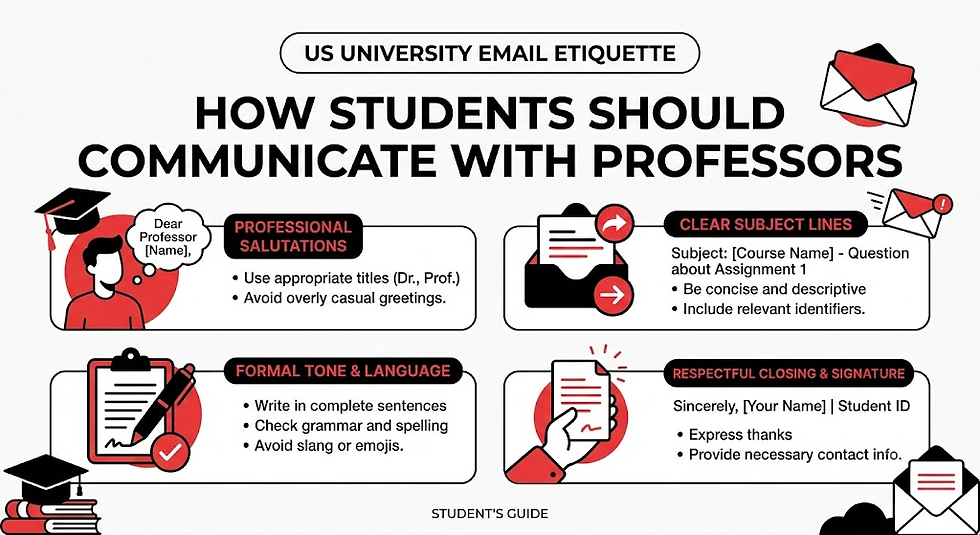
US University Email Etiquette: How International Students Can Communicate With Professors Professionally in 2026
Starting university in the United States involves learning much more than attending lectures, completing assignments, and earning credits. International students also need to understand the communication culture used on American campuses. One of the most important skills is knowing how to email professors professionally.
For students coming from India and other countries, communication styles can sometimes differ. A message that feels perfectly normal in one academic culture may appear too casual, too indirect, or unclear in another. Understanding US university email etiquette can therefore help students communicate their questions, requests, concerns, and academic goals more effectively.
University guidance published and updated for 2026 consistently emphasizes using institutional email, clear subject lines, professional greetings, concise messages, proper grammar, and respectful follow-ups. (Metro State University)
Whether you need clarification about an assignment, want to discuss research, need to explain an absence, request a meeting, or ask about an extension, your email should demonstrate preparation and professionalism.
Why US University Email Etiquette Matters in 2026
Email remains an important communication channel between students and faculty in US universities. Universities such as UMass Amherst, Stanford, Illinois, Utah, and Wisconsin provide students with specific guidance for communicating with professors professionally. (UMass Amherst)
For international students, an email can be more than a simple question. It can be the first step toward:
Building a professional relationship with a professor
Getting clarification about coursework
Discussing research opportunities
Requesting office-hour meetings
Communicating an absence
Asking about academic requirements
Seeking feedback
Discussing academic difficulties
Exploring recommendation letters or future opportunities
A professional email also helps professors quickly understand who you are and what you need.
The goal isn't to make every email extremely formal. Instead, the goal is to be clear, respectful, concise, and appropriate for an academic environment.
US University Email Etiquette: Start With Your University Email
Whenever possible, use your official university email account when contacting professors.
Your university email identifies you as a student and makes it easier for faculty to connect your message with their course roster. Several US universities specifically recommend using institutional email rather than a personal account. (Metro State University)
For example:
Better:studentname@university.edu
Less appropriate:coolstudent123@gmail.com
Your official account also creates a more professional impression, particularly when contacting a professor for the first time.
Before sending your message, check the syllabus to confirm the professor's preferred email address and communication method.
Write a Specific Subject Line
One of the easiest ways to improve your email is to write a useful subject line.
Professors may receive a large number of messages from students, colleagues, university departments, and other contacts. A subject line allows them to understand the purpose of your message before opening it.
Instead of:
"Hi"
"Question"
"Important"
"Please help"
"Urgent!!!"
Use something specific:
CS 501 – Question About Assignment 2
BIO 210 – Absence on September 30
Research Opportunity – Computer Vision Project
Request for Office Hours Meeting
ENG 101 – Clarification About Final Paper
University writing and advising resources consistently recommend concise, meaningful subject lines that provide context. (Academic Advising)
Avoid marking an email as urgent unless the situation genuinely requires immediate attention. Illinois, for example, advises students not to use the important flag casually. (Writers Workshop)
How Should You Address a US Professor?
The safest approach for a first email is to use the professor's academic title and last name.
Examples:
Dear Professor Anderson,
Hello Professor Anderson,
Dear Dr. Patel,
If you are uncertain whether the professor has a Ph.D. or which title they prefer, "Professor [Last Name]" is generally a safe starting point. Cornell recommends beginning more formally and then following the professor's preference if they indicate that students should use their first name. (Learning Strategies Center)
Pay attention to how the professor signs their emails. If Professor Anderson responds with "Best, Alex" and explicitly invites students to use Alex, you can follow that preference.
Avoid assuming that first-name communication is appropriate simply because it is common in some cultures or workplaces.
Introduce Yourself Clearly
Don't assume your professor remembers every student immediately.
This is especially important in large lecture classes where an instructor may teach hundreds of students.
Your first paragraph should identify:
Your full name
Course name
Course number
Section, if applicable
Your reason for writing
For example:
My name is Rahul Sharma, and I am a student in your CS 501, Section 02 class. I am writing to ask about the requirements for the upcoming project.
This gives the professor the context needed to respond efficiently. Universities including UMass Amherst and Utah specifically recommend identifying yourself and your course when contacting faculty. (UMass Amherst)
Check the Syllabus Before Asking a Question
One of the most important habits international students can develop is checking available course resources before emailing.
Before asking a question, review:
The syllabus
Assignment instructions
Learning management system announcements
Course calendar
Previous professor announcements
Class notes or materials
If the information isn't available, then email the professor.
Even better, mention that you already checked.
For example:
I reviewed the syllabus and the assignment instructions, but I could not find clarification about whether outside sources are required.
This demonstrates initiative instead of suggesting that you haven't reviewed the course material.
Illinois specifically recommends checking the syllabus and assignment materials before contacting a professor and mentioning that you looked for the answer if it wasn't available. (Writers Workshop)
Keep Your Email Short and Focused
A professional academic email doesn't need to be an essay.
The University of Wisconsin–Madison recommends keeping professional student emails concise, while Stanford similarly advises students to stay brief and focused on a specific purpose. (The Writing Center)
A useful structure is:
Paragraph 1: Introduce yourself and explain why you're writing.
Paragraph 2: Provide necessary context.
Paragraph 3: Ask your specific question or make your request.
Closing: Thank the professor.
Avoid including unrelated personal stories or lengthy explanations.
Instead of writing five paragraphs explaining why you missed an assignment, clearly explain the relevant circumstances and state what you are requesting.
Ask, Don't Demand
Your wording matters.
Compare:
Demanding:"Give me an extension for this assignment."
Professional:"Would it be possible to receive a short extension on the assignment?"
Similarly:
Too direct:"When can we meet?"
Better:"Would you be available to meet during your office hours this week?"
Academic communication generally works better when requests are respectful and specific. University guidance recommends making requests rather than demands. (fle101.wordpress.ncsu.edu)
However, being polite doesn't mean writing an excessively apologetic email. You can be respectful while still communicating your request clearly.
Avoid Texting Language, Emojis and All Caps
A professor's inbox is not the same as a group chat.
Avoid:
"Hey prof"
"pls"
"thx"
"u"
"gonna"
"wanna"
Excessive emojis
ALL CAPS
Multiple exclamation marks
Text-message abbreviations
For example:
Poor:"Hey Prof, can u pls tell me when the assignment is due???"
Professional:"Dear Professor Smith, I wanted to confirm the submission deadline for Assignment 2. I reviewed the course syllabus but would appreciate clarification on the due date."
US university guidance consistently recommends standard spelling, punctuation, complete sentences, and a professional tone. (fle101.wordpress.ncsu.edu)
Be Careful When Requesting an Extension
Asking for an extension is one of the situations where email etiquette becomes particularly important.
Don't wait until minutes before the deadline unless there is a genuine emergency.
Explain:
Which assignment you're referring to
The relevant circumstances
What you are requesting
When you can realistically submit the work
For example:
I am writing regarding the research paper due Friday. Due to an unexpected situation that has affected my ability to complete the paper on time, I wanted to ask whether a short extension would be possible. I understand that this is subject to your course policies.
Don't assume that an explanation automatically guarantees an extension. Professors may have different policies, so review the syllabus first.
How to Email About an Absence
If you cannot attend class, communicate as early as possible when appropriate.
A useful absence email should state:
Your name
Course and section
Date of the absence
Brief reason, when relevant
Any question about missed work
You generally don't need to provide unnecessary personal details.
For example:
Subject: BIO 201 – Absence on October 3
Dear Professor Lee,I am a student in your BIO 201, Section 1 class. I am writing to let you know that I will be unable to attend class on October 3. Could you please let me know if there are any materials or assignments I should review?Thank you for your time.Best,Rahul Sharma
Asking a Professor About Research Opportunities
For graduate and undergraduate students interested in research, email can be an important first point of contact.
However, avoid sending a generic message such as:
"Do you have any research opportunities?"
Instead, demonstrate that you have looked into the professor's work.
Mention:
A research area that interests you
A relevant course or project
A specific paper or research topic, if appropriate
Your skills
Why you are contacting that professor
For example:
I recently read about your work on machine learning applications in healthcare and found the topic particularly relevant to my coursework in data science. I have experience with Python and machine learning projects and would be interested in learning whether you have any research opportunities available for students.
This makes the email more specific and shows preparation.
Follow Up Without Being Impatient
Professors may not respond immediately.
Some universities recommend waiting roughly two to three business days before sending a polite follow-up, while other guidance notes that 24–48 hours may be reasonable depending on the situation and professor's stated expectations. (UMass Amherst)
Always check the syllabus first. Some professors specify when they normally respond to emails or which communication channels they prefer.
A follow-up can be simple:
Dear Professor Smith,I am following up on my email below regarding the research project. I understand you may be busy, and I wanted to check whether you had an opportunity to review my question.Thank you for your time.
Don't send repeated emails every few hours.
Should International Students Use AI to Write Emails?
AI tools can help students brainstorm, check grammar, or improve clarity. However, students should review every AI-generated draft before sending it.
This is particularly important in 2026 because research published in September 2026 is examining how AI-generated email drafts can influence culturally different communication styles. The research suggests that AI-generated language can shift the way people express politeness and directness, highlighting the importance of reviewing AI-assisted communication rather than sending it blindly. (arXiv)
Also check your university's policies if AI use is relevant to a course or academic task.
Your email should still sound natural and accurately represent what you mean.
A Simple Professor Email Template for Students
Use this structure for most academic emails:
Subject: [Course Number] – [Specific Purpose]
Dear Professor [Last Name],
My name is [Full Name], and I am a student in your [Course Name], [Section] class.
I am writing regarding [specific topic]. I reviewed [syllabus/assignment/course material], but I would appreciate clarification about [specific question].
[State your request clearly and politely.]
Thank you for your time and consideration.
Best,[Full Name][Student ID, if appropriate]
This format is flexible enough for questions about assignments, meetings, absences, research, and academic concerns.
Common Email Mistakes International Students Should Avoid
Before pressing send, check for these common mistakes:
Sending from a personal email instead of university email
Leaving the subject line blank
Using the professor's first name without permission
Writing "Hey" or overly casual greetings
Forgetting to identify your course
Asking questions already answered in the syllabus
Writing extremely long messages
Using texting abbreviations
Sending demands instead of requests
Sending multiple follow-ups too quickly
Forgetting attachments
Attaching the wrong document
Using an unclear filename
Sending an email without proofreading
Copying unnecessary people on the message
A final proofreading check can prevent simple mistakes that make an otherwise good email difficult to understand. (Northern Illinois University)
FAQ: US University Email Etiquette
What is the most important rule of US university email etiquette?
The most important principle of US university email etiquette is to communicate clearly, respectfully, and professionally. Use your university email, provide a specific subject line, identify your course, state your purpose clearly, and keep the message concise.
Should I call my professor by their first name?
Start with "Professor [Last Name]" or "Dr. [Last Name]" unless the professor has clearly indicated that students should use their first name. Follow the professor's preferred form of address once they establish it. (Learning Strategies Center)
How long should an email to a professor be?
Keep it as short as possible while providing all necessary information. For many routine questions, a few concise paragraphs are sufficient.
How long should I wait for a professor's reply?
Check the syllabus first because response expectations vary. If no policy is provided, waiting two or three business days before sending a polite follow-up is a reasonable approach in many academic settings. (UMass Amherst)
Can I use ChatGPT to write an email to my professor?
AI can help with drafting and proofreading, but you should review and personalize the final message. Make sure it accurately represents your situation, sounds natural, and follows your university's policies.
Final Takeaway
Learning how to communicate with professors is an important part of adapting to academic life in the United States. For international students, mastering US university email etiquette can make everyday academic communication more efficient and professional.
Use your official university email, write a meaningful subject line, address professors appropriately, identify yourself and your course, check the syllabus first, keep your message focused, make polite requests, and give professors reasonable time to respond.
These habits are useful beyond university. The same communication skills can help when contacting research supervisors, internship managers, employers, academic advisors, and other professionals throughout your career.
CTA: Build Stronger US University Communication Skills
Preparing for university life in the USA involves understanding both academic requirements and everyday campus expectations. Students can use official university resources to improve their writing and communication skills.
Explore the student communication guidance from Stanford University Academic Advising, UMass Amherst Student Success, and University of Wisconsin–Madison Writing Center.
For students preparing to study in the USA, developing professional communication habits before classes begin can make the transition to American university life much smoother.


Comments