
International Students Can Build a Social Circle

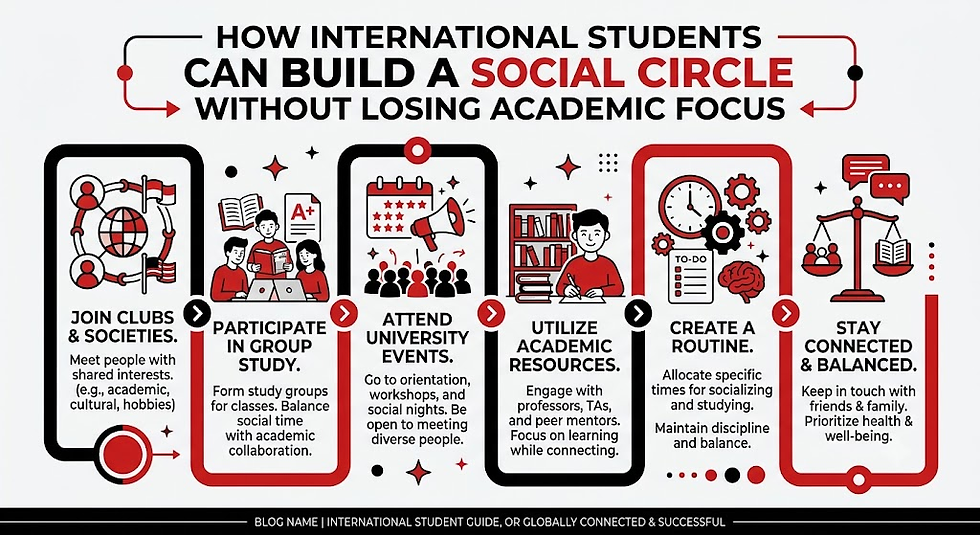
How International Students Can Build a Social Circle Without Losing Academic Focus in 2026
Moving to a new country for university is an exciting experience, but it can also be socially challenging. International students have to adjust to a new academic system, communication style, culture, transportation, finances, and everyday routines—all while trying to meet new people.
For students studying in the United States, building friendships can be especially important because campus life often extends beyond the classroom. Clubs, student organizations, residence halls, sports, career events, volunteer activities, and study groups can all become opportunities to connect with people.
However, there is an important balance to maintain: building a social circle should support your university experience, not interfere with your academic goals.
The latest available Open Doors data shows that U.S. colleges and universities hosted 1,177,766 international students during the 2024–25 academic year, representing a 5% increase from the previous year. India remained the largest place of origin, with 363,019 students, up 10% year over year.
That means international students are not alone in navigating this transition. The challenge is learning how to make meaningful connections while managing your time effectively.
Why Building a Social Circle Matters for International Students
Friendships are not simply about having people to spend weekends with. A healthy social network can provide practical, emotional, and academic support.
The CDC describes social connection as the size and diversity of a person's relationships and the sense of belonging and support those relationships provide. It also notes that supportive social connections can help people manage stress and improve overall well-being.
For an international student, a social circle can help with everyday situations such as:
Understanding unfamiliar campus traditions
Finding affordable restaurants and grocery stores
Learning how public transportation works
Discovering useful campus resources
Practicing conversational English
Sharing notes when someone misses class
Finding study partners
Learning about internships and student organizations
Having someone to talk to during stressful periods
Research highlighted by the University of Michigan in 2026 also found that first-year students who experience a stronger sense of belonging in their classes and on campus are more likely to develop social networks and positive academic experiences.
The goal, therefore, is not to choose between friends and academics. It is to create a routine where both can coexist.
Build Social Circle Abroad Without Sacrificing Your Studies
The best way to build social circle abroad is to make social activities part of an organized weekly routine instead of allowing them to consume your schedule.
Start by identifying your academic priorities.
At the beginning of each semester, check your syllabus, assignment deadlines, examination dates, project requirements, office hours, and major academic commitments. Once you understand your workload, you can decide how much time is realistically available for social activities.
For example, a student with three major exams during one week may need to reduce social commitments temporarily. During a lighter week, the same student may have more time for club meetings, dinners, campus events, or weekend activities.
This approach prevents socializing from becoming an unplanned distraction.
Use the “Academic First, Social Second” Rule
One practical strategy is to complete important academic responsibilities before committing to longer social activities.
For example:
Monday–Thursday: Prioritize classes, assignments, reading, and study sessions.
Friday evening: Attend a campus event or meet friends.
Saturday: Combine social activities with personal errands or recreational activities.
Sunday: Review upcoming deadlines and prepare for the week.
This does not mean studying every available minute. It simply creates boundaries.
A student can enjoy dinner with friends without spending five hours scrolling through social media afterward.
Start With Small Conversations
International students sometimes believe they need to become highly outgoing to make friends. They do not.
Friendships frequently begin with repeated, low-pressure interactions.
Start by talking to the person sitting next to you in class. Ask a roommate about their weekend. Introduce yourself to someone at a club meeting. Talk to another student while waiting for an event to begin.
Simple questions can work:
“Are you taking this course for your major?”
“Have you been to this campus event before?”
“Do you know where the student center is?”
“Are you joining any clubs this semester?”
“Would you like to study together before the exam?”
You do not need to create an instant best friend. The objective is to create opportunities for repeated interaction.
Choose Activities That Support Your Goals
Not every social activity has to be separate from your academic or career life.
One of the most efficient ways to build friendships is to participate in activities that already align with your interests.
Consider:
Academic clubs
Professional associations
Research groups
Entrepreneurship organizations
Coding clubs
Debate or public-speaking groups
Sports and fitness activities
Cultural organizations
Volunteer programs
Student government
Career fairs
Campus workshops
These activities can provide both social and professional benefits.
For example, an engineering student might join a robotics organization and meet classmates while working on a technical project. A business student might join a consulting club and develop friendships while practicing case interviews.
This creates a useful overlap between your academic, professional, and social life.
Do Not Stay Only Within Your Own International Community
It is natural for international students to initially spend most of their time with people from the same country. Familiar language, food, cultural references, and experiences can make the transition easier.
There is nothing wrong with maintaining those relationships.
However, deliberately expanding your network can provide a broader university experience.
Try to develop three types of connections:
Cultural connections: Friends who understand your background and experiences.
Campus connections: Students who help you understand university life.
Professional connections: Classmates, professors, alumni, and professionals connected to your career interests.
A balanced network can help you feel comfortable while also encouraging cultural exchange.
A 2026 systematic review of international students' social interactions found that language, institutional environment, and repeated interaction with host-country students can all influence social connection. The review also emphasized that meaningful intercultural interaction is not solely an individual student's responsibility; university environments can either enable or limit those interactions.
Use Study Groups to Combine Academics and Friendship
Study groups are one of the easiest ways to maintain academic focus while becoming more socially connected.
Instead of meeting friends only for entertainment, invite classmates to study together.
A productive study group might involve:
Setting a fixed meeting time.
Choosing one or two specific topics.
Studying independently for part of the session.
Discussing difficult concepts together.
Taking a short break.
Ending the session at a predetermined time.
This creates a clear academic purpose.
Over time, classmates can naturally become friends outside the study environment.
However, avoid turning every study session into a social gathering. If the group spends 20 minutes studying and two hours talking, the format needs to change.
Set Boundaries Around Social Time
One of the biggest mistakes international students can make is saying yes to every invitation because they are worried about missing out.
You do not need to attend every party, dinner, trip, club meeting, or campus event.
Learn to say:
“I have an assignment due tomorrow, but I can join you this weekend.”
That is not antisocial. It is responsible time management.
You can also establish practical limits:
Decide when you will leave an event.
Avoid late nights before important classes.
Keep at least some evenings free for academic work.
Turn off unnecessary notifications while studying.
Use your calendar to track both academic and social commitments.
Avoid accepting overlapping commitments.
A social circle should understand that university is your primary reason for being there.
Recognize When Socializing Is Affecting Your Academics
Building friendships becomes counterproductive when it consistently affects your academic responsibilities.
Warning signs may include:
Missing classes to spend time with friends
Frequently submitting assignments late
Studying only at the last minute
Sleeping too little because of social activities
Ignoring emails from professors
Falling behind in readings
Skipping important academic meetings
Spending excessive time on social media
Feeling unable to say no to friends
If these patterns appear, review your weekly schedule.
You may not need to stop socializing completely. Instead, reduce low-value activities and protect your academic priorities.
Make Weekday Friendships Easier to Maintain
International students often assume friendships require major plans.
They do not.
Small activities can become consistent social routines:
Having lunch after class
Getting coffee between lectures
Walking around campus
Going to the gym
Studying in the library
Cooking with roommates
Attending a weekly club
Watching a university sports game
Joining a campus volunteer activity
These activities are easier to fit into an academic schedule than frequent long-distance trips or late-night outings.
Consistency is often more valuable than intensity when building relationships.
Use Campus Resources
Universities generally have multiple services designed to help students become connected.
Check your university's:
International student office
Student activities office
Residence-life programs
Academic success center
Counseling and wellness resources
Recreation center
Student clubs directory
Career center
Orientation programs
Volunteer programs
EducationUSA, the U.S. Department of State's international education network, also provides resources for students planning and navigating U.S. study. Its network includes more than 430 advising centers in over 175 countries and territories.
Students should also remember that asking for help is normal. If loneliness or isolation becomes persistent and begins affecting daily life, academic performance, or well-being, consider contacting your university's student support or counseling services.
The CDC notes that loneliness and social isolation can affect mental and physical health, and identifies young adults and immigrants among groups that may experience these challenges.
Create a “Social Budget”
Students often create financial budgets but forget to create time budgets.
Consider treating your weekly time like a limited resource.
For example:
Academic work: 35–45 hoursSleep and personal care: 55–65 hoursMeals and errands: 15–20 hoursSocial activities: 5–10 hoursExercise and recreation: 3–6 hours
These numbers are examples rather than universal requirements. Your actual schedule should depend on your program, course load, commute, employment, and personal needs.
The important principle is that social time should fit into your overall schedule instead of competing unpredictably with your academic responsibilities.
Focus on Quality, Not the Number of Friends
You do not need dozens of friends to feel connected.
A small group of reliable people can be more valuable than a large network of acquaintances.
Look for people who:
Respect your academic goals
Encourage healthy habits
Communicate honestly
Respect cultural differences
Understand personal boundaries
Support you during difficult periods
Celebrate your achievements
Are willing to compromise
Good friendships should make university life more manageable rather than consistently creating additional stress.
FAQ: Build Social Circle Abroad While Studying
How can international students build social circle abroad without hurting their grades?
International students can build social circle abroad by choosing structured activities such as study groups, academic clubs, sports, volunteering, and campus organizations. Using a weekly schedule helps keep social activities within defined time limits.
Is it important for international students to make American friends?
It can be useful to develop relationships with U.S. students because these connections can provide opportunities for cultural exchange, communication practice, and greater familiarity with campus life. However, international students can also benefit from friendships with students from many different countries.
How many social activities should an international student join?
There is no universal number. Start with one or two activities and evaluate whether they fit comfortably alongside your classes, assignments, sleep, and other responsibilities.
What should I do if my friends distract me from studying?
Set clear boundaries. Tell friends when you need to study, establish specific social hours, and prioritize important academic deadlines. Healthy friendships should accommodate reasonable academic responsibilities.
Can study groups help international students make friends?
Yes. Study groups can combine academic collaboration with social interaction. They can also help international students become more comfortable communicating with classmates.
What if I feel lonely even after joining clubs?
Joining a club does not automatically create close friendships. Meaningful relationships usually require repeated interaction. Attend regularly, initiate conversations, and invite one or two people to meet outside the activity.
Final Thoughts
Building a social life is an important part of the international student experience, but it does not have to compete with academic success.
The most sustainable approach is to create connections through activities that fit naturally into your university routine. Study groups, academic clubs, cultural organizations, sports, volunteering, campus events, and simple conversations can gradually turn unfamiliar surroundings into a community.
For students trying to build social circle abroad, the key is balance: protect your academic commitments, make time for meaningful relationships, and choose friends and activities that contribute positively to your university experience.
In 2026, with international students continuing to represent a significant part of U.S. higher education, campuses offer many opportunities to connect across cultures. The challenge is not finding every possible social opportunity—it is finding the opportunities that fit your goals, schedule, and personality.
CTA: Start Building Your U.S. Campus Community
If you are preparing to study in the United States or are already on campus, use reliable official resources to discover student opportunities and international-student support:
EducationUSA: Explore U.S. study resources and advising through EducationUSA
Open Doors: Explore the latest U.S. international student data from Open Doors
CDC Social Connection Resources: Learn more about social connection and well-being
Your university website: Search for your institution's international student office, student organizations, recreation center, academic success center, and campus events calendar.
Your degree may be the reason you travel abroad, but the people and communities you meet can become an important part of your university experience. Start small, stay consistent, and make room for both academic progress and meaningful connections.


Comments