
Beyond the League Tables: How to Choose the Right University in 2026

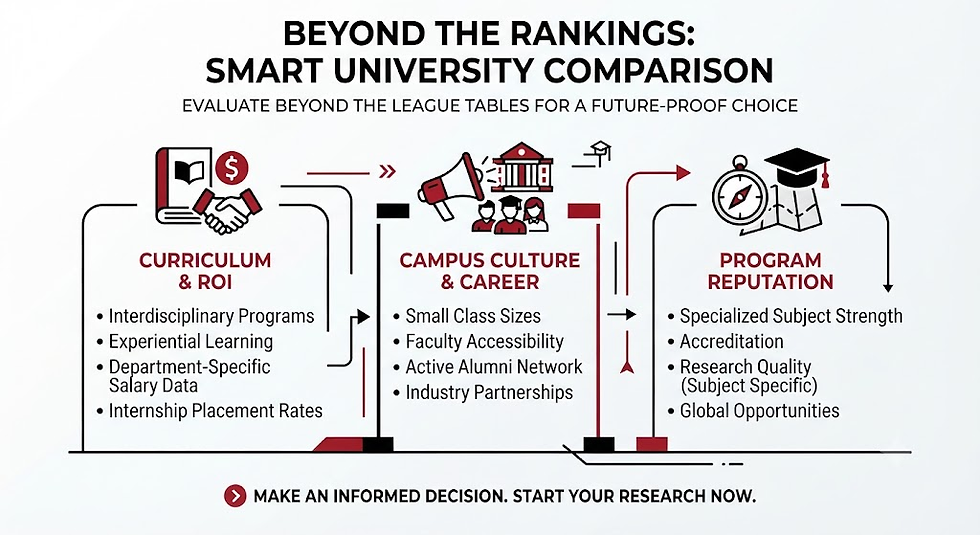
When admission season rolls around, the anxiety of making a "safe, credible, and future-proof" choice usually pushes students and parents straight toward global league tables and national scorecards. It is easy to see why: picking an institution based on a neat, orderly list feels objective.
However, over 20,000 higher education institutions exist globally, while major ranking systems like QS, THE, and ARWU spotlight only a tiny fraction. Relying exclusively on an overall rank can blind you to structural biases, research-heavy weightings that ignore undergraduate teaching quality, and a complete mismatch with your personal career trajectory.
If you want a truly valuable, future-proof education, you need to master how to compare universities beyond superficial numbers. This guide explores alternative metrics, curriculum depth, and real-world factors that matter most for your long-term success.
The Illusion of Global League Tables
Major ranking publishers evaluate institutions using heavily weighted criteria—such as international research citation counts, peer academic reputation, and Nobel laureate faculty counts. While these metrics indicate a university's research powerhouse status, they tell you very little about your day-to-day classroom experience, localized job placement assistance, or mental health support.
For instance, a university sitting proudly at rank #20 globally might have massive lecture halls where undergraduate teaching is entirely handed off to graduate teaching assistants. Meanwhile, an institution ranked #120 might offer small seminar sizes, personalized mentorship, and robust corporate partnerships tailored directly to your chosen industry.
To make an informed choice, students must shift from passive consumers of aggregate scores to active investigators of granular data.
Key Pillars for Evaluating Universities Beyond Rankings
When evaluating higher education institutions, structured analysis should replace blind prestige-chasing. Consider the following dimensions:
Curriculum Flexibility and Pedagogical Approach: Does the syllabus offer interdisciplinary paths, or is it rigidly traditional? Look for experiential learning opportunities, capstone projects, and co-op programs.
Faculty Engagement and Teaching Quality: Look past faculty-to-student ratios. Investigate whether professors are actively involved in undergraduate teaching or isolated in research labs.
Granular Career Outcomes and Return on Investment (ROI): Overall graduate employability metrics can be misleading. Instead, check department-specific median salaries, internship conversion rates, and active alumni networks within your target sector.
Campus Culture, Support Systems, and Wellbeing: Institutional development, mental health counseling availability, and student-run clubs heavily influence your personal growth and resilience over a three- or four-year degree.
Geographic Micro-ecosystems: The local industry hub surrounding a campus often dictates internship accessibility and part-time work viability far more than the campus name alone.
Subject-Specific Strength vs. Institutional Prestige
One of the most critical steps in evaluating higher education options is prioritizing program-level reputation over general university prestige.
A university might hold a modest overall standing due to a smaller medical or arts faculty, yet its engineering or data science department could be a world leader tied directly into major tech pipelines. Always check specialized subject tables (such as QS World University Rankings by Subject or national specific boards like the IIRF). If you intend to specialize in artificial intelligence, biotechnology, or financial economics, a department with strong corporate labs and active industry advisory boards will accelerate your career much faster than a generic ivy-covered reputation.
Financial Realities: Total Cost of Attendance vs. Net Value
Sticker shock is common during university research, but tuition fees only tell part of the story. When comparing your options, calculate the Total Cost of Attendance (COA) over the duration of the program:
Direct Costs: Tuition, laboratory fees, and mandatory administrative charges.
Indirect Costs: On-campus or off-campus housing, meal plans, textbooks, and transport.
Financial Aid & Institutional Scholarships: Look past merit-based entrance awards and evaluate recurring institutional grants, work-study options, and bursaries.
An expensive institution with minimal aid can saddle you with career-restricting debt, whereas a moderately priced regional university with targeted scholarships can leave you financially agile post-graduation.
Frequently Asked Questions
How to compare universities effectively if rankings are unreliable?
To compare universities accurately, look beyond general scorecards by evaluating course-specific syllabi, faculty accessibility, departmental placement records, campus culture, and true program costs relative to your career goals.
Do employers actually care about university rankings?
While top-tier global rankings carry initial brand weight for elite corporate pipelines, hiring managers across tech, finance, and creative sectors increasingly prioritize practical skills, portfolio quality, completed internships, and institutional alumni network strength.
Why are subject-specific rankings more important than overall rankings?
Overall rankings heavily weigh generalized academic research output. Subject-specific rankings evaluate the exact department you will study in, revealing whether that specific faculty, lab infrastructure, and curriculum align with your professional ambitions.
How do I check the true return on investment (ROI) of a degree?
Calculate your total cost of attendance—including living expenses and tuition—and cross-reference it with median starting salaries, job placement rates within six months of graduation, and scholarship availability offered by the institution.
Take the Next Step in Your Academic Journey
Navigating university admissions requires looking past the noise of league tables and focusing on what truly shapes your future. Whether you need help analyzing program-level data, mapping out financial aid options, or shortlisting institutions that fit your unique profile, expert guidance is available.
Explore comprehensive global university datasets and insights at Times Higher Education Student.
Discover specialized program criteria and study abroad advisory resources via QS Top Universities.


Comments